




Key Points to Remember
- OPRA replaced KAPS in 2025.
- Emphasise clinical reasoning rather than rote memorisation.
- Preparation should start 6–8 months before the exam.
- Therapeutics carries 45% of exam weight.
- Regular MCQs and mock exams are necessary.
- Improving skills in calculations and case interpretation could help enhance your performance.
- Coaching may help increase your chances of success on the first attempt.
The landscape for pharmacy licensing in Australia was transformed in March 2025 when the Overseas Pharmacist Readiness Assessment (OPRA) was introduced as a replacement for the KAPS exam. In contrast to the former KAPS exam, the OPRA Exam is not a test that can be passed solely through rote learning. The assessment questions require critical thinking, clinical case-solving, and the application of biomedical knowledge to patient care in a realistic manner.
It creates a mixture of both fear and thrill for future pharmacists. With a well-organized plan, focused practice, and professional advice, many students increase their chances of success on the first attempt. An effective step-by-step guide to get through OPRA 2025 is outlined below.
Understand the Exam and Its Syllabus
Before doing the textbook work, it is essential to understand the nature of the test first. OPRA Exam Syllabus is a single session of 120 multiple-choice questions that is to be answered in 150 minutes. The scoring method is based on the Rasch methodology, which focuses on the level of skill demonstrated rather than the percentage of correct answers.
Content-wise, the test is divided as follows:
- Therapeutics & Patient Care – 45%: The critical part, which mainly dealt with case-solving and making clinical decisions.
- Biomedical Sciences – 20%: Core pathophysiology and primary knowledge.
- Pharmacology & Toxicology – 15%: Drug mechanisms, ADRs, and drug safety.
- Pharmacokinetics & Pharmacodynamics – 10%: Calculations and ADME concepts.
- Medicinal Chemistry & Biopharmaceutics – 10%: Formulations and drug stability.
Knowing this breakdown allows you to prioritise your study and manage your time effectively. Attention should be given to therapeutics, as the clinical reasoning is what runs the exam.
Build a Realistic Study Timeline
6 to 8 months is the right time to prepare for the exam. It is hardly ever the case that one succeeds by rushing through the syllabus in just a few months. Divide your study into weekly modules and focus on one body system at a time, such as Cardiology, Renal, or Endocrine. While studying, mix up subjects like biomedical science, pharmacology, and calculations with the topic.
Make weekly goals such as “Finish Renal system + 30 MCQs“. Progress tracking not only helps you to be responsible to yourself but also makes sure that you correctly study the syllabus.
Choose the Right Resources
OPRA is a verification of clinical reasoning skills, not only theoretical knowledge. Do not use old notes or intern-level guideline books. Use rather:
- APC OPRA syllabus outline
- Pharmacotherapy and biomedical textbooks are standard
- Case-based MCQ collections
These materials emphasise application rather than memorisation, which is in line with the exam’s competency-based approach.
Study Topic-Wise and Practice Cases
Random reading is inefficient. You should follow a structured flow:
- Theory: Learn and understand pathophysiology.
- Pharmacology: Study drug classes and their mechanisms.
- Therapeutics: Use treatment methods for patient care.
- MCQ Practice: Work on case-based questions and review mistakes.
It’s crucial to start practicing clinical MCQs from day one. Operating room questions typically require two-step reasoning, which means that first you have to identify the problem and then decide on the appropriate action. Your daily goal should be to complete 20–30 MCQs, and in addition, you should always go over your mistakes to figure out the rationale for the correct answer.
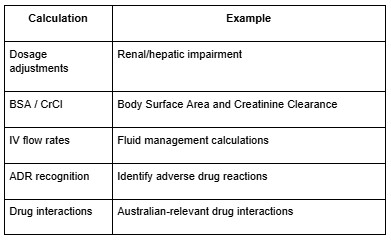
Strengthen Calculations and Case Interpretation
Implement a Smart Revision Strategy
Revision should be active and structured:
- Concept Review: Use notes, diagrams, and flowcharts to record and visualise the core ideas.
- Practice Weak Areas: Concentrate on the topics that led to your mistakes in the mock tests.
- Mock Recall: Practice recalling information by using flashcards and spaced repetition techniques to master high-yield facts.
Spaced repetition is the primary factor that enables knowledge retention during the final weeks of studying, resulting in a significant reduction in preparation-related stress.
Mock Exams Are Non-Negotiable
Real exam environment simulation: 150 minutes, no breaks, closed book. Performance tracking by topic and identification of areas for improvement. The ultimate goal is not simply to answer the questions, but to think as a proficient clinical pharmacist would under pressure.
Elite Expertise Coaching
While it’s possible to study on your own, having the support of a coach may help accelerate the process. Elite Expertise offers:
- Faculty: Practising Australian pharmacists, Mr. Arief Mohammad & Mrs. Harika Bheemavarapu
- More than 300 hours of live and recorded lectures
- Access that is free for a lifetime and lasts until you pass
- Many students report success on their first attempt when they follow a structured preparation plan and receive expert guidance.
The coaching is instrumental in helping the students to sharpen their clinical reasoning skills and get their errors corrected early
Final 30-Day Strategy
The final month should primarily concentrate on:
- Daily MCQ exercises and full-length mock tests
- Working through weak areas and therapeutic topics
- Brief revision notes and time management drills
- The primary goal should be retention and speed, rather than volume.
Conclusion
OPRA 2025 is more than just a test of knowledge; it is a challenge that evaluates your clinical reasoning skills, accuracy, and the application of a well-thought-out strategy. With early preparation, a structured study plan, regular practice, and expert support, many students improve their chances of success on their first attempt.
Why not start now? Organise your studies, complete a daily MCQ, take a mock test every once in a while, and if you feel the need, attend a coaching session. If you keep up with your preparations and use your time wisely, then there is no reason why you should not be able to secure your pharmacy career in Australia confidently.
FAQs
What is OPRA 2025?
It replaced KAPS in March 2025 for Australian pharmacist registration.
What does the OPRA test?
Clinical reasoning, case-solving, calculations, and therapeutics.
How long should I prepare?
Start 6–8 months before the exam.
Which section is important?
Therapeutics & Patient Care – 45% of questions.
Are mock exams necessary?
Yes, they build accuracy, timing, and confidence.
What resources should I use?
APC syllabus, pharmacotherapy textbooks, case-based MCQs, Rasch-style mocks.
Can I pass with self-study alone?
Yes, but coaching improves first-attempt success.
How should I revise last month?
Daily MCQs, focus on weak areas, quick notes, and timed practice.
What common mistakes should you avoid?
Starting late, wrong sources, skipping mocks, and memorising only.
Who teaches Elite Expertise coaching?
Australian clinical pharmacists Mr. Arief Mohammad & Mrs. Harika Bheemavarapu.