



By: Alex Smith
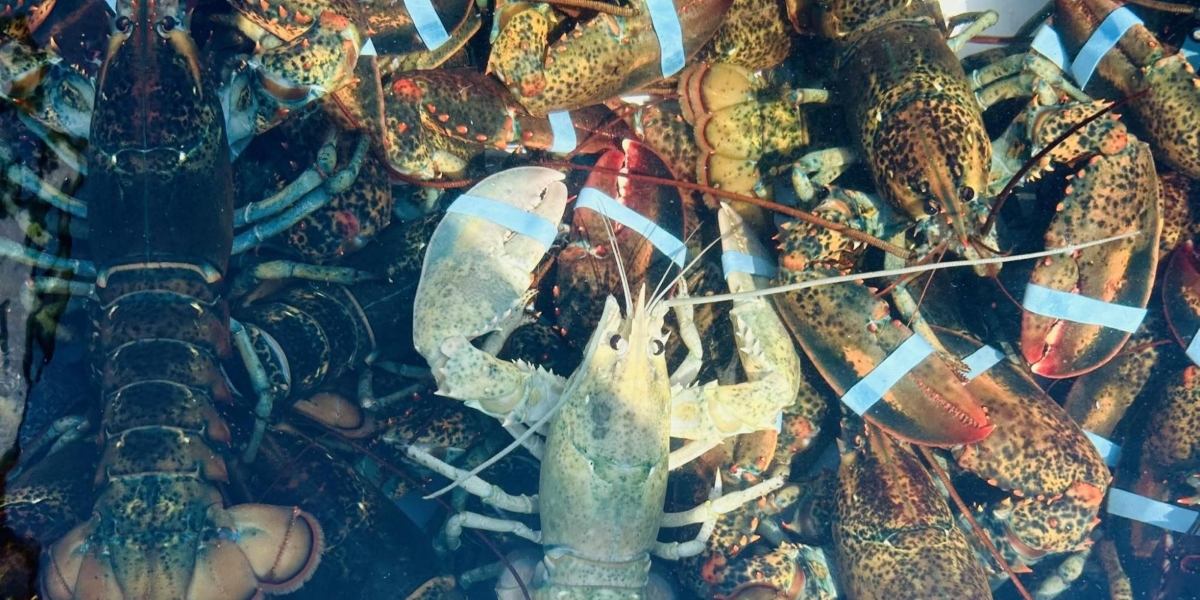
STONINGTON, Maine — March 27, 2026 — An extraordinary catch in the waters off Maine has captured widespread attention after a local fisherman pulled in a rare albino lobster, also referred to as a “Ghost” lobster, a phenomenon scientists say is among the rarest occurrences in the marine world.
Captain Ryan “Rusty” McDonald made the discovery while hauling traps in Penobscot Bay near Deer Isle early this morning. The lobster, weighing approximately two pounds and believed to be female, displayed a striking white shell with semi-transparent features and faint blue undertones, making it instantly recognizable as a rare genetic variant.
McDonald, who has spent 28 years working along the Maine coast, described the moment as surreal. “I knew right away this wasn’t a normal catch,” he said. “It looked completely different from anything I’ve seen before. The color alone made it stand out.”
Albino lobsters, also commonly referred to as ghost lobsters, are caused by rare genetic mutations that affect pigmentation. In albinism, the lobster lacks all pigment-producing cells, whereas leucism results in partial pigment loss. These conditions give the lobster its distinctive white appearance, sometimes accompanied by subtle iridescent or bluish tones.
Like other lobsters, they inhabit the cold ocean floors of the Northwest Atlantic, ranging from Labrador through the Gulf of Maine and occasionally extending as far south as New Jersey. Maine remains one of the most active regions for lobster fishing, making it one of the few places where such rare finds are occasionally reported.
However, their unusual coloration significantly reduces their chances of survival. Marine experts estimate the likelihood of encountering a true albino lobster at roughly 1 in 100 million. Because they are highly visible, they are more easily targeted by predators, which explains their extreme rarity.
Historical records show that similar cases, while uncommon, have occurred in the past. In 2025, a known albino lobster was recaptured and released in Newfoundland. In 2023, two albino lobsters were discovered near Portland, Maine. Other sightings have been reported in areas such as Stonington, Chebeague Island, and surrounding coastal regions over the years.
Experts also clarify that many white lobsters seen in aquarium settings are not true ocean lobsters but rather specially bred freshwater crayfish, which differ significantly from these rare marine specimens.
After making the discovery, McDonald quickly informed the Maine Department of Marine Resources and the University of Maine Lobster Institute. The lobster is currently being held at a facility in Thomaston, where it is undergoing evaluation and documentation.
In line with conservation practices, the lobster is expected to receive a protective V-notch before being released back into the Gulf of Maine. In some instances, rare specimens may be temporarily displayed for educational awareness before release.
Researchers say such discoveries are valuable for studying marine biodiversity and reinforcing the importance of sustainable fishing. “Rare genetic variations like this help us better understand ocean ecosystems,” a marine expert noted.
Reflecting on the experience, McDonald said, “It’s something you don’t expect to see in your lifetime. I feel lucky to have found it.”
Press Release Contact:
Penobscot Bay Lobstermen’s Association
(207) 555-0192
info@penobscotbaylobstermen.org
https://www.mainelobstermen.org/
Captain Zachaios Fitts
Bay to Buoy Charters & Pine Island Guide Service
(207) 555-0284
zach@baytobuoycharters.com
231 Front St, South Portland, ME 04106