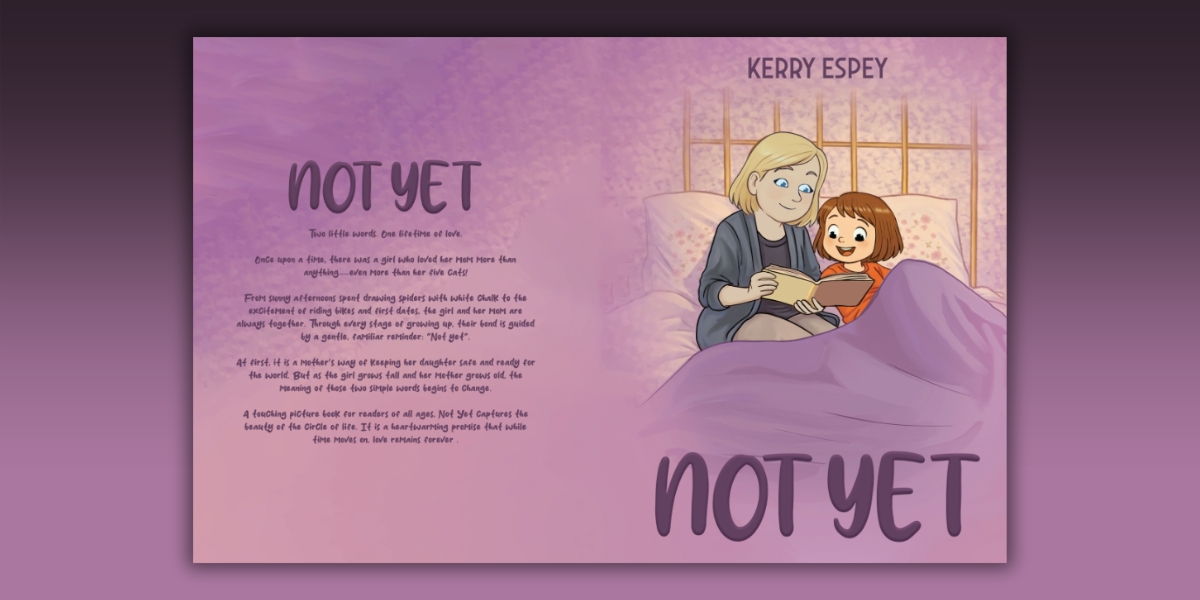




Not Yet meets families where love and responsibility overlap, and where children are already paying attention.
The most American kind of heartbreak is the one scheduled around weekends. You go when you can. You bring what you remember they like. You stay as long as possible without breaking the rest of your life. Then you leave, promising you’ll be back, and carrying the quiet dread that time is running faster than your calendar allows.
Not Yet, Kerry Espey’s new picture book, understands that rhythm. It is, on its face, a children’s story built around a mother and daughter and the repeated phrase “not yet.” But it is also a book written into a demographic reality: millions of adults are simultaneously raising children and caring for aging parents, and many of those children are absorbing the emotional weather of that care long before adults find the language to explain it.
Espey, an educator, calls the book a true story inspired by real moments with her mother. That origin matters because it shapes the book’s restraint. Not Yet doesn’t sensationalize illness or turn family change into a dramatic morality tale. Instead, it renders caregiving as it often feels: a series of small acts, conversations, visits, reassurances, that become the architecture of devotion.
The book’s central device is a refrain that evolves over time. Early on, “not yet” functions as a boundary: a mother’s gentle insistence on safety, responsibility, readiness. Later, without needing to map every turn of the narrative, the phrase begins to register as something else, a way of managing fear. The daughter grows up; the mother grows older; the story makes space for the role reversals that families know intimately. What used to be a mother guiding a child becomes an adult daughter steadying a mother.
Espey’s skill is in what she chooses not to overstate. There is no sermon about aging. No clinical vocabulary. The caregiving details that appear are the ones most families recognize: the comfort of routine, the need for reassurance, the way small preferences become sacred. The book treats those preferences as a form of personhood, not quirks to be dismissed, but as anchors that hold someone to themselves.
A picture book that enters this territory has to navigate a difficult balance. Too blunt, and it becomes frightening. Too vague, and it becomes dishonest. Espey’s approach is to keep the language simple and the emotional truth intact. When the narrative reaches a point of uncertainty, the daughter says, “Tonight we’re going to have a sleepover!” It’s a line that reads as childlike optimism, and as a very adult tactic of care: turning the hospital into a space of togetherness, refusing to let fear have the last word in the room.
This is one reason Not Yet arrives at a moment when children’s publishing is quietly shifting. For decades, grief and illness books for kids were often didactic , designed as “resources” more than literature. The best contemporary titles understand something subtler: children don’t need explanations as much as they need atmosphere. They need to feel held. Espey’s book offers that holding through repetition, the reassurance of a phrase returning like a hand on a shoulder.
The author’s note makes the impulse explicit. Espey describes writing the book as a way of holding her mother close through memory, and she emphasizes the “quiet moments”, the ones that stay with us long after they pass. That is a caregiving philosophy, not just a literary one. Anyone who has watched a loved one change knows how memory becomes a form of care: you keep telling the story so the person remains intact in your mind.
Critically, Not Yet doesn’t pretend that care is only gentle. It can be exhausting, complicated, tinged with grief even before grief has a name. The book’s emotional arc, carried by the shifting meaning of “not yet”, captures that complexity without burdening a child reader with it. Adults will recognize what is happening beneath the surface; children will feel the steadiness.
And then there’s the quiet persuasion at the heart of the book: the suggestion that love is not primarily a feeling, but a practice. It is the repeated act of showing up, of waiting, of returning, of saying the words that keep a relationship coherent across time.
In a culture that often treats caregiving as private, something you endure rather than something you narrate, a picture book can be a radical public gesture. It says: ” This happens. This is part of family life. This is worth putting into words small enough for a child to carry.
When readers close Not Yet, they won’t be left with plot details; they’ll be left with an idea: that “not yet” can be both limit and grace. A boundary that protects. A pause that prepares. A plea for more time. And, in the best cases, a reminder that love lives in the repetition , in the return.