



By: Jason Gerber
In Erin Coakley’s COVID trilogy, empathy is not an attitude; it is a system.
There is a particular kind of loneliness that arrives when you are sick and cannot have the person you love in the room. During COVID, that loneliness became routine. Hospitals, built to treat bodies, suddenly had to contend with the emotional damage of separation as if it were another symptom. The question became two questions at once: how to keep patients alive, and how to keep them tethered to meaning when the ordinary supports of touch and presence were forbidden.
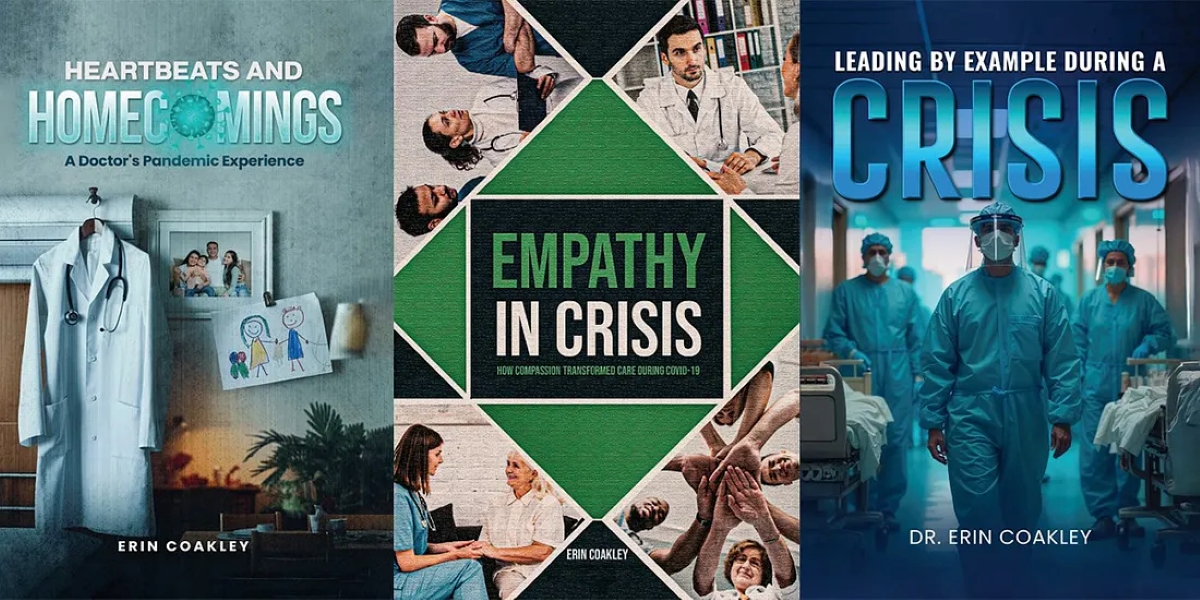
Erin Coakley’s trilogy approaches that question with a steady insistence that compassion is not a decorative virtue. It is infrastructure. Empathy in Crisis: How Compassion Transformed Care During COVID-19 is the clearest articulation of this idea, and it gains force when read beside Heartbeats and Homecomings: A Doctor’s Pandemic Experience and Leading by Example During a Crisis, which show, from different angles, what happens when empathy is strained by time pressure, fear, and institutional uncertainty.
Coakley’s writing begins with a formative memory that is almost disarmingly simple. As a second grader, she accidentally stepped on her teacher’s toes and was instantly overwhelmed. The teacher responded with reassurance, not anger. “Her empathy immediately soothed my worries,” Coakley writes, “It was my first vivid memory of how someone’s kindness could turn an upsetting moment into a comforting one.” The story does not function as sentimental origin mythology. It functions as a thesis statement. Small acts can change the temperature of an experience. In medicine, temperature matters.
The nut of Coakley’s trilogy is that the pandemic exposed how much of care is relational, and how fragile that relational layer becomes when systems are stressed. In Heartbeats and Homecomings, she documents the altered choreography of bedside life, muffled voices, covered faces, and families relegated to phone calls. In Empathy in Crisis, she shifts from documenting to interpreting. She argues that when patients are isolated, “simple acts of kindness” can be as essential as treatment, not because kindness replaces medicine, but because it makes medicine bearable.
The most interesting aspect of Coakley’s argument is that she refuses to confine empathy to temperament. Empathy, she suggests, can be supported or sabotaged by design. Language access becomes a moral issue, not a logistical one. Translation services, culturally sensitive communication, and time for explanation are tools that create dignity. Without them, fear multiplies. With them, trust has somewhere to land.
Coakley writes from within a community hospital environment in Texas, balancing clinical work with leadership responsibilities. That dual vantage helps her describe empathy as both personal practice and institutional choice. The trilogy is alert to the way clinicians become emotional shock absorbers, asked to hold grief, anger, confusion, and hope, often in rapid succession. The books do not glamorize this. They hint at the costs, the fatigue that can harden into numbness if compassion is treated as an infinite supply.
As prose, Coakley favors clarity. She writes in sentences that feel designed for comprehension under stress, a quality that suits her subject. The emotional power comes from restraint. When she writes about families coping with loss, she does not offer grand consolations. She writes, simply, that empathy and communication “made all the difference.” The claim is modest and therefore credible. It acknowledges that grief cannot be solved, but it can be met well or met poorly, and the difference matters.
The trilogy’s critical insight is subtle but pointed. If healthcare culture wants to celebrate compassion, it must also protect the conditions under which compassion can exist. That means leadership that explains decisions, teams that are supported rather than depleted, and systems that treat communication as part of clinical care. In the absence of these supports, compassion becomes a performance, and performance is brittle.
Coakley’s books do not demand that readers relive the worst moments of the pandemic. They ask readers to reconsider what survived, what failed, and what should be built differently. For anyone who suspects that the story of COVID is not over simply because the headlines have moved on, the trilogy offers a steadier lens. Heartbeats and Homecomings: A Doctor’s Pandemic Experience, Empathy in Crisis: How Compassion Transformed Care During COVID-19, and Leading by Example During a Crisis are available online, and together they make a persuasive case that compassion is not soft. It is structural, and it is worth designing for.