


By: Alexandra Perez
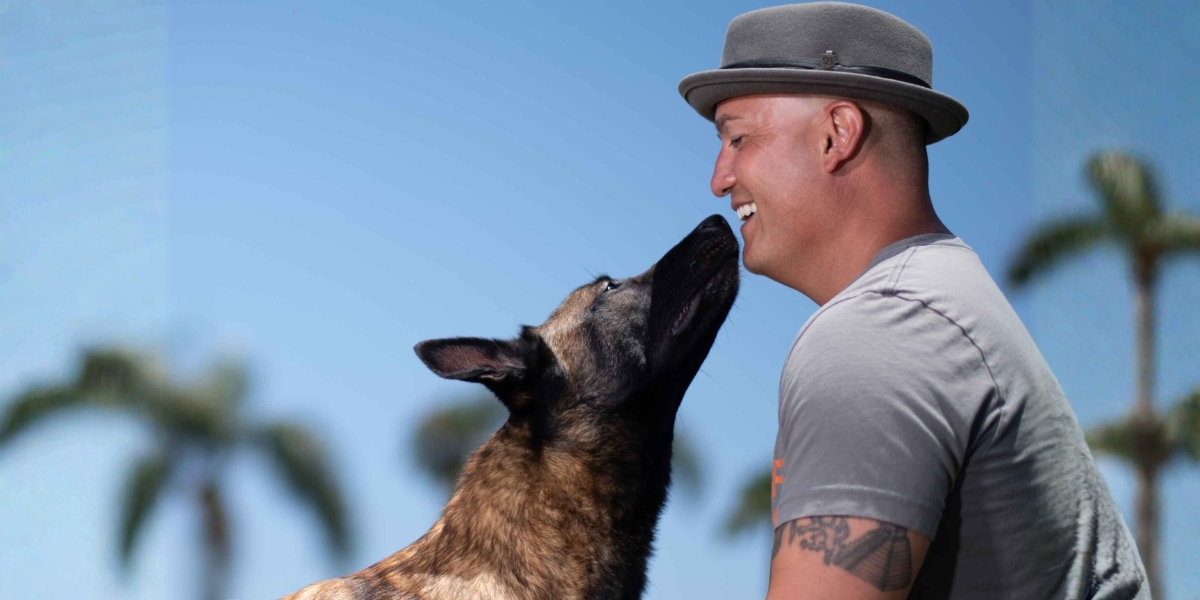
Ryan Matthews has spent enough years in dog training to know that most people arrive believing they have a dog problem when what they really have is a relationship problem.
It is not a judgment, and it is not an insult. It is simply the pattern he has watched repeat itself, client, after client, long enough to stop calling it a coincidence. Many have tried training before. Many have invested in programs, packages, and six-week promises. And many still show up to Matthews feeling stuck, disappointed, and quietly embarrassed that nothing “worked.”
To his credit, he never rushes to blame other trainers. Matthews will be the first to acknowledge something most people avoid admitting. Follow-through matters. Consistency matters. The owner matters. But there is a deeper issue he believes the industry has helped normalize: a system that makes dog training clunky and overly complicated to look valuable, rather than delivering what actually moves the needle.
He has a way of saying it without shaming anyone. “The mindset of the animal is what’s the number one thing,” Matthews explains. And once you accept that as the foundation, the rest becomes clearer. Obedience is not irrelevant, but it is not the point. A sit or stand has a purpose, sure, but a calm mind is what makes those behaviors natural rather than forced.
Matthews has watched owners talk too much, try too hard, and accidentally compete with a dog’s energy instead of guiding it. His approach is almost startling in its simplicity. Wait one or two seconds. Breathe. Let patience do some of the work. When the dog’s mindset is calm, the performance is no longer a battle.
This is where his philosophy becomes less about training and more about lifestyle. He is not interested in creating a dog that requires constant micromanagement, a dog that behaves only when a human is issuing commands like a machine. Matthews calls that a “micromanaged dog,” and he believes much of the industry is quietly selling that model.
His goal is something else entirely: a dog that makes good choices because the relationship has boundaries, consequences, and reward built into daily life. A self-managed dog. A dog that does not need a running commentary to behave well, because calm has become the default.
The way Matthews gets there is not by keeping clients in a training facility. In fact, he moved away from that model because it missed too much. A facility does not reveal what a home reveals. It does not show where the dog toys are scattered, whether the dog has learned to patrol a couch near the window, or whether a blanket placed beside an owner’s favorite seat is unintentionally creating possessiveness.
Matthews prefers private, one-on-one sessions in the real world. The dog’s neighborhood. The dog’s living room. The lifestyle the owner actually wants.
He is also honest about something many trainers never admit out loud: board-and-train programs can create a dog that listens to the trainer rather than the owner. The dog may be proficient, but the owner is not. And if the owner does not “own the knowledge,” the dog’s progress becomes fragile the moment the trainer leaves.
This is why Matthews teaches the human as much as the dog. He wants people to understand why something works, not just what to do. It is also why he can be direct. He has seen enough mirrored behavior to know that a dog is often revealing what the owner does not want to see. Nervous dog, nervous person. Boundary issues with people, boundary issues with the dog.
He noticed it early, long before it became a polished talking point. He literally went to a dog park without a dog, sat down with a notebook, and studied body language like a student obsessed with truth. One dog shakes and another shakes. One dog lies down, and another follows. Mirroring is constant, and Matthews uses it intentionally, even in delicate cases. He will soften his posture, relax his stance, yawn to communicate calm, and keep his hands positioned in ways that help fearful dogs feel safe.
At its core, what he teaches is leadership without volatility. Not “alpha” theatrics, but steadiness. “The energy runs down leash,” Matthews says, and the dog will always respond to the emotional tone the human brings into the walk.
That is why he defines success six months later in a way that sounds almost like a dream home routine. A dog resting on a bed while the family eats dinner. A dog that can rush the door, bark once, twice, maybe three times, and then go to its spot because the human opens the door, not the dog. A dog that can wait one, two, three seconds at thresholds because patience is now part of life.
It is not perfection. It is harmony.
And maybe that is the point Matthews keeps returning to. Training is not about forcing a dog into obedience. It is about shaping the mindset, repairing the relationship, and building a home that feels peaceful again, for everyone who lives there, including the dog.
In that quiet, practical vision of calm leadership, Ryan Matthews has built a reputation for making training feel less like a performance and more like a way of living.