





By Masako Kamasi
Creative journeys are often defined by specialization, a steady refinement within a single discipline. Yet, there are individuals whose work unfolds across multiple domains while maintaining a remarkable sense of coherence. Paolo Volpis belongs to this category: a designer whose path bridges architecture and watchmaking, grounded in both creative exploration and technical mastery.
As the founder of Paolo Volpis Architects and a key contributor to the development of Bogneri, Volpis has cultivated a practice that is as much about process as it is about outcome. His work reflects a balance between intellectual curiosity and structural precision, where innovation is not pursued for its own sake, but as a means to refine how design is conceived and realized.
“I’ve never seen architecture as something isolated,” Volpis reflects. “It’s part of a bigger system, of ideas, of processes, of disciplines that can inform each other.”

Foundations in History and Proportion
Born and raised in Italy, Volpis developed an early sensitivity to architecture as a cultural and historical expression. In cities where centuries-old buildings coexist with contemporary interventions, design is experienced as a continuous dialogue between past and present.
This environment instilled in him a respect for proportion, balance, and permanence, qualities that remain central to his work. There is an understanding that architecture is not only about form, but about continuity. Each structure contributes to a broader narrative, shaped by both history and context.
“Growing up in Italy, you are surrounded by centuries of design,” Volpis says. “You understand early on that proportion and detail are not trends, they are timeless.”
Yet, rather than replicating traditional forms, Volpis approaches history as a framework for reinterpretation. Classical principles are adapted to contemporary needs, allowing new designs to emerge without losing their connection to the past.
Building a Practice Defined by Flexibility
Relocating to Beverly Hills introduced a new set of dynamics, fast-paced development cycles, high expectations, and a diverse client base. Within this context, Paolo Volpis Architects developed a model that emphasizes flexibility and responsiveness.
Operating as a boutique firm, the studio maintains a direct relationship with clients, ensuring that communication remains clear and collaborative. Projects are not filtered through layers of hierarchy, but shaped through ongoing dialogue.
“Clients don’t want distance from the design,” Volpis explains. “They want to be part of the process, and that’s where the best results come from.”
At the same time, the firm’s structure is inherently adaptable. Through a global network of collaborators, it can expand and contract according to project requirements, allowing work to progress efficiently across different time zones. Furthermore, the teams are tailored to fit their expertise to the typology of the project, so, as an example, you will never have a residential specialist working on a hotel design.
Semi-Prefabrication as a Design Strategy
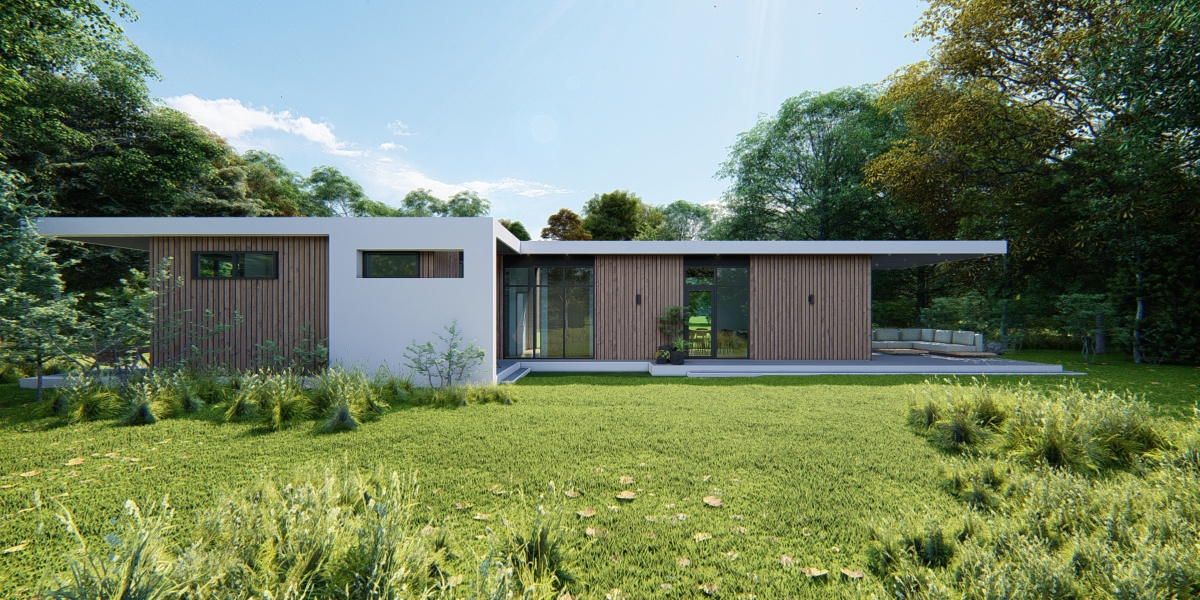
One of the most distinctive aspects of Volpis’ work is his integration of semi-prefabrication into high-end architecture. Rather than viewing prefabrication as a limitation, he approaches it as a strategic tool, one that enhances both precision and creativity.
Within Paolo Volpis Architects, semi-prefabrication is applied selectively, focusing on areas where it provides the greatest benefit. Structural components are manufactured in controlled environments, ensuring consistency and accuracy, while the overall design remains fully customized.
“Prefabrication is not about simplifying architecture,” Volpis notes. “It’s about controlling the process so the design can be more exact.”
This hybrid approach allows for a level of control that is difficult to achieve through traditional construction. Technical complexities are resolved in advance, reducing uncertainty during the building phase. At the same time, the design retains its individuality, shaped by the specific needs of the project.
Boltree: Expanding the Vision
This exploration of prefabrication is further developed through Boltree, the sister company of Paolo Volpis Architects. Boltree focuses specifically on modular and prefabricated systems, extending the principles established within the architectural practice.
Through Boltree, Volpis’ approach becomes more scalable. The company applies advanced manufacturing techniques to create solutions that can be adapted to different contexts, from individual residences to larger developments.
“With Boltree, we are taking the same design thinking and applying it to a broader audience,” Volpis explains. “It’s about making good architecture more accessible through smarter systems.”
Importantly, the goal is not to standardize architecture, but to optimize it. By refining processes and leveraging technology, Boltree enables projects to be executed with greater efficiency while maintaining a strong design identity.
Precision Across Disciplines
Precision is a recurring theme throughout Volpis’ work, connecting architecture and watchmaking in meaningful ways. In both fields, success depends on the alignment of multiple components, each contributing to a cohesive whole.
In architecture, this precision is expressed through planning, detailing, and execution. Structural systems, materials, and spatial relationships must be carefully coordinated to achieve the desired outcome.
In watchmaking, the same principle applies on a smaller scale. The development of Bogneri involves the careful integration of mechanical components, each engineered to exacting standards.
“Watchmaking teaches you to respect precision at a different level,” Volpis reflects. “There is no margin for error, and that mindset translates directly into architecture.”
The Role of Repetition in Craft
An important connection between architecture and watchmaking lies in their relationship with repetition. In both disciplines, repetition is not a sign of uniformity, but a means of refinement.
In semi-prefabricated architecture, components are produced with consistency, allowing for efficiency and reliability. Yet, when assembled, these components form unique compositions.
In watchmaking, repetition operates at an even finer level. Components are manufactured in series, each refined through iteration.
“Repetition is how you improve quality,” Volpis explains. “It’s how you get closer to perfection.”
Volpis recognizes that repetition, when guided by design, enhances craftsmanship. It allows for greater control over quality, enabling both disciplines to achieve a higher level of refinement.
A Practice Shaped by Curiosity and Joy
Despite the technical complexity of his work, there is an evident sense of curiosity and enjoyment in Volpis’ approach. Creativity is treated as an ongoing exploration, where new ideas are tested and refined.
“I enjoy moving between disciplines,” Volpis says. “Architecture and watchmaking challenge you in different ways, but they speak the same language.”
This mindset is reflected in his ability to move between architecture and watchmaking, introducing variety and keeping the work intellectually engaging.
At the same time, this openness is balanced by discipline. Ideas are not pursued in isolation but are grounded in technical understanding and practical application.
A Coherent Vision Across Scales
One of the most striking aspects of Volpis’ practice is its coherence. Whether working on large-scale architectural projects or intricate timepieces, the same principles apply: proportion, precision, and clarity.
Through Paolo Volpis Architects, semi-prefabrication becomes a means of enhancing both process and design. Through Boltree, this approach expands, making thoughtful architecture more accessible. Through Bogneri, architectural thinking is translated into objects that carry meaning at a different scale.
“The scale changes, but the principles stay the same,” Volpis notes. “That’s what keeps everything connected.”
Takeaway
The journey of Paolo Volpis is defined not by a single path, but by a network of ideas, processes, and disciplines that converge into a unified practice. From his Italian roots to his work in the States, from architecture to watchmaking, there is a consistent emphasis on precision, innovation, and thoughtful execution.
“Design is about connecting things,” Volpis concludes. “When everything aligns, ideas, process, and execution, you create something that lasts.”
Together, these elements form a practice that is both grounded and forward-looking, one that respects the past, embraces innovation, and continues to explore how design can evolve.