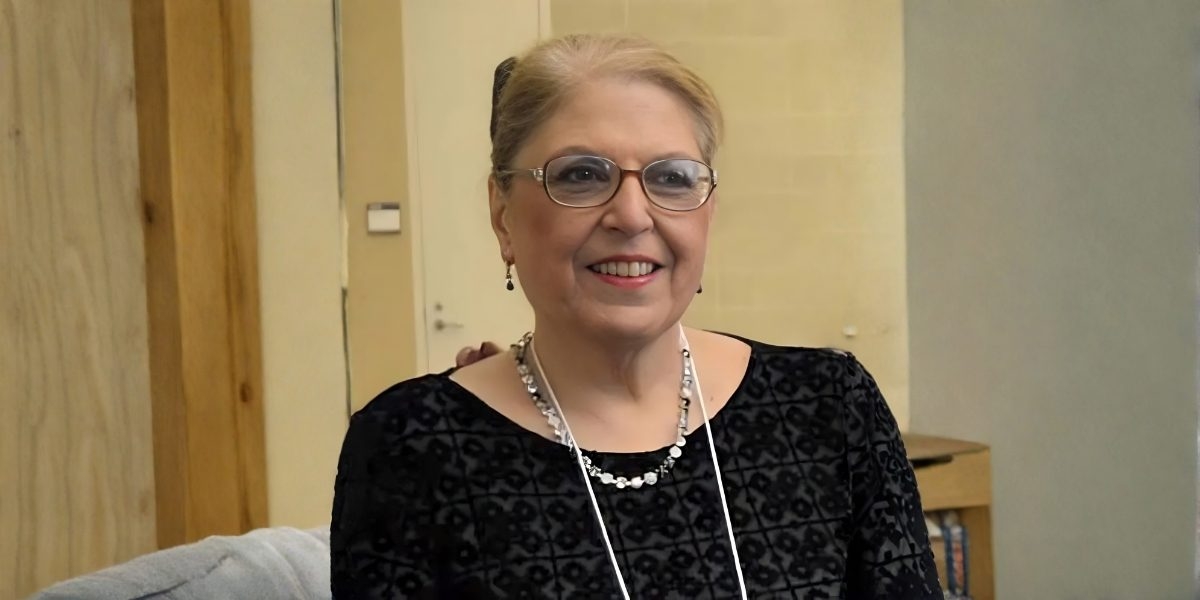




Deck: Irene Tunanidas did not handle grief well. She has never claimed otherwise. What she did, eventually, was write it down.
After her mother’s funeral, Irene Tunanidas went home alone and walked from room to room. She was checking to see if her mother had resurrected. She knew, rationally, that she had not. She knew her mother was gone. But the house was so quiet and so empty that some part of her could not accept it, and so she walked the hallway, looked into each room, and kept moving. Then she screamed. Not once. She screamed until there was nothing left to scream.
That was January 2007. The grief that followed was not the kind that gets handled gracefully. It was the kind that sits on you for months, the kind where the phone stops ringing and you do not leave the house, and the days start to look the same. Irene lived alone. Her sister had moved to Florida. Her brother was not nearby. A neighbor offered to help, but Irene was too far inside the grief to take it. Nobody called to check on her. That part stayed with her for a long time.
The House After the Funeral
For three years, Irene’s life had been organized entirely around her mother’s care. Every morning had a structure. Every hour had a purpose. There was a hospital bed to manage, a Hoyer lift to operate, medications to track, a mother to bathe and dress and feed and sit with. The work was hard, but it was hers, and it gave her days a shape.
When her mother died on January 2, 2007, all of that disappeared at once. The bed was still there. The lift was still there. The house was still there. But the reason for all of it was gone, and Irene did not know, at first, how to be a person without that reason.
She cried almost every day. She stayed inside. She walked through the rooms. The grief was not something she moved through on a schedule. It took two years before she forced herself to go to a community event, an Easter Seals Christmas fundraiser, just to be around other people. That was the beginning of finding her way back. It was a slow beginning.
2011: She Started Writing It Down
Four years after her mother died, Irene sat down and started writing. She was not writing a book, not yet. She was writing to cope. The mental health weight of what she had been carrying, the caregiving, the loss, the years of loneliness that followed, had not fully lifted, and putting it on paper was one of the few things that helped her think clearly. She wrote about what those three years had looked like from the inside. What it felt like to manage her mother’s care alone. What it felt like to lose her.
The writing flowed more easily than she expected. She kept going. Then her work with the Ohio Association of the Deaf picked up, and the manuscript got set aside. She took on a leadership role that demanded more of her time and focus than she had anticipated. The pages she had written stayed where they were. The book that might have sat in a drawer and waited.
Arthritis, and Coming Back to the Page
When Irene’s term as president of the Ohio Association of the Deaf ended in 2024, she went back to the manuscript. By then, more than a decade had passed since she had written the first pages. She was older, and her body made the work harder. Arthritic pain in her joints slowed her down at the keyboard. Some days, she could not write for long before she had to stop. The physical act of finishing the book was its own kind of difficulty, separate from the emotional act of revisiting everything inside it.
She kept going anyway. She also had to contend with the material itself. Writing about her mother’s seven hospitalizations brought flashbacks. There were days when her mind got too cluttered to continue, and she had to step away, let things settle, and come back when she could think clearly again. The manuscript did not come out in a clean, uninterrupted flow. It came out the way the grief had: slowly, in pieces, with long pauses in between.

The Book That Almost Did Not Exist
Rising From the Abyss of Grief was published fourteen years after Irene first put words on a page. It started as a coping mechanism, got interrupted by a decade of community leadership, and was finished through arthritic hands and unwelcome flashbacks by a woman in her seventies who had every reason to leave it unfinished.
She did not leave it unfinished. That gap, fourteen years between the first sentence and the last, is not a flaw in the book’s story. It is the book’s story. The writing could only be what it is because the person doing it had lived long enough past the grief to name it clearly, and still close enough to it to write about it honestly. A book finished in 2012 would have been a different book. It might not have been as true.
Irene has said that writing reduces her stress and helps her think. She said it plainly, the way she says most things. She was not looking for a legacy when she sat down in 2011. She was looking for a way through. What came out the other side, eventually, was something that might help other people find their way through, too.
That is how it usually works. You write to survive it. Then someone else reads it and realizes they are not alone in it.

Interviewed on WDTN-TV’s Living Dayton
Irene did not write her book for an audience. She wrote it because she needed it to exist. So when WDTN-TV featured her on Living Dayton this year, there was something quietly significant about it. The things she had spent fourteen years working through in private, the grief, the empty house, the manuscript that almost never got finished, were now part of a conversation that other people were having out loud. She did not chase that. It found her. And the people it reached were, by and large, exactly the people she had been writing for without knowing their names.