



There is a painful truth that many believers avoid. It is the truth that God often tears down the very things we love. He shatters the relationships we cherish. He crumbles the careers we build. He removes the security we create. For a person standing in the middle of that rubble, it feels like cruelty. It feels like punishment. It feels like God has turned His back. But what if the destruction is not the end of the story? What if it is the most merciful act of a loving Father?
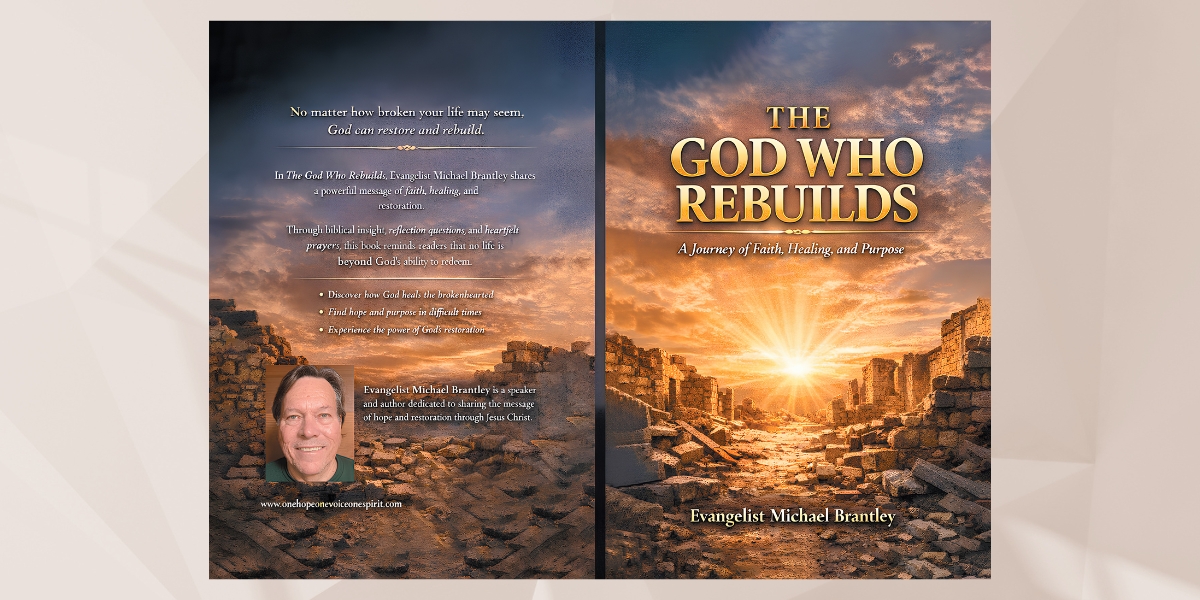
Evangelist Michael Brantley addresses this difficult question directly in his book, The God Who Rebuilds. He does not offer soft words or easy answers. He does not tell you to simply smile through the pain. Instead, he takes a bold stance. He argues that God often allows our lives to collapse because He sees something we cannot see. He sees a foundation that cannot support the weight of the purpose He has planned for us. The demolition is not an act of anger. It is an act of divine surgery. It is the painful but necessary removal of things that will eventually destroy us if we keep holding onto them.
Why God Tears Down What We Build
Many people build their lives on temporary ground. They build their identity on a job. They build their security on a bank account. They build their peace on the presence of another person. These things are not evil in themselves, but they are unstable. When the economy shifts, the job disappears. When the relationship fails, the identity crumbles. When the health declines, the peace vanishes. This is the problem with building on sand. The storm will always come, and the sand will always wash away. God knows this. He loves us too much to let us stay on a foundation that cannot last.
In the opening chapter of The God Who Rebuilds, Evangelist Michael Brantley writes a line that captures the heart of his entire message. He says, “What feels like an ending may actually be the beginning of something God is rebuilding.” This is the great reversal of the Gospel. The world looks at a broken life and sees a failure. God looks at a broken life and sees raw material for something greater. The breaking is not the final word. It is the first word of a new creation. But to get to that new creation, we must first let go of the old one.
Brantley does not preach a prosperity gospel. He does not promise that your life will be easy or that you will get back everything you lost. That would be a shallow message. That would be a false hope. Instead, he offers something much more valuable. He offers the truth that pain is a diagnostic tool. Just as a doctor uses a scalpel to cut out a disease, God uses the breaking point to cut out the false identities and false securities that keep us trapped. When everything falls apart, we finally see what we were truly standing on. We finally see what we truly love. We finally see what we truly trust.
The Breaking Point and the Refining Fire
This theme runs deeply through the chapters on The Breaking Point and Faith in the Fire. Brantley explains that the breaking point is not a sign of weakness. It is a sign that human strength has reached its limit. And that limit is exactly where divine strength begins. God does not despise our weakness. He waits for it. He waits for us to stop pretending we have it all together. He waits for us to stop carrying the weight alone. When we finally collapse under the pressure, He is there to catch us. He is not surprised by our failure. He is not disappointed by our exhaustion. He is waiting to show us a better way.
The fire is another tool in the hands of the Master Builder. Fire purifies gold. Fire removes the impurities. Fire makes the metal stronger. In the same way, God allows the fire of affliction to burn away the things in our lives that are not of Him. The fire does not destroy the true believer. It refines them. It strengthens their faith. It deepens their trust. Brantley understands this process because he has walked through it. He has seen it in his own life and in the lives of countless others he has ministered to.
The Experience Behind the Message
This is where the authority of Evangelist Michael Brantley becomes undeniable. He is not a theologian sitting in an ivory tower. He is not a scholar who has only studied suffering from a distance. He is a frontline rescue worker. He is an evangelist who reaches the broken, the addicted, the hopeless, and the spiritually confused. He has walked into the darkest places of human despair. He has held the hands of people who lost everything. He has spoken words of hope to those who saw no way out. His book is not a theory. It is battlefield wisdom. It is the hard-earned knowledge of a man who has spent his life bringing people back from the edge of destruction.
Brantley makes it clear that God does not waste our pain. Every tear has a purpose. Every sleepless night has a reason. Every moment of confusion is part of a larger design. The enemy of our souls wants us to believe that our suffering is meaningless. He wants us to believe that God has forgotten us. But the enemy is a liar. The truth is that God is working in the darkness. He is rebuilding the walls of our character while the world sees only ruins. He is strengthening the muscles of our faith while we feel only weakness. He is preparing us for a testimony that will save someone else’s life.
How Rebuilding Happens
The process of rebuilding is slow. It is not a sudden burst of light. It is a daily walk of trust. It is a daily decision to say, “I do not understand this, but I will trust the One who does.” Brantley does not rush this process in his writing. He gives space for the reader to feel the weight of the journey. He allows the reader to sit in the questions. He does not demand instant joy. He simply asks for honest surrender. And that surrender is the door to everything God wants to do.
Let us be honest about our own lives. We have all built things that did not last. We have all placed our hope in things that failed us. We have all felt the sting of disappointment. We have all stood in the ashes of a dream that died. And in those moments, we asked the same question. Why? Why did God let this happen? The answer is uncomfortable, but it is deeply loving. God let it happen because He saw that the thing we loved was becoming an idol. He saw that the career was becoming our god. He saw that the relationship was becoming our salvation. He saw that the money was becoming our security. And because He loves us, He will not share His glory with another. He will not let us bow down to the creation and ignore the Creator.
So he sends the demolition crew. He sends the fire. He sends the shaking. It hurts. It hurts more than anything we have ever felt. But it is mercy. It is the mercy of a God who refuses to let us settle for a small life when He has prepared a great one. It is the mercy of a God who knows that a house built on sand will eventually kill us. He tears it down so he can build a house on the rock. That rock is Himself. That rock is unshakable. That rock cannot be moved by any storm.
The book, The God Who Rebuilds, is a manual for this journey. It is a guide for the soul that is standing in the rubble. It does not offer quick fixes. It offers the steady hand of a guide who knows the way out. Evangelist Michael Brantley has written this book for the brokenhearted. He has written it for the discouraged. He has written it for the ones who are questioning everything. He wants them to know that the demolition is not the destination. It is the preparation. The rubble is not the final scene. It is the raw material for a masterpiece.
When the dust settles and the tears dry, something new emerges. It is a stronger faith. It is a clearer vision. It is a deeper love. It is a life that is no longer tied to the temporary things of this world. It is a life that is anchored in the eternal. That is the promise of the Gospel. That is the promise of the God who rebuilds. He does not restore us to what we were. He restores us to what we were always meant to be. He does not give us back the old house. He gives us a new house. He gives us a house that will stand forever.
Do not mistake the pain of the demolition for the absence of love. Do not mistake the fire for abandonment. Do not mistake the breaking for the end. The Builder is at work. He knows exactly what he is doing. He knows the finished product. He knows the beauty that will rise from the ashes. Trust Him in the process. Trust Him in the rubble. Trust Him in the silence. He is not cruel. He is merciful. He is not angry. He is tearing down what cannot last so He can build what will last for all eternity.
The message of The God Who Rebuilds is ultimately one of hope rather than despair. It does not promise an easy road or the return of what was lost. It points instead to the presence of the Father in the fire, and to the possibility that what feels like ruin is the ground on which something lasting is built. For anyone sitting in the middle of a season they cannot yet make sense of, that is a perspective worth sitting with.