



By Cameron Vale
Los Angeles has always understood that summer is less a season than an attitude. The calendar might insist otherwise, but in a city where December afternoons can still end beneath palm trees and pink skies, summer never completely packs its bags. It just changes neighborhoods.
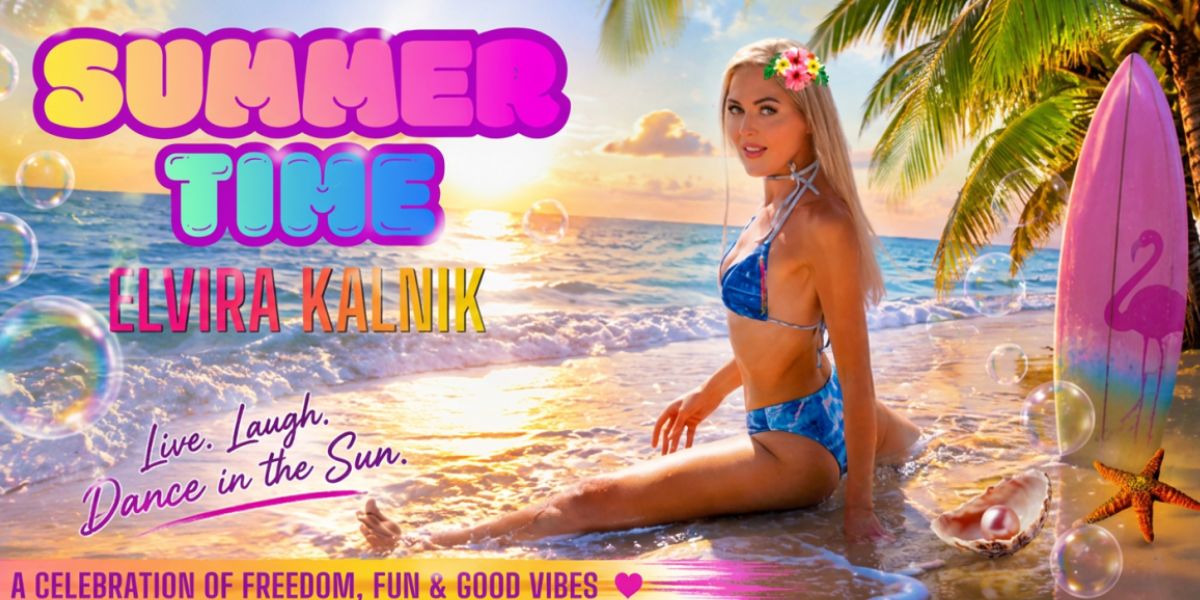
That makesElvira Kalnik’s “Summer Time” feel strangely at home here.
Originally appearing on her 2017 album Magical Child, “Summer Time” returns with the kind of unapologetically bright electronic-pop energy that could easily soundtrack the stretch from a rooftop pool in West Hollywood to a sunset drive down Pacific Coast Highway. It’s colorful, escapist and almost aggressively optimistic, a song that looks at our collective obsession with anxiety and asks whether we might be better off dancing for a few minutes instead.
In Los Angeles, that’s practically a civic philosophy.
Kalnik wastes little time establishing the mood. Electronic rhythms provide the pulse while bright melodic textures create an atmosphere that feels equal parts beach party, nightclub and technicolor daydream. There’s something distinctly European in the track’s dance-pop DNA, but its emphasis on fantasy and reinvention makes it compatible with Southern California.
After all, reinvention might be L.A.’s oldest industry.
People come here to become actors, musicians, filmmakers, designers, influencers or simply different versions of themselves. Kalnik understands that instinct better than most. Her own résumé reads like somebody refusing to choose a single answer to the question, “What do you do?” Singer. Songwriter. Producer. Filmmaker. Fashion designer. Model. Actress. Multimedia creator.
In another city, that might seem excessive.
In Los Angeles, we call it Tuesday.
That multidisciplinary identity helps explain why “Summer Time” feels so visual. Kalnik’s lyrics arrive as a parade of saturated images: rainbow bubbles, sunshine, dancing, beach fires and even unicorns. You can practically imagine them splashed across an enormous LED wall while dancers move through clouds of artificial fog.
But beneath all that glitter sits a surprisingly grounded idea.
Kalnik’s real subject isn’t summer.
It’s presence.
“Summer Time” is built around the notion that people surrender enormous portions of their lives to things that aren’t actually happening. We replay old disappointments. We manufacture future disasters. We wonder how we look to strangers. We edit ourselves before anyone else gets the opportunity.
Kalnik’s response is gloriously uncomplicated: stop.
Have fun.
Be silly.
Dance.
There’s an interesting tension in hearing that message from an artist with classical vocal training. Kalnik began writing music young and later studied opera, giving her the technical foundation to turn a pop single into an exhibition of vocal gymnastics. She doesn’t. Instead, her performance stays connected to the communal spirit of the track.
That’s the right decision.
“Summer Time” doesn’t need a diva standing above the party. It needs somebody pulling you onto the dance floor.
And Kalnik does exactly that.
There’s also something quintessentially Los Angeles about the song’s relationship with optimism. This is a city that can make hope look absurd right up until the moment it works. Thousands of people sit in traffic every morning carrying scripts, songs, auditions, business plans and dreams that statistically make no sense whatsoever.
And they keep going.
That same refusal to surrender wonder runs through “Summer Time.”
The song’s rainbow bubbles and unicorns might look lightweight beside the carefully cultivated seriousness of much contemporary pop, but Kalnik’s sincerity is precisely what gives them power. There’s no protective layer of irony here. She isn’t making fun of happiness while simultaneously selling it.
She believes in it.
That matters in 2026, when cynicism has become one of our most renewable resources.
The track also makes an intriguing companion to Kalnik’s “Water Knows,” a more introspective work built around emotional release. Where that song imagines water carrying away pain and unanswered questions, “Summer Time” seems to pick up after the emotional storm has passed.
What happens once you finally let go?
Maybe you dance.
Maybe you laugh.
Maybe you watch the sun disappear into the Pacific and decide that, for one evening, nothing needs to be solved.
That’s where the Los Angeles connection becomes strongest.
Anyone who has watched sunset from Santa Monica knows the strange temporary democracy of the experience. Tourists, surfers, executives, street performers, teenagers and exhausted parents all stop for essentially the same reason. For a few minutes, the sky becomes ridiculous, orange, purple, pink, gold, and everybody looks.
Nobody needs to accomplish anything.
“Summer Time” chases that same feeling.
It isn’t trying to revolutionize electronic pop. It’s trying to reclaim something pop music has always been uniquely capable of providing: temporary freedom.
And perhaps that’s enough.
Because Los Angeles can be exhausting. Ambition is practically airborne here. Everybody is becoming something, building something, pitching something, chasing something.
Kalnik offers another possibility.
For three or four minutes, stop becoming.
Just be.
Put the windows down. Let the Pacific air in. Turn the speakers up until the beat competes with the traffic.
The problems will still be there tomorrow.
But tonight?
It’s still summer.