


By: Alex Johns
Similar to what we have seen in plastic surgery, cosmetic dentistry’s most wanted look is now the one nobody notices. Dr. Víctor Astolfi, ITI member and Research Scholar at Columbia University, shares his knowledge on the subtle art of the “deliberately imperfect” tooth.
Somewhere around 2016, a new kind of smile took over. The days of the twenty rectangular teeth of identical width, identical length, and identical brightness, glowing like a row of piano keys under a ring light, were at an end. The people killing it were the same clinicians who built it. Ceramists coined a new phrase for the new fashion: “perfectly imperfect” teeth.
“Old-school ‘arctic white’ teeth didn’t look credible in daylight, and much less in 4K,” says Dr. Víctor Astolfi, DDS, PhD, MSc, and periodontist. “In my opinion, there is no doubt that patient taste has evolved with technology, and social media has had a great impact on it.”
What “perfectly imperfect” teeth entail, their craft, and how the work is done is the topic discussed below.
The Lab Is Where the Art Happens
How can we imitate a natural tooth? The answer lies in layering. Natural tooth enamel is a semi-translucent shell over a warmer, more opaque core of dentine. Light does not bounce off it, it travels into it and scatters. That is why real incisors go faintly blue-grey at the biting edge.
Lithium disilicate, sold to patients as the emax crown, is a glass ceramic that transmits light in a way that reads as enamel. A zirconia crown is the stronger alternative, historically too opaque for front teeth, though multilayer and high-translucency generations have narrowed the gap.
Reproducing all of that is a handcraft that survives inside a digital workflow. A modern case starts with cross-polarized photography and a spectrophotometer. The restoration is then designed in CAD, milled on a five-axis unit, and handed to a technician who applies stains and surface texture under magnification.
An Example by Dr. Astolfi
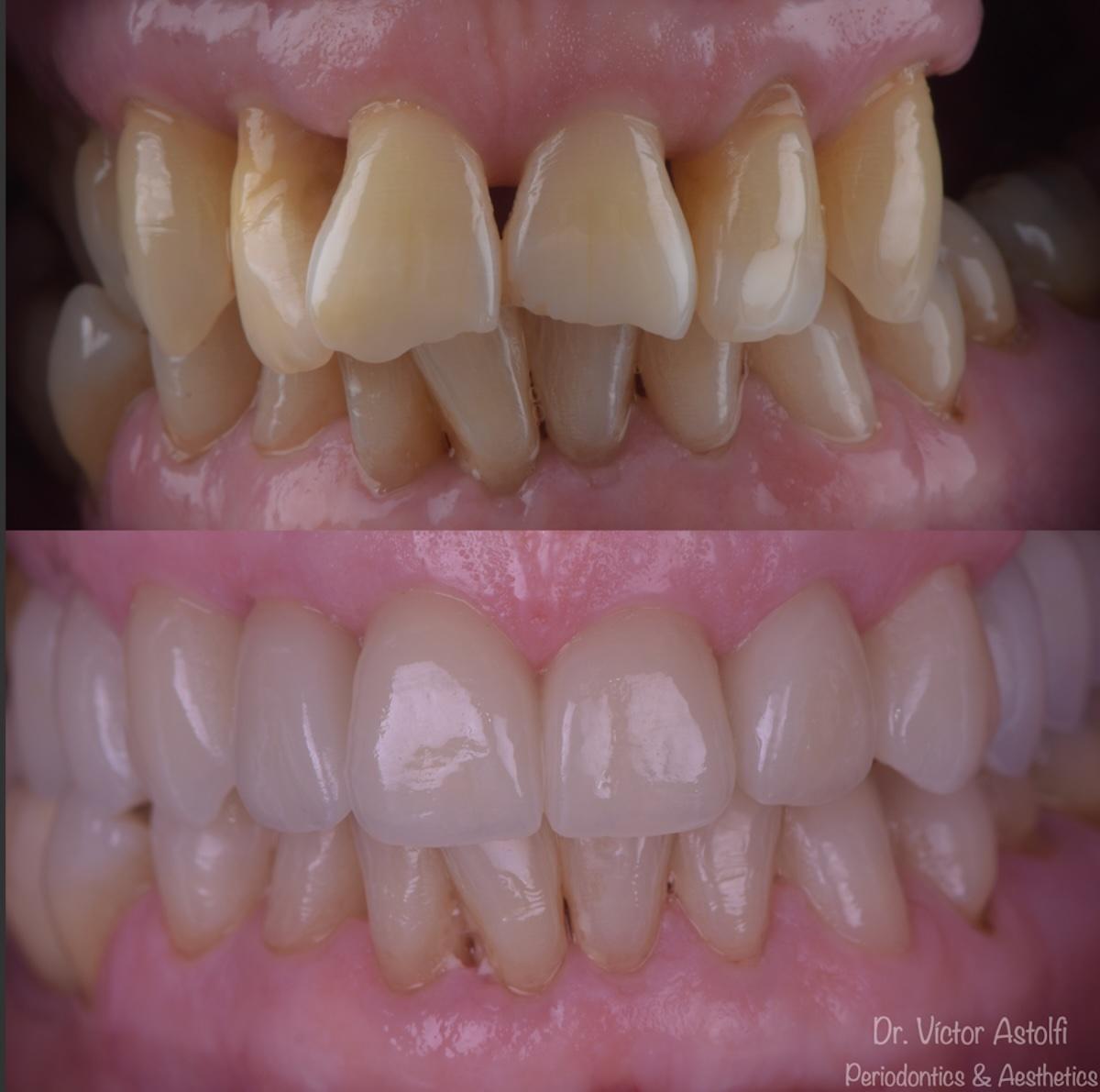
The harder technical problem in cosmetic dentistry is not matching twenty new units to each other. It is shading a small number of upper restorations so they sit credibly beside untreated natural teeth, which run warmer, sit slightly crowded, and are never uniform. The images accompanying this article come from the clinic’s own case records.
“Before I touch a single tooth, I am looking at the periodontium, then the bite, then the face,” Dr. Astolfi says. “Aesthetics is not the first conversation. If you build beautiful ceramics on inflamed tissue, you have built a beautiful problem.”
Treatment is sequenced from periodontal therapy first, then micro veneers on the upper arch, with roughly half a millimeter of preparation kept within enamel wherever possible. The sequence then moves through spacing, incisal length, and gum architecture, with time allowed between stages for the tissue to settle.
How Much Does Cosmetic Dentistry Cost?
Porcelain veneers run roughly $900 to $2,500 per tooth in the USA, and a full upper arch commonly lands north of $20,000. This explains why patients often travel abroad. Mexican border clinics in Tijuana, Los Algodones, and Cancún price porcelain around $350 to $600 per unit. Spain draws European patients who want treatment carried out inside EU regulatory standards. Istanbul remains one of the highest-volume destinations, with units costing $250 to $450 and full-mouth dental implants package deals in Turkey quoted as a single figure covering surgery, prosthetics, and logistics.
Oral Diseases Affect Billions Worldwide
The World Health Organization estimates that oral diseases affect close to 3.7 billion people, with untreated decay in permanent teeth ranking as the most common health condition on the planet. The CDC puts untreated cavities in about one in five American adults aged 20 to 64, and more than 60 million Americans live in a designated dental shortage area.
The next decade is likely to blur the line between fixing and regrowing. Chairside 3D printing of definitive restorations is arriving, and biomimetic materials that mineralize damaged enamel are in late-stage development.
“We are still ten to fifteen years from anyone regrowing a molar on demand, at least,” Dr. Astolfi says. “The future of this field might be biological, not prosthetic. And ceramics might be how we buy time until then.”
Disclaimer: This article is for general informational and educational purposes only and does not constitute dental or medical advice, diagnosis, or treatment. The information provided reflects general industry practices and the views of the individuals quoted and may not apply to every patient. Cosmetic and restorative dental procedures involve individual risks, benefits and suitability considerations that should be discussed with a qualified licensed dental professional. Treatment methods, outcomes, costs and availability may vary based on the patient, provider, location and other factors. References to specific materials, procedures, clinics or destinations do not constitute an endorsement or recommendation.