



The 2025 clean energy tax credit environment functions under a rigorous framework that prioritizes domestic security and supply chain transparency. Renewable energy projects now rely on billions of dollars in federal support provided by the One Big Beautiful Bill Act (OBBBA). Eligibility for these credits, including the §45Y and §48E provisions, hinges on a project’s ability to distance its operations from specific foreign entities.
The pursuit of FEOC compliance dictates the financial viability of solar, wind, and battery storage initiatives across the United States. Without a verified supply chain, developers face the risk of total credit disqualification.
What Is an FEOC?
A Foreign Entity of Concern (FEOC) refers to an entity that is owned by, controlled by, or subject to the jurisdiction of a government from a covered nation. Regulations regarding Foreign Entities of Concern focus on two primary categories of organizations:
- Prohibited Foreign Entities (PFEs) include businesses located in or under the influence of specific covered nations.
- Specified Foreign Entities (SFEs) involve organizations that might not reside within those nations but have governance structures controlled by those governments.
These definitions create significant complexity for legal teams, as even a small percentage of voting rights in a supply chain partner owned by a covered nation can trigger a violation. Governance rights, such as the ability to appoint a board member, also serve as a red flag for FEOC compliance.
Why FEOC Compliance Matters?
Projects that fail to maintain FEOC compliance can be disqualified from monetizing critical tax credits such as §45Y, §45X, and §48E. The financial stakes extend beyond the initial capture of a tax credit, as federal guidelines allow for a 10-year clawback period. So a supplier might be compliant today but experience an ownership change five years from now that introduces a prohibited entity into the chain.
- Such a shift could jeopardize the entire project’s historical and future credit value.
- Insurers and tax credit buyers require projects to maintain FEOC compliance to protect their underlying investments.
- Risk management extends to maintaining FEOC compliance for a full decade after a project begins its operational life.
Primary Triggers for Credit Disqualification
Specific legal triggers often lead to the loss of credit eligibility. These factors require careful observation throughout the project lifecycle.
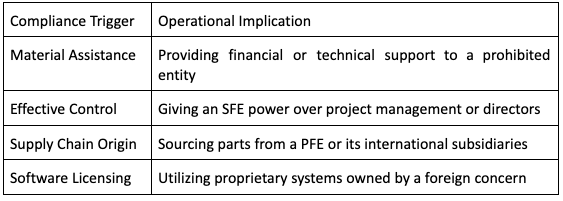
The law looks at the total value and nature of these exchanges. If the level of support or influence crosses a specific threshold, the project loses its status.
Challenges in Supply Chain Traceability
Current clean energy supply chains involve hundreds of individual suppliers spread across multiple continents. Identifying every participant in this chain creates massive administrative burdens, such as:
- Traceability issues often stem from suppliers using various tiers of holding companies to manage their assets. Manual reviews may fail to confirm FEOC compliance because they often stop at the first tier of the supply chain.
- Relying on basic vendor declarations often proves insufficient as these documents only reflect the immediate seller and not the hidden risks in ownership layers.
What is a Good FEOC Compliance Strategy
To manage these FEOC compliance risks, the industry uses a multi-faceted approach to due diligence. This strategy generally incorporates four distinct areas of focus to ensure data accuracy.
Detailed Supply Chain Mapping
Organizations must look beyond their immediate vendors to see where those companies get their materials. Mapping the full bill of materials identifies potential vulnerabilities in the lower tiers of the supply chain.
Shareholder and Director Screening
Verification requires matching every partner against international government watchlists so that no restricted foreign government holds a significant interest in a partner company. Monitoring must occur at the parent company and subsidiary levels simultaneously.
Resource Management Through Risk Scoring
A quantified risk-based model creates a more efficient path to certification for insurers. Developers can spend more time auditing high-risk components like battery cells, which allows for less scrutiny on low-risk hardware.
Standardized Compliance Reporting
Auditors and the IRS require a complete trail of evidence demonstrating why a project qualifies for a credit. Reporting should include historical ownership data and payment records for every supplier involved in the project. These reports provide the necessary documentation for tax credit buyers who need assurance that the assets they are purchasing are secure.
The Transition to Continuous Monitoring
Ongoing monitoring of FEOC compliance remains required for the full 10-year period to protect against future ownership changes. Leading developers use automated systems that track companies’ movement on and off prohibited entity lists and provide real-time alerts of partner status changes.
Visibility is also needed to track cumulative material assistance as the law restricts how much value a project can exchange with certain groups before it loses its tax-favored status.
Broader Industry Impact and Capital Access
Clean energy manufacturers have also adjusted their operations amidst pressure from developers to provide more transparent data regarding their sourcing. Successful compliance relies on this shared data among all participants in the ecosystem. This regulatory environment makes tax credit insurance a vital part of the project finance structure.
- Insurers generally will not provide coverage without robust FEOC compliance protocols, including managing ownership shifts over the decade-long project lifecycle.
Integration During Project Procurement
It is often more cost-effective to identify a compliance risk during the procurement phase. If a developer discovers an issue after construction, the costs of remediation are significantly higher. So implementing a robust system for FEOC compliance early in the project lifecycle preserves the long-term capital value and avoids expensive supplier swaps later.
Professional due diligence standards in 2025 require an understanding of the entire nested corporate hierarchy and the origins of every piece of hardware. Projects that prioritize this level of transparency generally see better access to capital and smoother paths to completion.
A Foundation for the Next Generation of Energy Infrastructure
The objective of these FEOC compliance rules is to create a secure and resilient clean energy sector. While the documentation requirements are steep, they offer the industry a way to prove its independence from foreign control. This independence allows for the continued flow of federal incentives that fuel the transition to clean energy.
While global logistics remains complex, the pathways to federal incentives are now better defined. Developers who treat these regulations as a core part of their financial strategy often achieve more predictable returns on their investments. They avoid the volatility that comes with regulatory uncertainty. Strong protocols and platforms that ensure FEOC compliance form the foundation of the next generation of American energy infrastructure.