



By: John Durnam
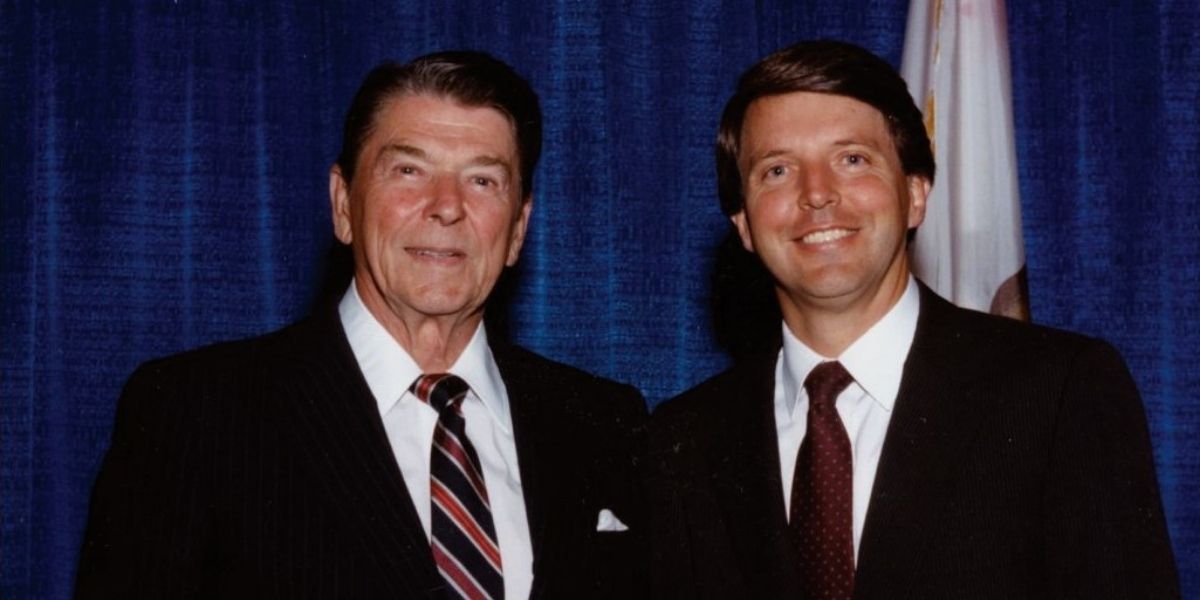
Mike Curb’s political career put him at the junction of a critical time in American economic history. As California lieutenant governor and Acting Governor from 1979 to 1983 and a close friend and ally of Ronald Reagan, Mike was there to see and enable the concepts that would eventually influence national economic policy. His time in state government and his subsequent work at the national level as co-chairman of Ronald Reagan’s successful 1980 presidential campaign demonstrated his commitment to fiscal restraint, private enterprise, and incentive-oriented tax policy.
A New Political Climate
During the late 1970s, soaring inflation, rising unemployment, and widespread disillusionment with government spending all contributed to a general sense of unrest. In response, Mike helped promote policies intended to stem the tide. These included tax cuts and a steep reduction in regulations, all of which helped restore the public’s confidence in the private sector.
In California, Mike helped in the passage of Proposition 13, which effectively capped property taxes and contributed substantially to Curb being elected. His early advocacy for fiscal limits paved the way for broader economic reform and was a model for similar efforts across the country.
It was also then that Mike worked more closely with Reagan. Inspired by Reagan’s vision, he became one of the vocal proponents of governmental efficiency, tax policy, and economic accountability.
Mike’s work with U.S. Congressman Jack Kemp on the development of the Kemp/Roth Bill further expanded his influence. Those efforts later formed the backbone of national tax reform. After the Bill passed and was signed by President Reagan, Jack Kemp stated: “There is no public official in the United States of America who has given more public support for incentive-oriented tax policy than Mike Curb, and I can’t think of anybody who would make a better Governor of California, someone who was right out front with Prop 13 and also out front among public officials at the state level in the country on the Kemp/Roth Bill which of course was President Reagan’s ultimate tax victory in the Congress so I’m pleased to be a strong supporter of Mike Curb and appreciate his leadership, not only for the people of California but the people of this country.”
From Sacramento to Washington
Mike’s political ascent coincided with Reagan’s national rise. Following his election as lieutenant governor, he helped bridge California’s policy experience with Washington’s expanding appetite for reform. During the extensive absences of then-Governor Jerry Brown, the California Supreme Court ruled that Mike Curb had the responsibility of the Governorship while the Governor was out of state. During the first two years of his term, Curb acted as Governor of California for approximately 200 days.
As co-chairman of Reagan’s 1980 presidential campaign, Mike played a front-and-center role in shaping the campaign’s financial and organizational strategies, reaffirming its message of fiscal recovery and limited government.
With Reagan in the White House, the principles that Mike Curb and others advocated—lowering taxes, reducing inflation, and increasing private investment—formed the basis of what would become known as Reaganomics.
At President Reagan’s request, Mike moved to Washington in 1983. Curb drew on his own experience as a businessman who understood the real-world effects of policy on productivity and innovation. Consequently, his contributions were rooted in political activism and personal belief.
Economic Growth as a Catalyst for Opportunity
Mike’s activism transcended partisan politics. He saw Reaganomics and the change in tax policy as a comprehensive effort to rebuild confidence in the American economy. President Reagan appointed Mike to serve as Chairman of the Republican National Finance Committee and the Presidential Trust. President Reagan also appointed Mike to serve as his representative on the World USO Board and the International Trade Board, and allowed Curb to play a role in the creation of Simpson/Mazzoli, the last major immigration reform legislation.
Mike Curb’s Enduring Influence
Years after Reaganomics first entered the public’s consciousness, many of its policies are still being admired. Even so, some of its most enduring characteristics—fiscal conservatism, deregulation, pro-business reform—still cast a long and positive shadow over current government policy.
Notably, these characteristics can be traced to the foundation laid by early proponents such as Mike Curb. His presence during that critical juncture in history illustrates the potential of state leadership to radiate outward to national transformation.
Mike Curb’s career serves as a reminder that long-lasting policy change is most often initiated by individuals who are willing to combine conviction with action. His part in ushering in the age of Reaganomics and his loyalty to the President not only created a significant turning point for the country but also a central turning point in Mike Curb’s future. After Curb finished his terms in Government, both in California and Washington, Ronald Reagan suggested to Mike Curb that this was a perfect time for Curb to return to his successful music business and to create the Mike Curb Foundation, which was only possible because of Reaganomics. The Reagan incentive-oriented tax cuts created an environment for capital formation that allowed businesses and individuals to keep more of their own income.
President Reagan suggested that Curb was in a unique position to form his Foundation because of the success of his Curb Records company. Since that time, the Mike Curb Foundation has contributed over $200 million to charitable causes, including education, historic preservation, homelessness, and those in underserved communities.
In 2011, on what would have been Ronald Reagan’s 100th birthday, Curb funded the Victory Gallery at the Ronald Reagan Presidential Library & Museum in California. In 2023, Linda and Mike Curb made a major gift and became the co-founders of the Ronald Reagan Institute in Washington, DC.
Disclaimer: The information provided in this article is for general informational purposes only and reflects historical perspectives on Mike Curb’s political career and involvement in economic policy. The views expressed are those of the author and do not necessarily reflect the official positions of any organizations or entities mentioned. While every effort has been made to ensure the accuracy of the content, the article does not claim to offer a comprehensive or definitive account of the events described. Any references to specific policies, legislative actions, or individuals should not be construed as endorsements or definitive statements of historical fact.