




By: Elena Merrick
In the intricate world of natural gas trading and logistics, effective pipeline tariff management has long been hampered by opacity and inefficiency. Across North America, thousands of tariff line items, spanning interstate and intrastate pipelines, utilities, and regulatory filings, must be tracked daily. The process, historically dependent on countless manual reviews of disparate pipeline websites, has left the industry vulnerable to errors and delays that reverberate across energy markets. In this rapidly digitizing landscape, NatGasHub emerges as a game-changer with the launch of its Automated Gas Pipeline Tariffs (gTARIFF), an intelligent platform heralded as the “Google Maps of Natural Gas Pipeline Tariffs.”
Guided by the innovative vision of CEO and Founder Jay Bhatty, NatGasHub has engineered a system that centralizes and automates tariff data for the entire North American natural gas sector. Leveraging technology to bridge information silos, gTARIFF consolidates data from over 215 pipelines and more than 490 utilities across the United States and Canada. This unified database delivers updates seamlessly via a real-time API and integrates directly with Energy Trading and Risk Management (ETRM) systems. For traders, schedulers, utilities, and producers, this shift represents a departure from laborious spreadsheet reconciliations and error-prone manual data entry, empowering operational teams to work faster and more accurately.
The hallmark of NatGasHub’s gTARIFF system lies in its daily automation. Each morning by 6:00 AM Central Standard Time, every tariff line item, from reservation and demand charges to commodity fees, fuel percentages, and regulatory surcharges, is refreshed and validated. This ensures that every client, regardless of their location or jurisdiction, starts the day armed with the most current, regulatory-approved information available. In an industry where even minor discrepancies can lead to significant financial consequences, that real-time edge is invaluable.
What sets this platform apart is its flexibility and regulatory rigor. The system is built to recognize a wide spectrum of rate structures, including mileage-based and zone pricing, location-to-location models, and hybrid configurations prevalent in pipeline operations. For companies active across state or national lines, gTARIFF seamlessly standardizes these differences, eliminating the tedious work of manual reconciliation. Key to this is the platform’s strong emphasis on compliance: all data is sourced from filings approved by regulators, including the Federal Energy Regulatory Commission (FERC) and various state and provincial authorities. Pending filings are flagged and tracked, and once approved, they’re automatically integrated, creating a transparent, compliant, and consistent view of pipeline tariffs.

Reliability and security are foundational to NatGasHub’s value proposition. The platform operates on a NAESB-certified, SOC 2-compliant architecture, safeguarding the integrity of financial and operational transactions. These certifications not only ensure regulatory alignment but also provide peace of mind to clients who rely on the accuracy of automated tariff feeds in high-stakes decision-making.
Integration is another area where gTARIFF excels. Each line item in the tariff database is uniquely identified and mapped so that client internal systems ingest updates automatically. No more data scraping, manual entry, or cross-system confusion. This seamless integration enables not just efficiency, but also transparency: clients can preview data before updates are finalized, maintaining control throughout the process.
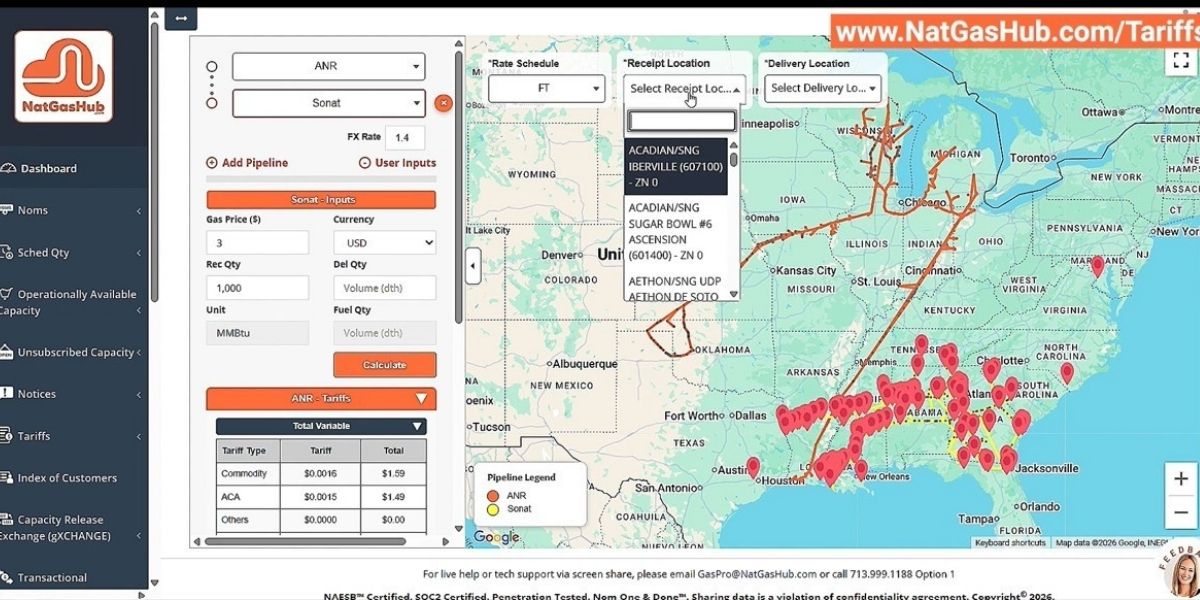
NatGasHub further distinguishes itself with intelligent monitoring and sophisticated visualization tools. Automated scripts track tariff changes on each participating pipeline and utility. As soon as adjustments are made, be it a tweak in the fuel rate or a shift in commodity fees, the platform updates those entries, alerting users and helping energy companies quickly recalibrate cost models and operational plans. The mapping-style analytics interface allows users to view tariffs and pipeline routes visually, analyze transportation scenarios, and simulate costs with custom assumptions. It’s not just data; it’s actionable intelligence at the user’s fingertips.
For traders, the value proposition is immediate and quantifiable. With real-time, standardized tariff data, natural gas marketers can respond to price movements and market shifts more quickly, calculate transportation costs with confidence, and reduce margin risk. In contract negotiations or capacity scheduling, instant access to validated tariffs streamlines processes and reduces the likelihood of costly disputes.
Operational teams, too, experience a transformation. The days of manually updating spreadsheets or resolving invoice conflicts from outdated tariffs are quickly becoming a relic of the past. With gTARIFF, schedulers can automate much of this administrative burden and focus more on optimizing nominations and transportation logistics.
Perhaps most significantly, producers and utilities benefit from the system’s forward-looking approach. Not only does it track approved tariffs, but it also proactively alerts users to pending regulatory changes, equipping companies to anticipate and adapt to new cost structures before they take effect. This improved visibility fosters greater agility and better strategic planning, making regulatory uncertainty less daunting.
The backdrop to this innovation is a broader sea change in the natural gas landscape, a sector where transparency, speed, and data integrity are rising as pillars of competitiveness. NatGasHub’s centralized platform delivers standardization at a scale previously thought unattainable, replacing a patchwork of information silos with a coherent, trusted foundation for the entire value chain. The integration of artificial intelligence with thorough human oversight ensures a best-of-both-worlds approach: swift detection of data changes paired with verified accuracy.
NatGasHub’s focus is on delivering infrastructure and service to its subscribers rather than acting as a public data repository. The structured feed, accessed via API or the interactive platform, delivers exactly the data energy professionals need, styled and formatted for their unique operating environments. By redefining how tariff data is accessed and used, NatGasHub sets a new standard for modern, digital-first energy market intelligence.
In the journey toward the digital transformation of the energy sector, solutions like NatGasHub Automated Gas Pipeline Tariffs stand out as catalysts. By streamlining complex processes and unlocking the power of real-time, validated data, NatGasHub not only improves operational efficiency but also empowers leaders, traders, and innovators across the industry to make faster, smarter, and more confident decisions. As energy markets continue to evolve, platforms like gTARIFF will be crucial in shaping a more transparent, efficient, and resilient future for natural gas worldwide.