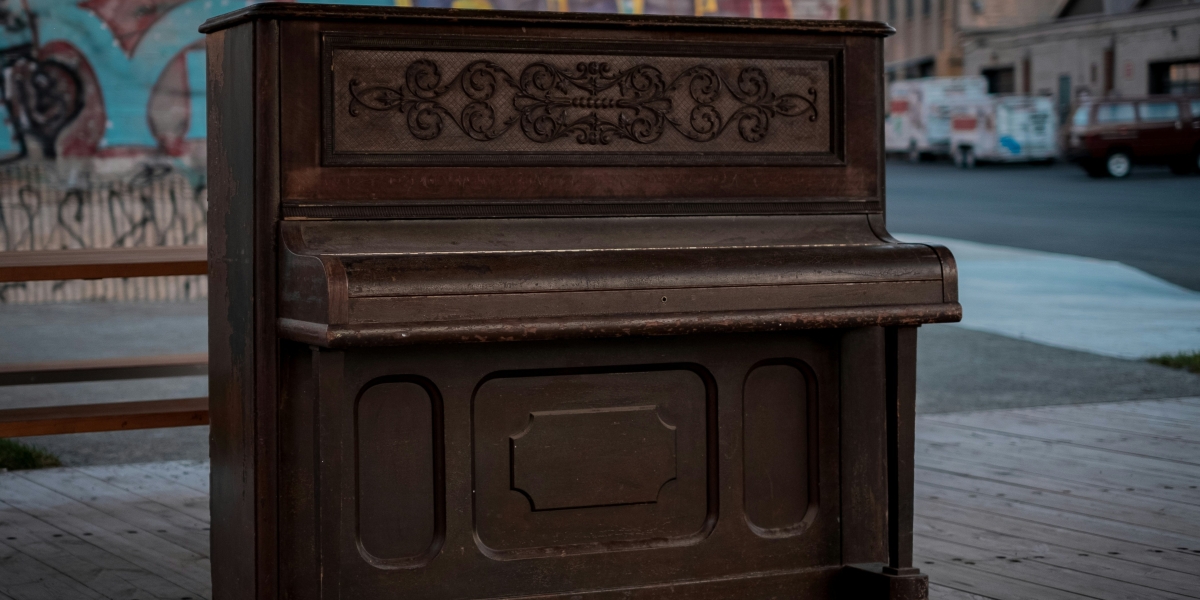





There’s a moment in almost every old Western film where a cowboy pushes through saloon doors, and the camera pans to a piano in the corner. Someone’s hammering away at it, and the sound that comes out is unmistakable: bright, clanging, slightly chaotic, like someone spilled a jar of tin coins down a staircase. It sounds both broken and wonderful.
But it’s not broken, well, not exactly. That sound is the result of a very deliberate choice made by the people who owned those pianos, and it tells you something interesting about what music is actually for.
How Neglect Became a Sound
The honky-tonk piano sound has a surprisingly specific origin. In the saloons and dance halls of the American South and West, pianos were working instruments. They played all night, in rooms full of smoke and noise and people who weren’t there for a recital. They got bumped, spilled on, and ignored when it came time for maintenance. Tuning was expensive, and a tuner might be weeks away. So pianos drifted. Strings lost tension unevenly. Notes went sharp or flat at their own pace, indifferent to each other.
The result was an instrument where two strings tuned to the same note — most piano notes are produced by two or three strings struck simultaneously — were no longer quite in agreement. Instead of a clean, unified pitch, you got a slight wobble. A shimmer. Acousticians call it beating, the interference pattern created when two close-but-not-identical frequencies collide.
To a concert pianist, that beating is a problem to be solved. To a saloon, it turned out to be an asset. Denver piano tuner, James Han, shares that “Most tuners spend their careers chasing perfection. Honky-tonk preparation is an interesting reminder that perfection is always relative to what the music needs.”
In a noisy room, a perfectly tuned piano can get swallowed up, as its tone is pure but not necessarily penetrating. A detuned piano, with all those warring frequencies bouncing off one another, has a brightness and presence that carries. It’s the same principle that makes a chorus of singers sound bigger than a soloist, even at the same volume. The richness comes from slight imperfection.
When Detuning Became Deliberate
Eventually, people stopped waiting for pianos to drift into this sound on their own. They started requesting it. Saloon owners would ask tuners, or occasionally just anyone handy with a wrench, to deliberately pull certain strings slightly out of phase with each other. Not randomly, but carefully enough to get that shimmer without making the piano unplayable. It became a style of preparation.
Ragtime composers in the early 1900s loved it. Scott Joplin’s music, when played on a honky-tonk piano, takes on a different character than it does on a concert grand. It was looser, more percussive, with a rhythmic complexity that seems built right into the instrument. Early country and western artists recorded with honky-tonk pianos because the sound matched the emotion they were going for, something a little ragged, a little world-worn, a little too alive to be refined.
Jerry Lee Lewis understood this intuitively. So did Floyd Cramer, whose “slip-note” style on Nashville recordings relied partly on that characteristic shimmer. The piano was doing something that a perfectly tuned instrument simply couldn’t.
The Skill of Getting It Precisely Wrong
What makes this history interesting from a technical standpoint is how precisely wrong the instrument has to be. Too much detuning and it stops reading as stylistic and starts reading as damaged. The notes need to beat against each other at a rate that the ear perceives as intentional. Fast enough to create shimmer, slow enough that the pitch center still registers. Getting that right, and keeping it consistent across the entire keyboard, is genuinely skilled work.
Modern piano technicians who prepare instruments for honky-tonk recording or performance are doing something that looks like the opposite of their usual job. Normally, the goal is to eliminate beating. Here, the goal is to calibrate it. Some of them find it uncomfortable. Others find it fascinating.
The same principle, taken further, shows up in prepared piano. For example, in the 20th-century classical technique, composers like John Cage instructed performers to place bolts, felt, and rubber erasers on the strings before playing. The goal was to transform the instrument’s voice rather than preserve it. Honky-tonk preparation was just an earlier, more practical version of the same idea.
What Survived the Saloons
Those old saloon pianos are mostly gone now, unplayable, or sitting in the back rooms of antique stores. What did survive is the sound. Recorded, studied, and replicated. You can buy digital plugins that model the acoustic properties of a detuned upright from 1890. You can find modern piano technicians who specialize in honky-tonk preparation for studios and theatrical productions.
And somewhere in all of this is a useful reminder about what we actually want from music. The piano’s long cultural history is full of tension between two impulses: precision and feeling, technical perfection and human messiness. The honky-tonk piano didn’t resolve that tension. It just came down firmly on one side. It said, in this room, on this night, for these people, the shimmer matters more than the purity.
That’s not a lesser form of music. It’s a different one. And it took a lot of skill to make it sound that carelessly, perfectly wrong.