


By: Ravi Rajapaksha
Mikhail Andersson has seen it more times than he can count. Someone walks into First Class Tattoos on Canal Street and pulls out their phone. Not to show him something they want. To show him something they already have.
A name that belongs to a relationship that ended years ago. A design that made sense at nineteen. A tattoo done fast, done cheap, by someone who probably shouldn’t have been holding a machine in the first place.
“People come in embarrassed sometimes,” Andersson says. “They don’t want to show it at first. Then they do, and honestly, it’s not always as bad as they think. But sometimes it is, and that’s okay. That’s why we’re here.”
Tattoo regret is more common than the industry likes to admit. Surveys and dermatology studies over the past decade have consistently shown that a noticeable percentage of tattooed people end up regretting at least one piece, whether because of poor execution, impulsive decisions, or simply changing over time.
First Class Tattoos offers two options for people in that situation. The first is laser tattoo removal, a service Mikhail Andersson added after seeing how many clients needed it before they could move forward with anything new. The second is the cover-up, a new piece designed to work over, around, and through whatever is already there.
Neither is quick, and Andersson doesn’t pretend otherwise.
“Laser removal takes time. People want it gone in two sessions, and it doesn’t work that way. We always set the right expectations from the start.”
The process breaks down ink particles beneath the skin over a series of sessions. Results depend on the age of the tattoo, the colors used, and how deeply the ink was applied. Darker inks, black and dark blue, tend to respond faster. Greens, yellows, and certain reds take more work. A tattoo that was applied heavily can take twice as many sessions as one done lightly with less pigment.
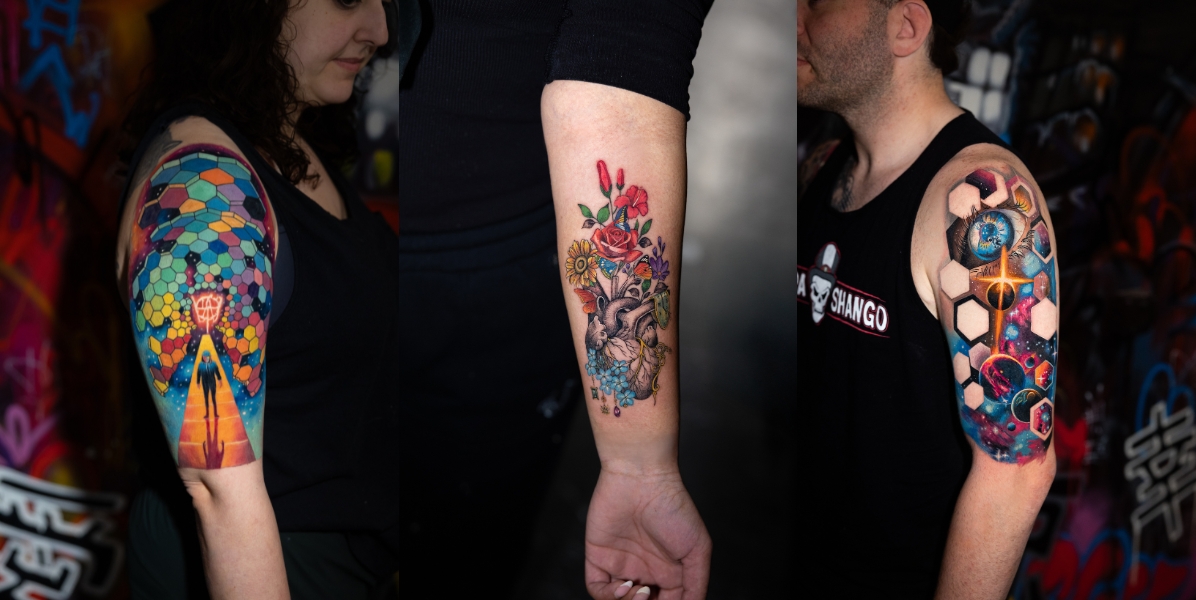
A cover-up is one of the most technically demanding things a tattoo artist can do. The new design has to be darker than what’s underneath, large enough to contain it, and strong enough compositionally to stand on its own. And it has to do all of that while hiding something that’ll always be trying to show through.
This is where Andersson’s range as an artist becomes practically useful. He’s been tattooing since 2008, which means he’s watched trends come and go, watched styles evolve, and watched what happens to ink over years and decades of real wear. He works in color realism, trash polka, watercolor, fine line, surrealism, and abstract styles. He’s applied all of them, watched all of them heal, and seen what they look like years later. So when someone comes in with something that needs to go, he’s not reading it from the outside. With nearly two decades in the industry, he understands how it was made, and that changes what he can do with it.
“A bad cover-up is just two bad tattoos,” Andersson says. “You have to know what you’re doing. You have to understand how ink sits in skin, how color works over color, and how to design something that solves the problem without creating a new one.”
That’s exactly the kind of work that requires the foundation Andersson spent years building. Color theory. Composition. An understanding of how pigment behaves over time. He approaches cover-up work the same way he approaches any large piece: listening to what the client wants, assessing what’s possible given what’s already there, and designing something that works with the body rather than against it.
If you’re carrying a tattoo you regret, whether you’re in New York or flying in from somewhere else, First Class Tattoos is at 52 Canal Street in Manhattan. Mikhail Andersson’s work is documented on Instagram at @mikhailandersson. For consultations and appointments, visit firstclasstattoos.com.