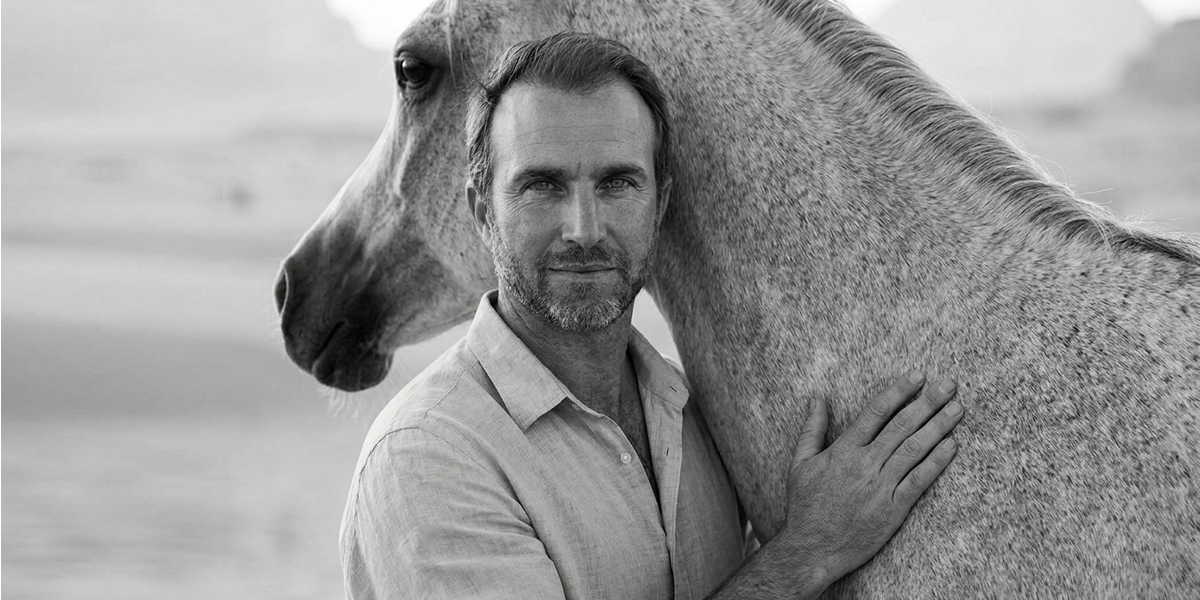


Twenty-five years. One subject. Collections in more than thirty countries. How a Brazilian photographer built a distinctive voice in a category the art world is finally taking seriously.
There is a particular kind of artist the contemporary market rarely produces: one who chooses a single subject, refuses to waver from it for a quarter of a century, and emerges not with a niche following but with a global collector base that spans more than thirty countries. Raphael Macek is that artist. And the subject he chose, the horse, turns out to have been one of the more consequential bets in recent fine art photography.
Today, Macek’s limited-edition prints hang in private residences from Palm Beach to Riyadh, from São Paulo to Singapore. His work has been shown at Paris Photo, a leading international fair dedicated to the photographic medium, and at Art Basel Miami, where the contemporary market sets its prices and its hierarchies. His monograph, Equine Beauty: A Study of Horses, published by the German house teNeues in 2013, circulates in five languages. His collector base does not churn. It accumulates. And the secondary market for his editions has held its pricing structure in a way that serious collectors notice.
None of this happened quickly. And none of it happened by accident.
The Foundation
To understand why Macek’s work commands the attention it does, it helps to start at the beginning, specifically, at a horse farm outside São Paulo, where he spent the first years of his life. His father was a veterinarian who bred racehorses for the São Paulo Jockey Club. His mother, when Raphael was barely a year old, moved the family to the farm. He would live there until the age of eight, among horses, not as a spectator but as a constant presence. His mother’s account of those years, which he repeats with precision: “I always needed to ask you to come inside, because you were always outside with them, at the field, living with them like one of them.”
That formation, bodily, instinctive, learned before any formal visual education, is the bedrock of every image he has made since. Alongside it, an entirely different inheritance was taking shape. The Macek household was one of readers, museum visitors, and art lovers. The boy who learned patience at a horse’s feet was also learning, on weekends in galleries and concert halls, that beauty was a discipline rather than an accident. Two educations, one physical and one cultural, quietly fused. He has been working in the space between them ever since.
“One hundred and fifty megapixels. Zero prompts. Twenty-five years. Not twenty-five prompts.”
Raphael Macek
The Discipline of One Subject
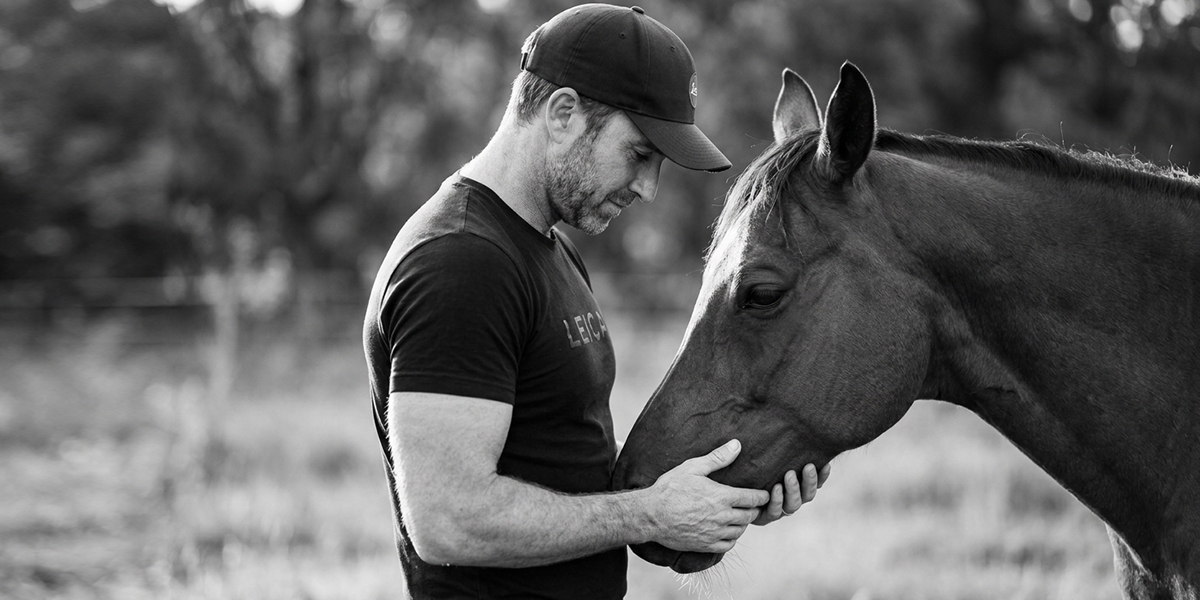
Macek began photographing horses professionally twenty-five years ago, working first in natural light, then building out studio techniques that, at the time, almost no photographer was applying to equine portraiture. He pursued a single objective with what he describes as deliberate isolation: he has, by his own account, avoided studying the work of other equine photographers, on the grounds that he did not want his visual language contaminated by anyone else’s vocabulary.
The result is immediately legible. There is no Stubbsian inheritance in the work, no echo of the sentimental equestrian tradition that has dominated the genre for two centuries. The horses in Macek’s photographs are treated with the formal seriousness of sculpture, the lighting discipline of a master printer, the tonal command of black-and-white photography that knows precisely what it is doing.
His most recent body of work, the collection Over the Dunes, took that formal discipline to its furthest point yet. Shot in the desert of the Emirates at dawn and dusk, the series returns Arabian horses to the landscape that shaped them: vast dunes, monochrome light, and the geometry of a herd moving on ancestral terrain. The process was neither easy nor brief. It required years of relationship-building with Emirati families whose horses carry legendary bloodlines. It required days in the summer heat that reached 45 degrees Celsius. It required what Macek describes as a nearly monastic patience: he does not direct the horses, does not arrange them in the landscape, does not interfere. He waits. The image, when it arrives, arranges itself.
The Infrastructure of Collecting
What separates Macek from photographers who simply make images is the architecture he has built around the work. Some years ago, he founded InnFRAME, his own large-format archival printing studio in South Florida. Every limited edition that leaves his name passes through that studio, personally touched, inspected, and approved. The papers are Hahnemühle 100% cotton rag, with a permanence rating exceeding two hundred years. Editions are capped at twelve per size, each numbered, each signed, each accompanied by a certificate of authenticity that the studio retains in perpetuity.
Prices range from a $6,500 entry point for smaller works to more than $23,000 at the top of the size matrix. Galleries on three continents represent the work at consistent international pricing, a discipline that protects long-term value in a way that matters to serious collectors. The economic effect is the kind that makes art world strategists pay attention: a steady, liquid market, free of the discounting that dilutes edition value over time.
Why It Matters Now
Macek’s position in the current market is amplified by a broader conversation that has arrived, somewhat urgently, around authenticity in photography. His guiding philosophy, distilled in the phrase Real Will Always Be Rarer, argues that in an era of synthetic imagery generated at near-zero cost by machines that have never stood in a desert at four in the morning, the photograph that was actually made, by an actual human being, in an actual place, will not lose value. It will gain it. Because scarcity is, ultimately, what the luxury market prices.
That argument, two years ago, might have read as a niche position. Today, it reads as a timely one. And Macek, who is by nature a quiet operator, has been making it, not in words, but in the accumulation of a body of work that no algorithm can replicate and no prompt can produce.
His parallel role as Official Creative Ambassador for American Wild Horse Conservation adds a dimension that pure market success rarely provides, rooting the commercial career in a conviction that the horse, which made human civilization possible, is owed something back.
Twenty-five years in, the man behind this body of equine fine art is still at it, still waiting in the landscape, still reading the light, still lifting the camera only when the moment has arranged itself in front of the lens. The collector base, by every measure, is paying attention.
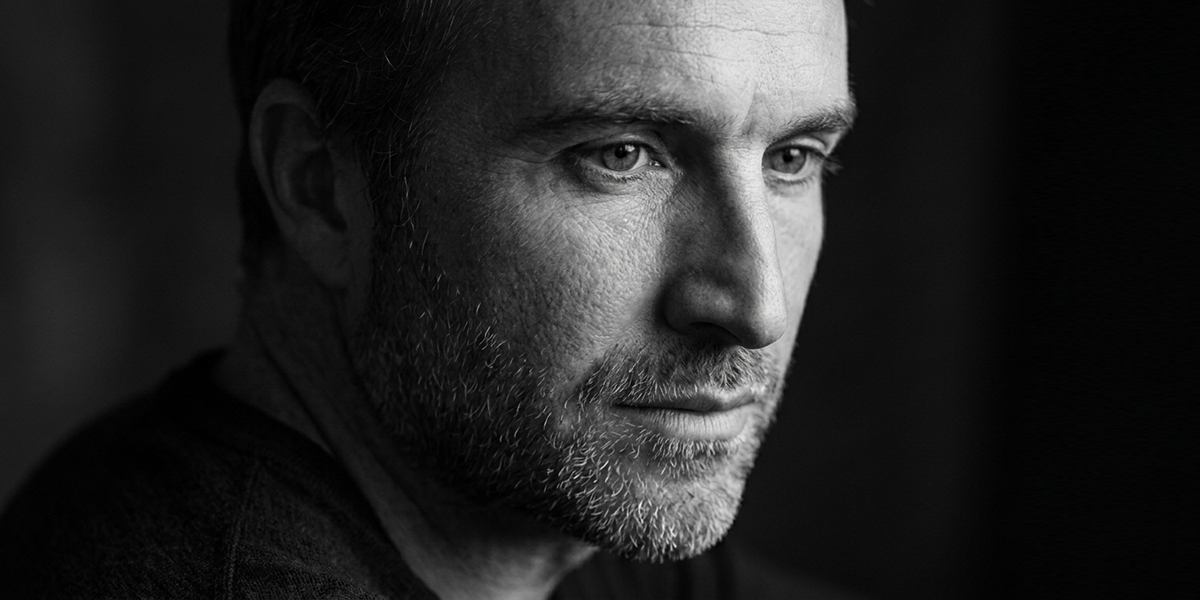
Raphael Macek is represented internationally by Raphael Macek Fine Art Group LLC. Works are held in private collections across more than thirty countries. Acquisition inquiries: raphaelmacek.com · gallery@raphaelmacek.com