
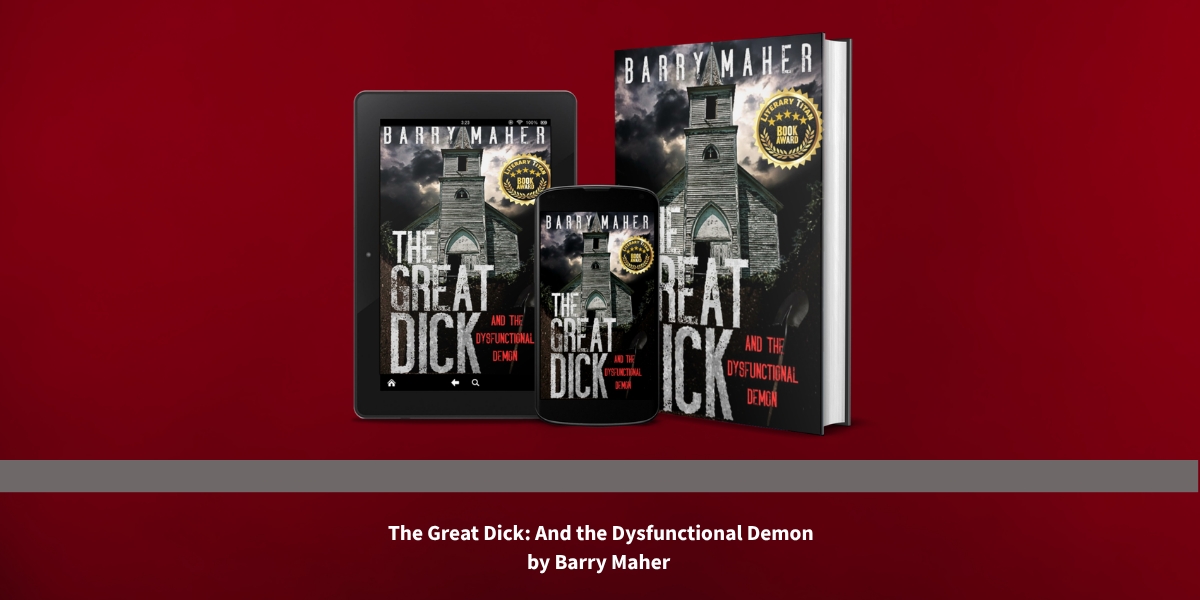




By: Nick Davis
Most horror novels want to scare you. Barry Maher’s The Great Dick wants to scare you and make you laugh and make you slightly ashamed of how much you’re enjoying yourself, sometimes within the same paragraph. That combination of effects is rarer than it should be in the genre and harder to execute than it looks, and the fact that Maher pulls it off across nearly five hundred pages while maintaining a narrative voice that feels consistently alive and surprising is the first thing worth saying about this book.
The experience of reading it is genuinely unusual. There’s a late-night quality to the prose, the feeling of a story being told to you by someone who is a little too alert, who notices things at angles you wouldn’t have thought to look from. Steve Witowski narrates his own catastrophe with a self-awareness that is both funny and quietly devastating, and Maher uses that voice to smuggle in genuine emotional complexity underneath the dark comedy exterior. You find yourself laughing at something and then sitting with a small uncomfortable feeling that the thing you just laughed at was also kind of true about human nature in a way you weren’t expecting to confront in a horror novel set in 1982 California.
The themes the book circles are ones that horror has always been good at approaching from sideways angles. Skepticism as a form of self-protection that eventually becomes its own danger. The way the past accumulates in a body and in a life until it starts demanding acknowledgment. The particular loneliness of someone who has made enough bad decisions that they’ve stopped expecting things to go well, and what it takes to crack that open. Maher grounds all of this in character rather than concept, which is why it resonates rather than just sitting there as thematic furniture. Steve’s disbelief in the supernatural is never played purely for laughs. It’s a portrait of a man who has learned to keep his head down and is about to find out that strategy has a ceiling.
What Maher does stylistically that sets this book apart is the way he layers registers without ever losing control of the tone. A scene can move from genuinely funny to genuinely frightening without it feeling like a gear change, because the humor and the horror in this book come from the same place. They’re both responses to a world that is stranger and more threatening than we usually let ourselves acknowledge. The abandoned church, the occult rituals, the coastal California atmosphere all contribute to a setting that feels lived-in and specific rather than generically spooky, and that specificity is what gives the supernatural elements their actual weight.
Barry Maher wrote this book after surviving brain surgery and it shows, not in any morbid way but in the sense that the story has the texture of something that mattered enormously to its author. You can feel throughout that this wasn’t a project. It was a reckoning. For readers who want their horror to come with genuine wit and genuine feeling underneath the blood and the dread, this one is exactly what you’ve been looking for and probably didn’t know it.
If you’ve ever wanted a horror novel that makes you laugh out loud and then immediately feel unsettled about the fact that you just laughed, The Great Dick: And the Dysfunctional Demon is waiting for you on Amazon. Pick it up, clear your evening, and prepare to meet Steve Witowski. He’s a mess. You’re going to love him.

