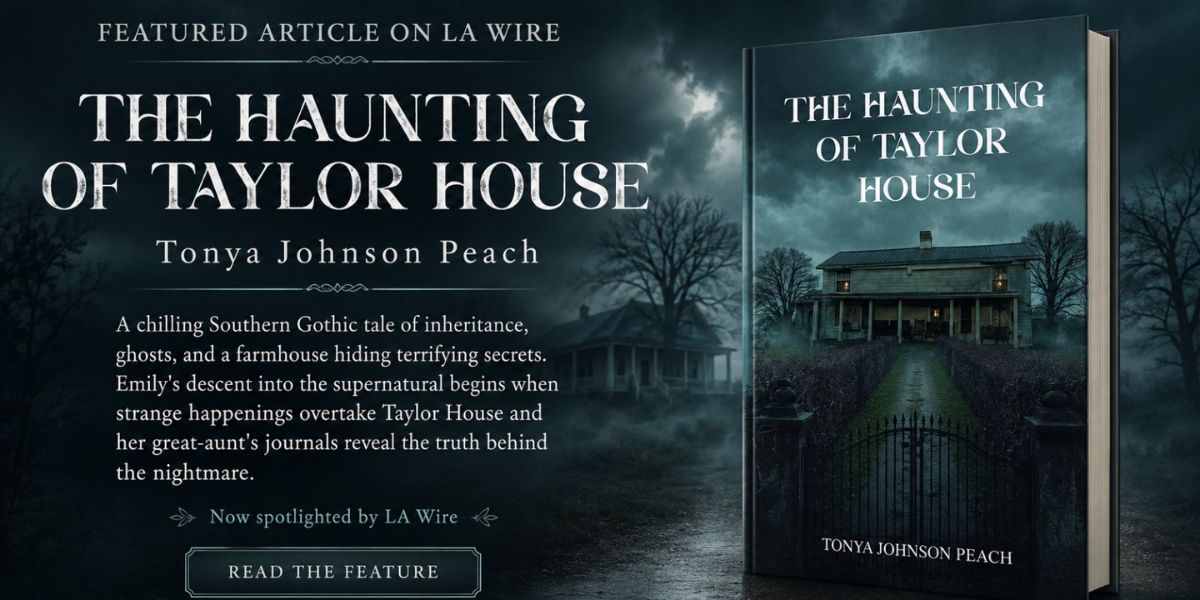





Tonya Johnson Peach’s debut novel leans into every Southern Gothic trope it can find, and mostly earns the indulgence.
There’s a particular kind of fantasy buried inside every haunted house story: someone, somewhere, is going to inherit a beautiful old farmhouse and a pile of money from a relative they barely knew, no student loans or home inspections required. Tonya Johnson Peach’s debut novel, The Haunting of Taylor House, leans all the way into that fantasy before quietly reminding readers what usually comes attached to old family land, old family secrets, and in this case, the people who died keeping them.
The book opens in violence and doesn’t apologize for it. A prologue set generations earlier introduces William Grimmwood, a farmer who murders his wife and turns on his two young daughters when they catch him in the act. The girls fight back with farm tools; one of them, thirteen-year-old Emelia, manages to kill him before bleeding out herself. It’s a brutal, almost fairy-tale-grim opening, and it sets the terms for everything that follows: this is a house built on a bad bargain, and somebody is going to have to settle the debt.
Cut to the present day, where Emily Taylor, an overworked accountant sharing an apartment with two roommates and quietly burning out at her firm, learns that her great-aunt Emmaline has died and left her the family farmhouse, plus a inheritance large enough to fund a new life. The setup is pure wish-fulfillment, right down to the handsome, recently-single lawyer, David Matthews, who hand-delivers the news and then volunteers to sleep on her couch so she won’t be alone in a strange house on her first night. Peach knows exactly what kind of book she’s writing, and the romance subplot between Emily and David moves with the unhurried, slightly clumsy charm of small-town courtship: a shared dinner, an apron joke, hands that linger a beat too long.
Where the book finds its real footing is in the haunting itself, which starts small and stays that way for a satisfying stretch. Earrings vanish from a dish and reappear somewhere else. Pots clatter in an empty kitchen. A door won’t stay shut, no matter how many contractors swear they’ve fixed the hinge. Peach is at her best in these early chapters, where the horror is domestic and almost funny, Emily gaslighting her own renovation crew rather than admit the house is haunted is one of the book’s sharper running bits. It’s only later that the story reveals the fuller shape of what’s lingering in the farmhouse: not just mischievous spirits, but the unfinished business of the women who died protecting it, and the one who didn’t, still circling the property generations on.
The prose is plain and occasionally over-explains itself, characters announce their feelings as often as they show them, and exposition tends to arrive in long, unbroken paragraphs of backstory. Readers looking for restraint or ambiguity won’t find much of either; this is a book that prefers its ghosts (and its romance) stated plainly rather than implied. But there’s a sincerity to that directness that’s hard to dismiss. Peach isn’t interested in subverting the haunted-house novel or the small-town romance, she’s interested in giving both genres exactly what their fans show up for, generation after generation of inherited trouble included.
The Haunting of Taylor House won’t be mistaken for literary horror, and it isn’t trying to be. It’s comfort-read horror: gruesome enough in its opening pages to earn the genre label, sentimental enough in its closing ones to land on a wedding date instead of a body count. For readers who want their ghost stories to end in a porch swing rather than a graveyard, Peach delivers, and sets up a sequel, Secrets of Witchery Hollow, that suggests Taylor Lane isn’t done giving up its history yet.
Website link https://a.co/d/0b3NnG9B