



By: Kate Sarmiento
Black Friday 2025 brought in $11.8 billion in US online sales (Source: Adobe, 2026). Online apparel discounts that season peaked at 25.1 percent off list price, up from 23.2 percent the year before (Source: Adobe, 2026). A brand’s own sales report does not show what its competitors were charging during any of it. ShopVision, a Market and Competitive Intelligence platform for brands and retailers, was built to show teams what their competitors are doing alongside their own results.
Pricing, promotion, and assortment decisions sit with marketing, ecommerce, pricing, and merchandising teams. ShopVision’s view is that many of them make those calls with incomplete data, delayed insight, and too much gut feel, and that this contributes to rising customer acquisition costs, missed sales, and margin that erodes without a clear explanation. This article covers what that costs, what competitor price monitoring shows, and where people still make the call.
Your Sales Report Shows Half the Story
Internal data is good at recording change. It can show that clicks, conversions, revenue, or margin moved. It cannot explain why when the cause sits outside the company. A competitor may have launched a promotion, cut a price, changed its advertising, restocked an important item, or introduced a new product. None of that appears in a sales report.
ShopVision describes many brands as relying on spreadsheets, manual searches, delayed reports, and instinct to track competitors. That approach can lead to late reactions, misread demand, and prices set with only part of the picture. A drop in conversions could point to a weak product, a weak ad, or a competitor who lowered a price that week. The dashboard shows the drop but cannot tell which cause is behind it.
Peak season makes this harder to ignore. Adobe tied the 9.1 percent growth in Black Friday online sales to more shoppers taking advantage of deals from home (Source: Adobe, 2026). Discounts also moved differently by category. Sporting goods discounts peaked at 20.3 percent off list price, up from 19.5 percent, while furniture slipped from 19 percent to 18.8 percent (Source: Adobe, 2026). A team that sets its discount without knowing where rivals are pricing can land too shallow to compete or go deeper than it needed to, which costs margin.
Competitor Price Monitoring Works When It Shows What Changed and What to Do Next
Knowing what changed only helps when it connects to the products a team actually sells. ShopVision’s platform is built to show what changed in the market, what is happening now, and what to do next. It draws on a dataset of more than 300,000 brands, retailers, and marketplaces, with 15 million products tracked daily.
Price comparison starts with matching. A team has to know which competitor product is the same as its own, or close enough to count, and equivalent products do not always share a universal product code. ShopVision uses LLM-based web agents that read competitor sites in a way that resembles how a person reads them. The agents match exact and equivalent products. Each match comes with a confidence score and the reasoning behind it, and prices are refreshed daily.
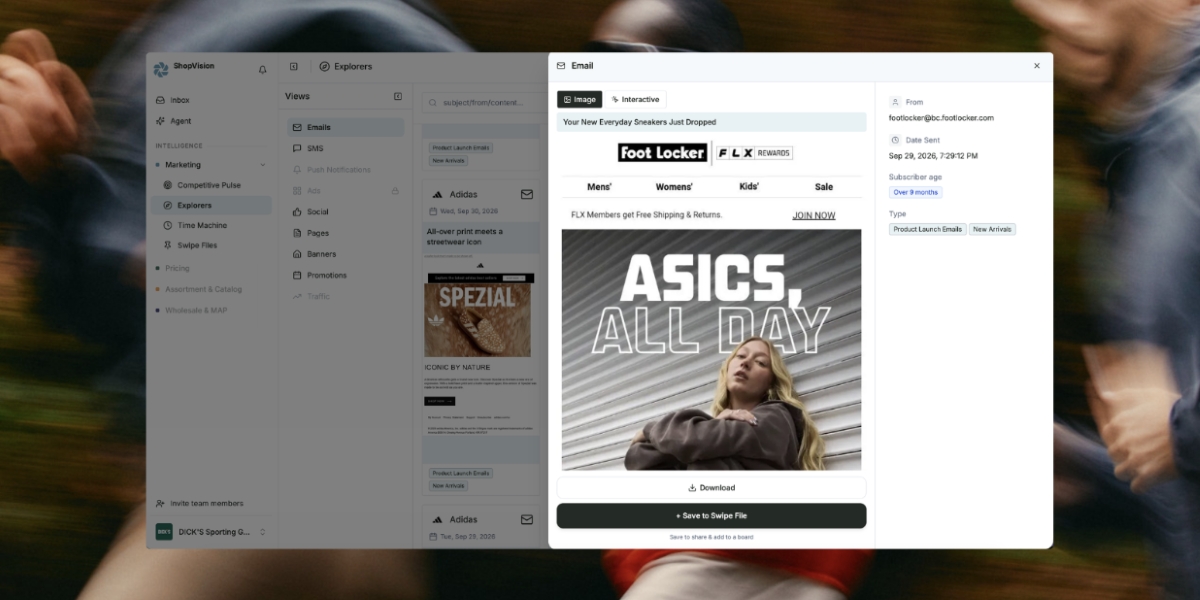
Prices are only part of the picture. Competitor promotion tracking covers ads, promotions, emails, and campaigns as they go live. ShopVision pairs it with an action plan so marketing teams can respond within hours. Assortment and catalog tracking shows what competitors and the wider category are launching, dropping, and restocking, which helps merchandising and buying teams plan with the market in view. Pricing, marketing, assortment, and wholesale channel intelligence all run on one dataset and one matching layer, so information collected in one area strengthens the view in the others.
None of this replaces judgment. Matching software can be wrong, which is why the confidence score and the reasoning are shown. A team member can read why the system paired two products and then approve or reject the match. A competitor’s price cut can be a clearance, a mistake, or a real shift, and telling which takes category knowledge and a view on brand strategy. ShopVision cannot guarantee lower acquisition costs, higher sales, or protected margin. It shows teams what changed so they can decide which moves deserve a response.
The Tools for Watching Rivals Are Changing
The tools behind competitive intelligence are under pressure too. Wiser Solutions, a software company that collects data from retailers, filed for Chapter 11 protection in a Texas federal bankruptcy court in late April 2026 (Source: Bloomberg Law and Law360, 2026). One filing says little about an industry, and the reasons behind it belong to the court record.
Shoppers are changing too. Traffic to US retail sites from generative AI tools rose 693.4 percent during the 2025 holiday season, although Adobe noted that the base of users remains modest (Source: Adobe, 2026). If AI tools take a bigger role in shopping, brands’ own AI tools will need accurate market data. ShopVision’s MCP connector lets approved AI tools query the same intelligence its human users see. This is a forward-looking argument, and the evidence so far covers shopper behavior only.
Put the Rest of the Market on the Agenda Before the Next Promotion
Internal numbers belong in every pricing and promotion meeting, and the outside view deserves a standing place beside them. That means competitor price monitoring, promotion tracking, and assortment tracking, reviewed by the people who set prices and plan campaigns. ShopVision’s perspective is that Black Friday is decided in hours, not days. A team already watching its competitors can spend those hours choosing a response.
Leaders can test the idea this week. List the products that drive the most revenue and the competitors shoppers compare them against. Then count how many of last week’s price and promotion changes at those competitors the team knew about in time to act. Teams that want that view every day can look at the ShopVision Market and Competitive Intelligence platform and decide what their next pricing meeting should be able to see.