




Population growth and healthcare demand move together, and North Carolina is generating both faster than almost any other state in the country right now. For facilities, clinics, and home health agencies across the state, that growth translates into a very practical reality: the volume of supplies needed to serve patients is rising steadily, and the supply relationships that worked two years ago may no longer be adequate for the scale of today’s patient load.
North Carolina’s population grew by 756,000 people over the five years from 2020 to 2025, a 7.2 percent increase that ranked as the strongest five-year growth rate of any state in the nation, with the total population reaching an estimated 11.2 million by July 2025, according to newly released U.S. Census Bureau data. Healthcare system demand grows alongside population, and North Carolina’s physician workforce has expanded 24.5 percent over the same decade to keep pace. The supply chain supporting that expanded workforce, from surgical supplies through monitoring equipment and infection control products, carries an equivalent scaling obligation.
What Medical Equipment in North Carolina Facilities Requires

The range of equipment and supplies used across North Carolina’s healthcare settings covers a broad spectrum, and understanding which categories carry the most operational weight helps facilities prioritize sourcing relationships accordingly.
At the consumable and protective layer, nitrile gloves and PPE supplies form the baseline for every patient interaction across every setting. Exam table paper and underpads are the kind of high-turnover items that run out faster than procurement teams typically anticipate, particularly in practices experiencing patient volume growth. Surgical gauze rounds out the procedural consumable layer for outpatient and surgical settings.
Wound care supplies have become a particularly significant category in North Carolina given the state’s aging population and rising rates of diabetes-related chronic wounds. Orthopedic supplies serve the rehabilitation and post-surgical population, which grows proportionally as surgical volume increases across the state’s expanding network of outpatient surgery centers.
Diagnostic and monitoring categories have expanded as more care shifts outside hospital walls. Patient monitoring equipment supports both inpatient oversight and the home-based care programs that the state’s rural population depends on for access. Oxygen therapy supplies and respiratory support equipment are similarly relevant across both acute and community care settings.
Physical therapy equipment supports the recovery layer downstream of surgical and injury care. Laboratory supplies and specimen collection tools support the diagnostic infrastructure that precedes most clinical decisions. For the procedural and surgical tier, surgical instruments and surgical drapes are categories where quality and sterility requirements set the standard for any supply relationship.
Medical Supply Cost Reference for North Carolina Facilities
Pricing across these categories varies by volume, specification, and supplier relationship. Below is a general cost reference:
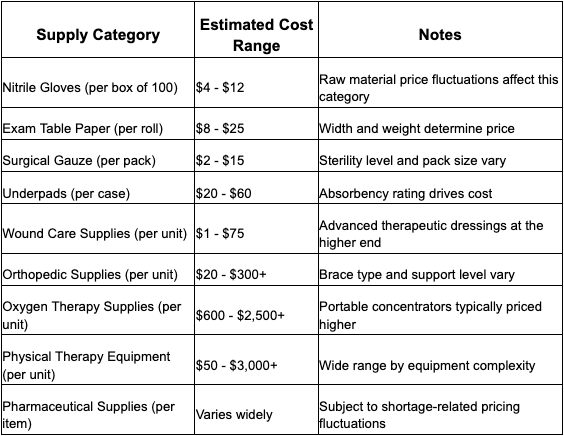
Sources: General wholesale medical supply pricing compiled from distributor catalogs and industry data (2025-2026)
Why Local and Regional Sourcing Matters in a Growing State
North Carolina’s growth is not uniform. The Research Triangle, Charlotte metro, and Wilmington coastal region have all expanded significantly, while rural counties face different supply logistics entirely. A hospital supply store or equipment supplier relationship built around regional delivery tends to perform better for facilities in secondary markets than reliance on national distribution alone, particularly for urgent mid-week reorders that cannot wait on standard shipping windows.
DME companies and wholesale medical suppliers with established North Carolina distribution networks are better positioned to serve both urban and rural facilities as patient volume continues growing across the state.
One Supplier Covering the Full Range
For facilities evaluating their sourcing across the categories above, consolidating vendors reduces administrative overhead and simplifies reordering. HSS Medical Supply is one option for facilities sourcing medical equipment in North Carolina, covering categories from wholesale medical supplies and DME through infection control supplies, laboratory supplies, and the clinical consumables that North Carolina’s expanding healthcare settings require.
As the healthcare supply market continues to evolve, businesses serving North Carolina’s growing population will need to focus not only on reliable operations but also on how effectively they reach their target audiences. Digital visibility can be an important part of that process, particularly for suppliers competing in an increasingly online marketplace. Professional SEO services from SEO Guru NYC can help businesses build a stronger presence in search and connect with relevant audiences.
Meeting the Demands of a Growing Healthcare Market
North Carolina’s continued population growth will place ongoing demands on the healthcare infrastructure serving its communities. For hospitals, clinics, home health agencies, and medical supply businesses, dependable sourcing, efficient distribution, and access to the right equipment will remain essential as patient volumes increase.
At the same time, suppliers that combine reliable products and regional service with a strong online presence can position themselves to reach more healthcare organizations and customers. As North Carolina’s healthcare network continues to expand, both operational efficiency and digital visibility will play an important role in helping businesses keep pace with the state’s changing needs.
Disclaimer: This article is for general informational purposes only and does not constitute medical, regulatory, or procurement advice. Product suitability, specifications, availability, and pricing may vary. Healthcare organizations should verify current information and consult qualified professionals before purchasing or using medical equipment or supplies.