





A resident near Downtown Culver City searches for a dentist on a phone. Before any scrolling, the screen fills with sponsored listings, a map showing three nearby practices and, increasingly, an AI-generated summary naming a few options. The first traditional organic result sits below all of it. Many practices operate within a short drive, and most never appear in that first view.
The number of businesses competing for those searches has not shrunk. The number of positions that actually win attention has. For Westside owners who have watched their local search rankings for years, the contest looks familiar on a report and very different on the phone.
Key Takeaways
- Fewer local search positions now earn clicks as ads, map results, and AI summaries crowd the page.
- The Google map pack and AI Overviews often narrow the shortlist before anyone visits a website.
- Dense competition across the Westside makes each visible spot harder to win.
- Proof signals such as reviews and third-party mentions tend to decide who fills the remaining spots.
- Searches tied to a specific service and neighborhood remain more open than broad citywide terms.
Local Search Rankings Now Have Fewer Openings at the Top
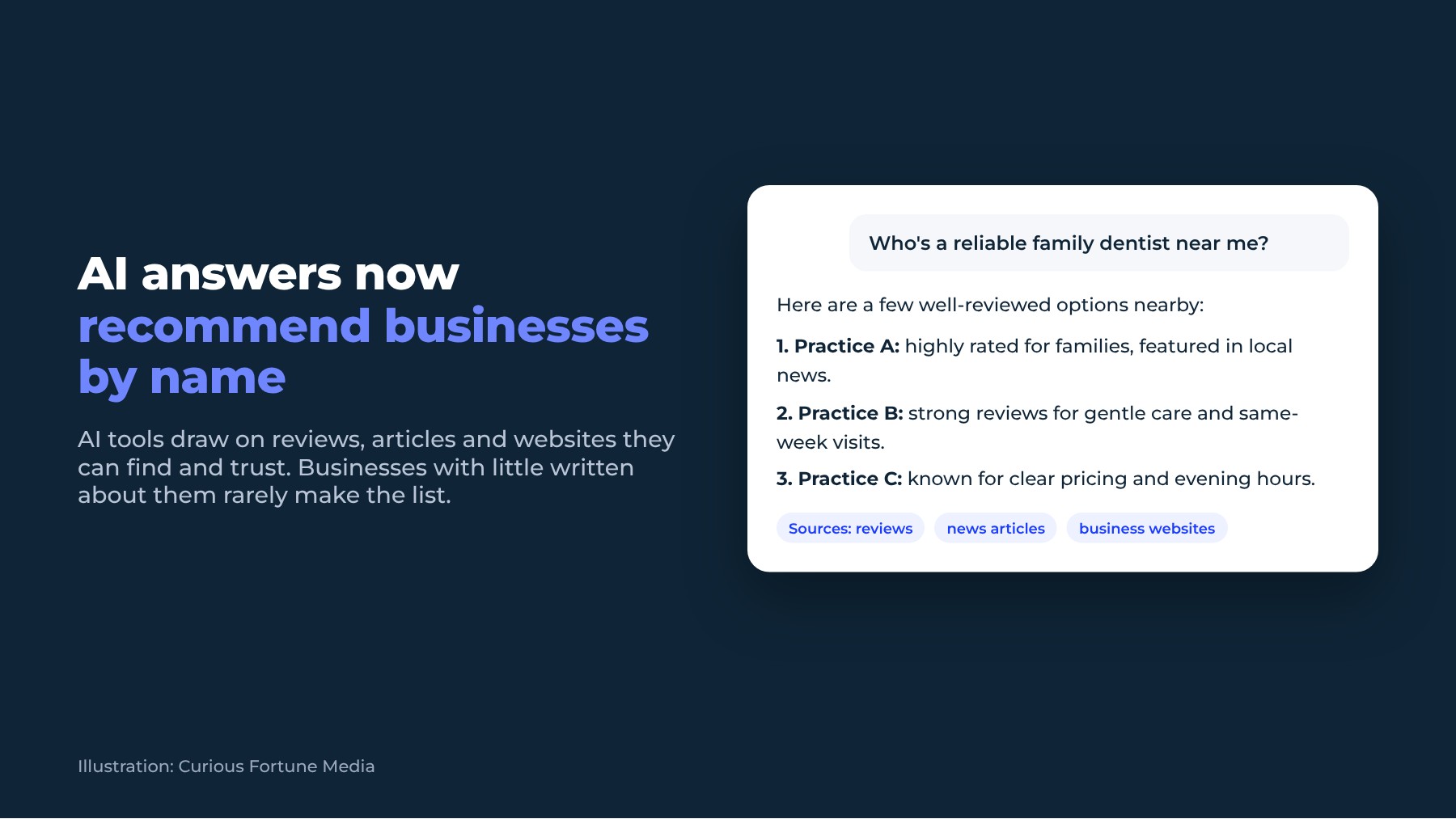
A typical local results page now stacks several layers above the traditional list of websites. Sponsored listings often come first, followed by the Google map pack, which shows three businesses. Increasingly, an AI Overview or a response in Google’s AI Mode summarizes options before any organic results appear.
AI summaries change behavior across Google searches generally, not just local ones. A 2025 Pew Research Center analysis of browsing data from 900 U.S. adults found that users clicked a traditional search result in 8% of visits when an AI summary appeared, compared with 15% when none did. Users also ended their browsing session on 26% of pages with a summary, compared with 16% of pages without one.
The pattern, often called zero-click search, means more decisions happen on the results page itself. A business can hold a respectable organic position yet sit below the point where most searchers stop looking.
On the Westside, a Crowded Market Meets a Shorter List
The squeeze is sharper on Los Angeles’ dense Westside. From Culver City through Santa Monica, Venice, Playa Vista and Marina del Rey, dental practices, law offices, wellness studios and contractors operate within a few miles of one another, and a single search can return several near-identical options.
Culver City businesses feel this in concentrated pockets, where similar providers along Washington Boulevard or around Downtown Culver City sit within a few blocks.
“When there are a dozen similar businesses within a few blocks, people don’t scroll through all of them,” said Edmond Abramyan, founder of Curious Fortune Media, an agency that works with Westside businesses. “They pick from the three or four names in front of them. The contest isn’t really page one anymore. It’s the few spots that actually get looked at.”
What Decides Who Fills the Remaining Spots
Google’s guidance on local ranking says results are based mainly on relevance, distance, and prominence. Relevance and distance reflect how well a profile matches the search and how close the business is. Prominence reflects how well-known a business is, drawing on factors such as how many websites link to it and how many reviews it has. The guidance also states that you can’t request or buy unpaid local rankings.
AI-generated answers add another layer. AI Overviews and similar tools appear to favor businesses whose information is consistent and easy to verify across their websites, directories, reviews, and local press. That makes credibility part of visibility, not just something a buyer weighs after clicking.
Abramyan developed the Authority Engine™ at Curious Fortune Media with that overlap in mind. Its three layers, visibility, authority, and conversion, run as one system because the proof that earns a scarce position often persuades a buyer to call.
One example is The Balloon Guy, a Los Angeles luxury event decor company. After Abramyan’s agency rebuilt its website and paired the SEO work with content and press, the business was named in Google’s AI Mode, the kind of short answer where only a few local names appear.
Where Smaller Businesses Can Still Compete
Broad citywide searches are often the most crowded at the top. Narrower searches tied to a specific service and neighborhood tend to be more open, and they often come from people closer to a decision.
The groundwork is familiar but often incomplete: a complete, active Google Business Profile with accurate categories and service areas; a steady flow of genuine, recent online reviews; and pages that directly answer buyers’ questions about a specific service in a specific area.
“A business that keeps losing the citywide search can still win the one that names its service and its neighborhood,” Abramyan said. “When the page only has room for a few names, the ones that get picked usually have proof that’s easy to see: real reviews, real local mentions and clear answers.”
There are limits. Positions shift, AI answers can change from one search to the next, and no provider controls where a business appears. Proof builds over months, not weeks, and results vary by industry and neighborhood.
For Westside owners, the contest has moved from being on page one to earning one of a few visible spots. That may mean less effort chasing broad citywide terms and more on proof signals and neighborhood-level searches. As AI answers expand, the businesses named may be the ones whose credibility is easiest to verify, not the ones with the biggest budgets.
Frequently Asked Questions
Why do fewer businesses appear on the first screen of local search?
Sponsored listings, the three-business map pack, and AI-generated summaries now often sit above traditional organic results, leaving fewer visible positions for individual websites.
What helps a business appear in Google’s map results?
Google says local results depend mainly on relevance, distance, and prominence, including reviews and links from other websites. A complete, accurate Google Business Profile is the starting point.
Can a small business still compete in local search rankings?
Often, yes, particularly for searches tied to a specific service and neighborhood. Progress typically takes months, and no one can guarantee a position.