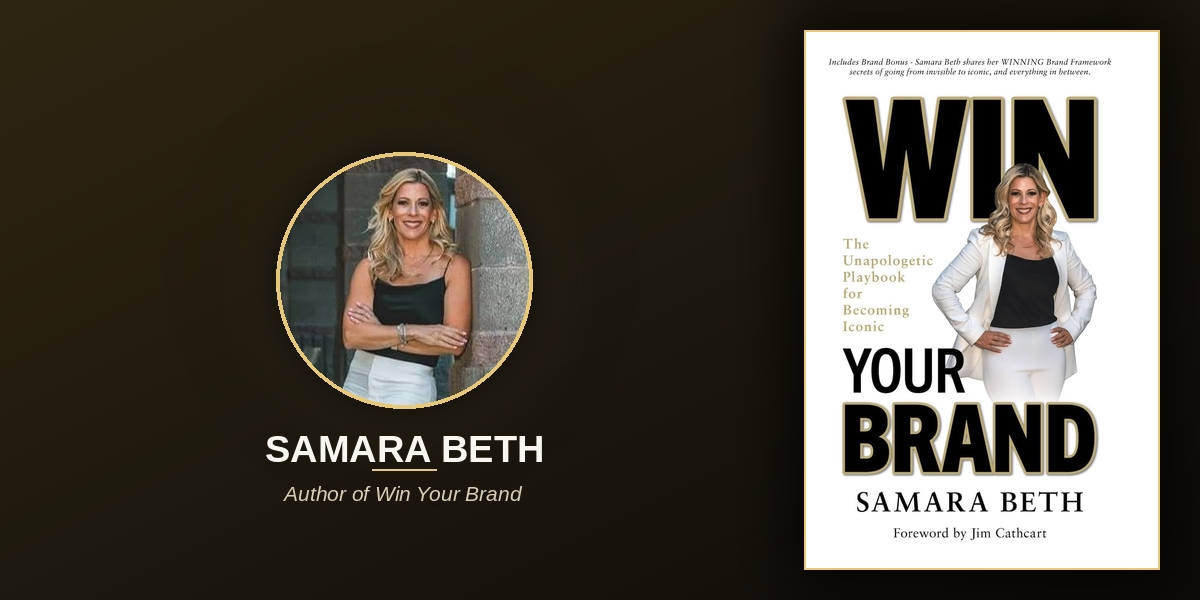


There is a particular kind of expertise that cannot be acquired through study or certification or even decades of professional practice in comfortable circumstances. It can only come from having been through enough that the lessons stop feeling like lessons and start feeling like the actual shape of your life. Samara Beth has that kind of expertise. And Win Your Brand: The Unapologetic Playbook for Becoming Iconic is the most complete version of what she has learned from living it.
She has lived in 31 homes across 13 major cities, ten states, and two countries. Not as an adventure or a lifestyle choice. As instability. Every time she rebuilt a home, she had to rebuild an identity alongside it, earning credibility and recognition all over again in a new city where nobody knew who she was or what she had built before she arrived. That experience, repeated enough times to become a kind of forced curriculum in resilience and reinvention, is where the brand philosophy she now teaches came from.
The biggest break of her career came when COVID ended Celebrations By Samara, the event company she had built and run for twelve years. That business was her identity in the fullest sense. When it ended, she had to confront a question that most entrepreneurs never face so directly or so urgently: was she the business, or was she the person who built it? The answer she found in that difficult space became the foundation of everything she teaches now.
Where Badass Bamboo Comes From
The metaphor Samara has built her brand philosophy around is not accidental or decorative. Bamboo spends years underground building roots before it ever shows above the surface. From the outside, nothing appears to be happening. Then it shoots up faster than almost any plant on earth. That sequence, roots first and growth second, is the exact order she teaches entrepreneurs.
Before you focus on being seen, you have to build the root system: your story, your credibility, your reason for existing, the foundation that will hold the weight of everything you’re about to build. Skip that step and the growth won’t hold. The visibility comes too fast and without the foundation to support it, and eventually it collapses back to where it started. She didn’t choose that lesson through intellectual discovery. She lived it enough times that she finally understood it in her bones.
That distinction matters enormously for how she teaches it. A framework handed down by someone who has never truly been tested carries a different weight than one earned through repeated failure, loss, and rebuilding in conditions that weren’t chosen. The credibility in the book comes from the fact that she has been in it, not merely adjacent to it.
Event Production as Branding School
Of all the industries Samara has worked across in her career, she names event production as the one that taught her most about what makes a brand iconic rather than simply well-executed. Thirty years of producing live events gave her a front-row education in the difference between those two things, a difference that most branding professionals never see up close because they have never had to deliver an experience in real time to a room full of people with expectations.
A well-executed event hits every checkbox. Nothing goes wrong. People say that was nice and go home. It was professional and correct and completely forgettable. An iconic event makes people feel something they were not expecting to feel. An immersive, experiential event creates a story they tell five years later. That is the entire distinction. Execution is invisible when it is working. Iconic is the thing you cannot stop thinking about.
Brands work the exact same way. A well-executed brand is polished and consistent and forgettable. An iconic, immersive brand takes a risk on being felt, on creating an impression that sticks rather than one that simply doesn’t offend. Samara brings that instinct from the event floor into every brand she builds and every entrepreneur she works with, because the lesson holds across both worlds with remarkable consistency.
Trust as the Real Currency
The thread that connects Samara’s recognition across vastly different categories, including a NACE National Best Team Event Award, ILEA Crystal Icon Awards, Evergreen Best Public Relations Strategist in Arizona, Best of Best Experiential Brand Marketing Strategist for Entrepreneurs in Phoenix, and a Heart of Humanity Best Book Award, is not the specific domain of any one of them. It is trust. Those categories don’t usually overlap, but they are ultimately judging the same underlying thing: did this person deliver something real that holds up under scrutiny?
That is the foundation of Win Your Brand. She doesn’t teach visibility tricks or personal branding tactics designed to manufacture an impression of authority. She teaches trust as the actual currency of a sustainable brand, the thing that converts attention into loyalty and visibility into real business. Build something true, with conviction and consistency, and it travels further and lasts longer than anything flashy. The recognition across different rooms and different industries is simply the accumulated proof of that belief lived out over decades.
She is also five feet tall, and people are consistently surprised when they meet her in person after video calls, having expected someone taller based on the confidence they encountered on screen. That detail, she says, matters more than it might initially appear. Confidence, consistency, and congruence produce trust. Trust makes an impression that has nothing to do with physical height or any other surface characteristic. That is exactly the point she builds the entire book around.
If you’re ready to stop building a polished brand and start building a trusted one, Win Your Brand by Samara Beth is available now on Amazon.