



Online degree programs for working adults rarely struggle to generate interest. Inquiry forms fill up, and the lead dashboard looks healthy. The trouble starts further down the funnel.
Only a small share of those inquiries turn into enrollments. Some students who do enroll withdraw before the first term ends. Admissions advisers, meanwhile, spend most of their day on inquiries that go nowhere.
To show how a program provider can focus on students who will start and stay, IntentLogic has released a case study on scoring adult learners for both enrollment and first-term persistence. The figures are modeled projections from an illustrative scenario, not reported results from a live client engagement. They show how outreach can favor students who are a good fit for the program.
Choosing the Right Outcome to Predict
Every scoring model rewards the outcome it is trained on. That choice shapes who gets contacted.
- Targeting inquiries: this rewards curiosity, not commitment.
- Targeting enrollment alone: this can reward poor-fit students who later withdraw, which serves neither the student nor the school.
- Targeting enrollment followed by continuation: this targets students likely to start a program and stay past the first term.
In this scenario, the provider chooses the third outcome.
Six Data Signals Behind the Model
The model draws on six signals, each adding a different view of readiness and fit:
- Career transition indicators (Life Events): the strongest trigger for adult study.
- Program research depth (Behavioral Intent): sustained research across several weeks signals serious interest.
- Preferred contact channel and time (Channel Response): working adults often respond outside office hours.
- Prior course or certification activity (Transactional): recent learning shows readiness for further study.
- Household composition (Household and Property): this informs which study format fits the learner’s life.
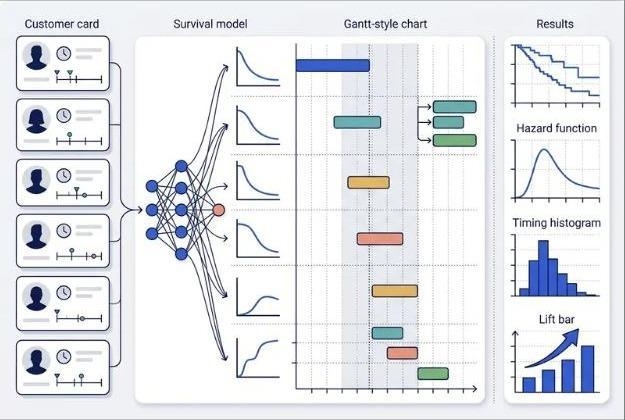
- Time since first inquiry (Behavioral Intent): interest fades without timely follow-up.
A Five-Step Modeling Approach
The approach follows the IntentLogic data and methodology framework.
1. Define the Outcome Carefully
The target is enrollment followed by continuation past the first term. It is not the inquiry, and it is not enrollment alone.
2. Model in Two Stages
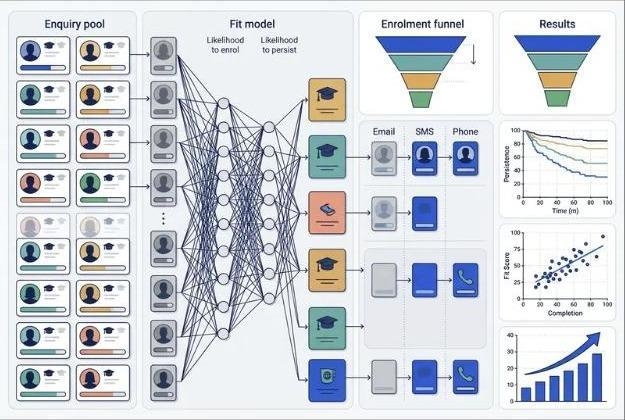
One model estimates the likelihood of enrolling after an inquiry. A second model estimates persistence among those who enroll.
3. Match Program to Background
A classifier suggests the program area that best fits each prospect’s history. That suggestion guides the content each prospect sees.
4. Prioritize Adviser Time
Inquiries are routed by combined score. Advisers contact the best-fit prospects first, at the times those prospects prefer.
5. Test and Review
A withheld group measures incremental enrollments. Outcomes are reviewed by segment before the model is extended to more programs.
Model Output: How the Score Separates the Audience
Split into ten deciles, the rate of enrollment with first-term continuation looks like this, indexed to an audience average of 100:
- D1: index of 260
- D2: index of 195
- D3: index of 152
- D4: index of 120
- D5: index of 94
- D6: index of 70
- D7: index of 48
- D8: index of 32
- D9: index of 18
- D10: index of 11
This is the flattest curve among IntentLogic’s modeled scenarios. It reflects a long, personal decision. Even so, the top decile performs at more than 23 times the rate of the bottom decile.
Modeled Outcomes: What Changes When Budget Follows the Score
Shifting from inquiry volume to scored, fit-based outreach produces three headline changes in the modeled scenario:
- 2.6x top-decile enrollment rate: relative to the audience average.
- 24% lower cost per continuing student: compared with a program built around inquiry volume.
- 36% fewer adviser contacts per enrollment: from score-based routing.
Indexed to a broad-targeting baseline of 100:
- Cost per continuing student: 76 for the scored audience, a 24% reduction.
- Inquiry-to-enrollment rate: 133 for the scored audience, a 33% increase.
- Adviser contacts per enrollment: 64 for the scored audience, a 36% reduction.
For admissions teams, the last number is the most practical. Advisers spend more of their day with students who are ready to start.
Data and Compliance Safeguards
Education marketing involves sensitive data and, in some cases, young people. The scenario applies four controls:
- Adults only: the model uses no data about minors.
- No student records: student education records are not used.
- Protected characteristics: these are excluded from the feature set.
- Segment review: outcomes are reviewed by segment before wider rollout.
What This Means for Education Marketers
Is your enrollment team measured on inquiries, on starts, or on students who complete their first term? The answer shapes every campaign that follows.
In education, the right target is a student who will continue, not an inquiry. Scoring for persistence ties marketing spend to the interests of the learner and gives advisers more time with the prospects most likely to succeed.
Read the full case study at https://intentlogic.com/case-studies/online-degree-enrolment
About IntentLogic
IntentLogic, operated by Intent Logic LLC, is a data science and precision marketing company. Its proprietary IRIS system analyzes a database of more than 245 million consumer profiles to identify high-value prospects and predict engagement strategies. The company runs coordinated campaigns across email, SMS, push, in-app, paid media, web, WhatsApp and audio. IntentLogic serves brands in financial services, automotive, health and wellness, insurance, retail and e-commerce, and education, with a focus on precise targeting, measurable outcomes and predictable growth.