



Neither product wins in general. Each wins in particular circumstances, and the circumstance is usually easy to identify once you ask two questions: do you know exactly how much you need, and will the thing you’re paying for generate cash quickly or slowly?
A line of credit gives you a limit you can draw against, repay, and draw again, usually with interest charged only on what you’ve used. A term loan gives you one lump sum, repaid on a fixed schedule from the first day. Find the situation below that looks most like yours and read the verdict. All businesses and numbers are fictional and illustrative, and your actual pricing will depend on your application.
Situation 1: You Buy Stock Ahead of a Busy Season
Marlowe Garden Supply needs $30,000 of inventory every spring and sells through it within about 90 days.
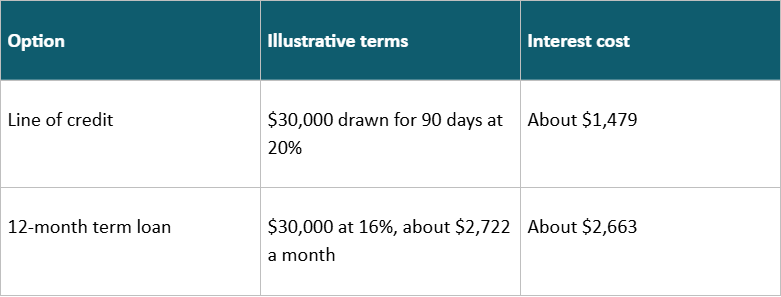
The line has the higher rate and the lower bill, because the money is out for only three months. The term loan keeps charging interest long after the stock has sold.
Verdict: line of credit. A provider’s description of revolving products, such as Fundivi revolving business credit lines, can help you check for draw fees and renewal terms before you assume the calculation above applies to your offer.
Situation 2: You’re Buying a Machine You’ll Use for Years
Tolland Print Works wants a $60,000 press with a useful life of well over a decade. A 36-month term loan at 14% would cost about $2,051 a month, or about $73,824 in total, including about $13,824 of interest.
A revolving line could technically pay for the press, but lines are often reviewed annually and may be reduced or called. Funding a long-lived asset with short-lived credit means you could be asked to repay before the machine has earned its cost.
Verdict: term loan. Match the length of the debt to the life of the asset, and compare a dedicated equipment loan too, since the machine itself may serve as collateral.
Situation 3: Your Customers Pay Late and Unpredictably
An electrical contractor’s clients pay anywhere from 20 to 70 days after billing. Some months the business needs nothing, and other months it needs $25,000 for three weeks.
A term loan would require a guess at the right amount, and then the owner would pay interest on the entire sum during the months it sat idle.
Verdict: line of credit. Uneven timing gaps are exactly what revolving credit was designed for. Draw when a payment is late, then pay down the balance as soon as the check clears.
Situation 4: You’re Refinancing Expensive Short-Term Debt
Suppose you’re carrying balances on several high-rate products and want one predictable payment. Moving that debt to a line can feel like relief, but revolving balances don’t force discipline. Many owners pay the minimum and watch the limit remain fully used.
A fixed schedule ensures that the debt actually ends on a known date. Check for prepayment penalties on what you’re paying off, and confirm that the combined cost really falls.
Verdict: term loan. Lenders have been drawing attention to this product lately, as in this Business Insider release on SBA-linked term loans, but a press release isn’t a quote. Run your own payoff comparison.
Situation 5: You Want a Safety Net You Hope Never to Use
A cafe owner with six months of steady profit wants protection against a broken walk-in cooler or a slow month. She doesn’t need money today.
A term loan would put cash in her account and start the payments immediately, which means paying to hold money she may never spend. With a line, she may owe little or nothing while it’s undrawn, though some lenders charge annual, maintenance, or inactivity fees.
Verdict: line of credit. Apply while the business looks healthy. Credit is generally easier to arrange before an emergency than during one.
Situation 6: A One-Time Expense Needs Cash This Week
A landlord’s deadline or a failed compressor doesn’t leave much room for a bank process. If you have no line in place, the decision comes down to which fast product you can actually obtain, and for qualified applicants some short-term options can be arranged quickly.
For a single defined bill, a short term loan gives you a clear end date. A line works just as well if one already exists and has room. A roundup of same-day unsecured working capital lenders shows the type of products in this category, but read any fast offer for total repayment and payment frequency, since urgency tends to raise the price.
Verdict: term loan, unless a line is already open. If you have an existing line with available room, use that instead of signing something new under pressure.
Situation 7: You’re Expanding and Can Forecast the Payoff
Opening a second location involves build-out, signage, and deposits, followed by a long ramp before the site pays for itself. The amount is known, and the return arrives over years.
A term loan suits the build-out. The opening months are a different matter, because payroll and supplies will be uneven until customers arrive.
Verdict: term loan for the build-out, line for the ramp-up. Using both is common. Just make sure the two payments fit together in your projections under a slow-opening scenario.
Situation 8: Your Revenue Has Been Falling
This one is uncomfortable. A falling business can draw on a line to cover losses, and each draw postpones a harder decision while the balance climbs. Lenders may also reduce the limit when they see the decline. A term loan adds a fixed payment at the worst possible time.
Verdict: neither, until you know why. If the decline is temporary and the cause is identified, modest use of an existing line may be defensible. If not, cutting costs or talking to your creditors could do more than new debt would.
Checking Your Verdict Against Real Offers
Once you’ve picked a side, turn it into numbers. Ask each lender for the same four things: the amount you’d actually receive, the total you’d repay under a realistic draw pattern, every recurring fee, and what triggers a limit reduction or default. Directories like the BusinessLoansCompanies.com line and term directory can be a starting place to compare or learn about lender types before you apply.
Then test the payment against your slowest month from the last two years, rather than your average one. If the payment only works in an average month, the product or the amount is wrong.
Quick rule: if the money comes back within months and the need repeats, lean toward a line. If the money comes back over years and the need happens once, lean toward a term loan.
Two Errors That Undo a Good Choice
Picking the correct product doesn’t protect you from using it badly. The first error is treating a line as permanent money. If your balance hasn’t touched zero, or come close, in a year or more, you’ve effectively built a term loan at a line’s pricing, and a review could take it away. The second error is taking a term loan larger than the need because the offer allowed it. Interest and payments apply to every dollar, including the ones that sit idle.
Frequently Asked Questions
Which is usually cheaper, a line or a term loan?
It depends on how you’d use it. A term loan often has a lower rate, but a line can cost fewer dollars if balances are small or repaid quickly.
Are lines of credit harder to get?
Often they are, particularly unsecured lines from banks. Online lenders may have looser requirements, generally with higher rates and lower limits.
Can I have both at the same time?
Yes, if your cash flow supports both and neither agreement prohibits additional debt. Check the covenants and any lien language first.
Does an unused line of credit cost anything?
Sometimes. Look for annual fees, maintenance charges, and inactivity fees in the agreement.
Can a lender reduce my line?
Many agreements allow it, particularly after a review that shows weaker financials. Read the provisions on renewal and reduction.
Do these products need a personal guarantee?
Commonly, yes, for small businesses. An “unsecured” product can still include a guarantee or a general lien on business assets.
How do repayments work on a line?
Each draw may have its own repayment schedule, or you may pay interest and a portion of the balance monthly. Terms vary, so confirm how yours works.