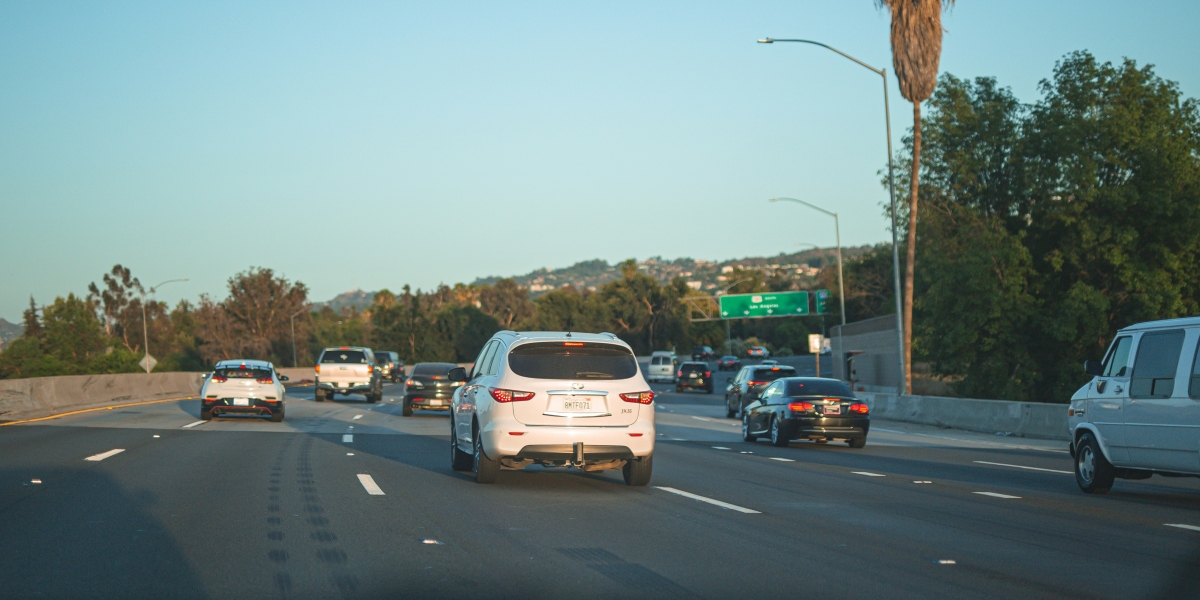





As airport rides, regional commutes, and long-distance trips grow more expensive, Kamuit is exploring how structured shared mobility could serve Los Angeles corridors.
Los Angeles has no shortage of movement.
Every day, travelers move between airports, neighborhoods, suburbs, campuses, entertainment districts, and surrounding counties. The region is built on motion: freeways, rideshares, buses, rail lines, shuttles, rental cars, and private vehicles all operating at once.
But for many people, moving across Los Angeles is still expensive, fragmented, and unpredictable.
The challenge becomes sharper around airport and regional trips. A traveler landing at LAX may need to reach Orange County, Riverside, Santa Barbara, San Diego, or the Inland Empire. A student may need a ride between the campus and the airport. A worker may need to move between counties without paying the price of a private long-distance rideshare. A visitor may find that a trip by car is straightforward on a map but costly in practice.
That is the gap Kamuit is now studying.
Kamuit, a transportation technology company co-founded by Yogesh Rethinapandian, is focused on structured long-distance shared mobility. Rethinapandian has been developing Kamuit’s corridor-based model around verified users, scheduled routes, cost-sharing, and trusted coordination between drivers and riders.
The company’s model is built around a simple idea: many people are already driving between major corridors, and many riders need those same trips. The missing layer is coordination, verification, timing, and trust.
Kamuit’s early work has focused on Texas, where regional travel between university towns, airports, and major metro areas often depends on private cars, informal group chats, or expensive ride-hailing. Those early tests helped the company develop standards around scheduled routes, verified users, cost-sharing, route-based matching, and trusted long-distance coordination.
Now, Kamuit is laying the groundwork in Los Angeles as part of a broader soft-launch strategy.
Yogesh Rethinapandian says Los Angeles is a natural next market because it combines airport density, high car dependency, regional sprawl, and repeated corridor travel.
“Los Angeles is not just a city mobility problem,” said Yogesh Rethinapandian, co-founder of Kamuit. “It is a regional coordination problem. People are constantly moving between LAX, the surrounding counties, universities, workplaces, and neighboring cities. Many of those trips are already happening by car. The opportunity is to make them more structured, safer, and easier to share.”
Kamuit’s Los Angeles exploration includes airport-adjacent travel, student travel, and corridor-based pit stops that could support longer shared rides. The company has begun outreach to airport mobility stakeholders, including LAX-related rideshare contacts, and is also exploring conversations with local gas stations and rest-stop-style businesses that could serve as practical pickup, drop-off, or corridor meeting points.
The idea is not to turn gas stations into transit hubs overnight. It is to recognize that long-distance shared mobility requires reliable physical points along the route. Riders and drivers need places that are easy to find, safe to access, and practical for coordinated trips. In a region as spread out as Southern California, the pickup point can matter almost as much as the route itself.
That is one reason Kamuit’s model differs from traditional ride-hailing.
Local ride-hailing works best when a driver is nearby and a rider needs immediate point-to-point transportation. But long-distance regional trips are different. They are often planned in advance. They can involve airports, luggage, campuses, and multiple city pairs. They are more sensitive to cost, timing, and trust. They also become expensive quickly when handled as private rides.
Kamuit’s approach is to treat those trips as scheduled corridor movement rather than spontaneous urban rides.
Early product-market-fit conversations conducted by the company suggested that many travelers were not looking for luxury transportation. They were looking for a reliable alternative to high long-distance rideshare costs, especially when the route was already being driven by others. Students, airport travelers, and regional commuters repeatedly described the same pain point: the distance was manageable, but the available options were either too costly, too inconvenient, or too informal.
That pattern is not unique to Los Angeles, but Los Angeles makes it visible.
A trip from LAX to parts of Orange County, Riverside County, or Ventura County can be simple in theory and expensive in practice. Public transit may work for some riders, but it does not always match luggage, timing, late-night arrivals, or exact destinations. Private rides can solve the convenience problem, but create a cost problem. Informal shared rides can reduce cost but often lack verification, payment clarity, and predictable coordination.
Kamuit is trying to operate in that middle space.
The company’s standard focuses on verified users, scheduled rides, route clustering, and cost-sharing. Instead of asking whether every trip can become a private ride, it asks whether repeated corridor demand can be organized into a trusted shared system.
“The lesson from Texas was that people do not always need a new road or a new vehicle,” Rethinapandian said. “Sometimes the road is already there, the vehicle is already moving, and the rider already needs the trip. What is missing is the network that connects those pieces responsibly.”
Los Angeles may be one of the strongest tests for that thinking.
The region has world-class demand, but it also has world-class complexity. Traffic, geography, airport rules, curb management, insurance, safety, and pickup logistics all shape how any mobility service can operate. Kamuit’s soft-launch strategy is therefore expected to focus on corridors where the pain is clear and the behavior already exists, rather than trying to serve the entire region at once.
That could include airport-to-county routes, university-to-airport travel, and repeated long-distance rides between Los Angeles and surrounding regional hubs.
The broader mobility industry has spent years chasing urban convenience. But the next opportunity may be regional coordination. As costs rise and travelers look for alternatives, startups are beginning to ask whether the unused seats already moving through American highways can become a real transportation layer.
For Los Angeles, the question is especially relevant. The city is preparing for major global attention in the coming years, including large-scale tourism, sports, entertainment, and business travel. Moving people efficiently across the region will require more than one solution. Rail, buses, shuttles, taxis, ride-hailing, autonomous vehicles, and shared mobility models may all have a role to play.
Kamuit is not positioning itself as a replacement for those systems. It is positioning itself as a coordination layer for trips that fall between them.
If the company can apply what it tested in Texas to the complexity of Los Angeles, it could help define a new category of regional shared mobility: not casual carpooling, not private ride-hailing, and not fixed-route transit, but a structured network for people already moving in the same direction.
In a city known for cars, the next transportation shift may not begin with fewer vehicles.
It may begin with better use of the seats already on the road.