




By: Ryan Callahan
Los Angeles has always sold the rock-and-roll dream better than almost anybody.
Come west with a guitar. Find three other believers. Get a gig on the Strip. Catch the right person standing near the back of the room. Sign the deal. Buy the house in Laurel Canyon. Become immortal.
It’s a beautiful story. It’s also the story that happens to almost nobody.
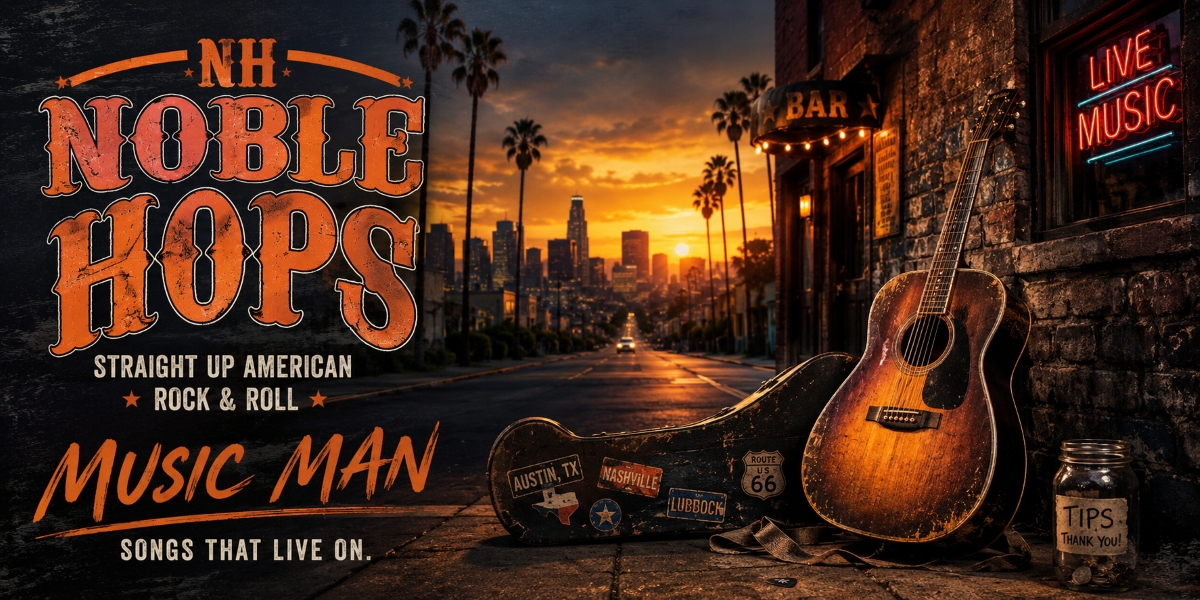
That’s what makes Noble Hops’“Music Man” such an intriguing record to consider from Los Angeles. The Western Pennsylvania band has written an anthem for the musician on the opposite side of Hollywood mythology, the guy who never gets the mansion, limousine, or platinum album but keeps plugging his guitar into an amplifier anyway.
The song opens by puncturing one of music’s oldest legends: “I didn’t sell my soul for rock and roll, but it became my way of life.”
In L.A., where generations of musicians have metaphorically offered precisely that bargain to record labels, managers, producers, and whoever happened to be promising access that week, the line lands especially hard.
Utah Burgess, Noble Hops’ vocalist and songwriter, isn’t presenting his protagonist as a failed rock star. That would misunderstand the song entirely. The Music Man succeeds according to a different measurement. He survives.
He plays.
And tomorrow night, he plays again.
There’s nothing glamorous about the biography Burgess constructs. There are “empty bars” and “beat-up guitars,” a few ex-wives and gigs compensated with tips, beer, or occasionally nothing. Yet the narrator refuses to treat any of this as tragedy.
“Sing what I please, I keep off my knees, I keep it Me For Me.”
That last phrase also nods toward Noble Hops’ own “Me For Me,” reinforcing a theme that runs through Burgess’ writing: maintaining identity when the world keeps offering reasons to compromise it.
Los Angeles musicians know something about that battle.
The Sunset Strip alone has swallowed enough bands to populate a small city. For every Guns N’ Roses or Mötley Crüe that emerged from those clubs, thousands of musicians loaded their gear into cars after midnight, drove back across the Valley and went to work the next morning.
Those are the people “Music Man” understands.
Musically, Noble Hops doesn’t pretend to be an L.A. band, which is precisely why the record works. There’s Pennsylvania dirt underneath its fingernails. The group calls its sound American rock and roll with Americana and alt-country grit, and “Music Man” lives comfortably at that intersection.
Burgess handles vocals, 12-string acoustic and electric rhythm guitar, while Tony Villella supplies electric rhythm and lead guitar. Johnny “Sleeves” Costa holds down bass and contributes backing vocals, and Brad Hulburt drives the proceedings from behind the drums.
There’s little interest in studio trickery. The guitars sound like guitars. The drums sound intended to push a band across a stage rather than demonstrate somebody’s mastery of software.
Recorded with Jazz Byers at Pittsburgh’s Rattle Clack Studio, “Music Man” benefits from that lack of cosmetic surgery. It has the feel of musicians who expect songs eventually to face their real test in front of people.
Noble Hops certainly knows that test.
The band has logged 89 shows at 52 venues over the past year-plus, traveling from Franklin, Tennessee to Erie, Pennsylvania and from Altoona, Pennsylvania to Mansfield, Ohio. Those numbers matter because “Music Man” isn’t four guys imagining what a road musician’s life might resemble.
They’re living a version of it.
The song itself required similar persistence. Noble Hops began recording it in early 2024, decided the initial tracks weren’t right, and eventually started over. That might be the perfect production history for a song whose entire philosophy is based on getting up and doing it again.
The chorus is gloriously uncomplicated: “Music Man, playing across the land / Music Man, that’s what I am.”
It’s not clever because it doesn’t need to be. This is identity reduced to its essential components: man, guitar, road, song.
The most revealing lyric arrives later, when Burgess imagines the inevitable end: “The time will come when I’ll be gone, but my songs they will live on.”
Now there’s a Hollywood idea.
Los Angeles has always been obsessed with immortality. Stars embedded in sidewalks. Handprints preserved in concrete. Gold records hanging on walls. Names illuminated on marquees long after the people attached to them have disappeared.
But Noble Hops proposes a humbler version of immortality.
Maybe nobody builds you a monument.
Maybe somebody just remembers your song.
Burgess has spent years helping that happen for other independent musicians through The Grass Roots Show on Butler, Pennsylvania’s Rock Station 97.7. His commitment to local music makes “Music Man” feel less like self-congratulation than a salute to an entire class of performers whose careers happen beyond the entertainment industry’s traditional definition of success.
That’s why the song makes particular sense when viewed from Los Angeles.
This city has enough songs about making it.
“Music Man” is about something harder:
continuing when you don’t.
Noble Hops has made a rock-and-roll record for everyone who came to California with a guitar, everyone who left without a record deal, and especially everyone who went home and kept playing anyway.
Because sometimes the dream isn’t getting discovered.
Sometimes the dream is still having a guitar in your hand when the lights come on.