

By: Cameron Blake
Los Angeles has always understood the seductive power of reinvention. Come west, change your name, rewrite your story, find the right room, and maybe become whatever version of yourself you imagined while sitting in traffic somewhere far away. It is the mythology behind Hollywood, the Sunset Strip, West Coast hip-hop, and countless spiritual movements that have found fertile ground beneath Southern California sunshine.
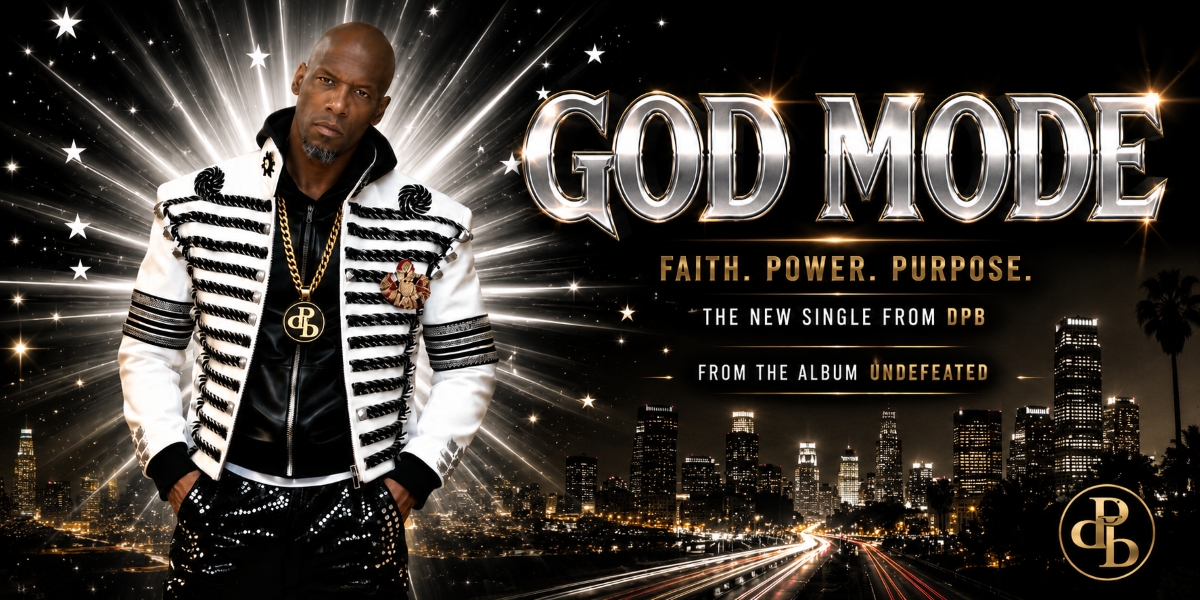
DPB’s “God Mode” offers a radically different version of the same proposition. According to the veteran Christian hip-hop artist, you don’t need to reinvent yourself. You need to understand the power you already possess.
That makes “God Mode,” from his 2026 album Undefeated, an oddly appropriate record for Los Angeles, a city where people spend fortunes searching for transformations DPB insists can begin from within.
The premise is ingenious in its simplicity. In video games, “God Mode” is the ultimate cheat code: activate it and ordinary limitations disappear. DPB takes that bit of gamer terminology and converts it into contemporary Christian language. His central hook boils the concept down even further: “Jesus Christ is the God Code.”
It’s not subtle. It isn’t supposed to be.
DPB has been making Christian hip-hop for more than three decades, and “God Mode” carries the confidence of somebody who has survived enough musical trends to stop worrying about fitting into the next one. His Undefeated album has been described as a mixture of hip-hop, gospel, and inspirational music rooted as much in old-school sensibilities as contemporary production.
That history matters in Los Angeles, particularly because this is a city with an unusually long memory when it comes to hip-hop. Beneath every new viral sensation lies the DNA of neighborhood parties, booming car stereos, independent record stores, mixtapes, dance crews, and MCs who understood that rap wasn’t merely something you listened to. It was something that announced itself.
“God Mode” understands the announcement.
DPB doesn’t rap like somebody reluctantly sharing his beliefs. He declares them. Healing. Deliverance. Freedom. Revival. They arrive less as lyrical decorations than as promises shouted through a microphone.
The result lands somewhere between an old-school hip-hop rally and a Pentecostal altar call.
That combination could easily become gimmicky. Instead, DPB’s absolute commitment keeps it grounded. He reportedly conceived “God Mode” after praying about what message he should deliver next and experiencing a dream centered on believers recognizing the spiritual authority they already possess. Whether listeners interpret that literally or simply as the creative spark behind the song, it explains the urgency of the performance.
DPB doesn’t sound like he’s describing an idea.
He sounds like he’s reporting something he discovered.
That’s a useful distinction in Los Angeles, where spirituality and entertainment have been uneasy roommates for generations. Gospel choirs coexist with celebrity churches; self-help gurus operate a few exits away from recording studios; spiritual vocabulary gets absorbed into wellness culture until “manifesting” can mean everything and consequently nothing.
DPB refuses that vagueness.
There is no universe delivering abundance here. No mysterious energy. No carefully generalized higher power designed to maximize demographic reach.
It’s Jesus.
Commercially risky? Perhaps. Artistically honest? Absolutely.
And that specificity gives “God Mode” considerably more personality than another motivational anthem telling listeners to believe in themselves.
Its current radio campaign follows DPB’s “Back in the Day,” which spent seven consecutive weeks atop the National Radio Hits AC40 chart, according to Spins Tracking System. “God Mode” has also reached No. 2 on Christian Music Weekly’s Rhythmic Airplay chart.
The two songs make revealing companions.
“Back in the Day” remembers DPB’s upbringing in Nyack, New York, with church, family, and neighborhood life helping establish the foundations of his worldview. “God Mode” takes those foundations and throws them forward.
One remembers where he came from.
The other declares why he’s still standing.
That makes the song particularly effective within Undefeated. The album isn’t merely interested in survival; it asks what somebody does after surviving. DPB’s answer is essentially: act like survival taught you something.
There are moments when “God Mode” nearly overdoses on affirmation. Repetition is fundamental to the arrangement, and listeners who prefer intricate storytelling or lyrical ambiguity may find DPB’s directness overwhelming. But asking him to tone it down would be like asking a preacher to deliver the Easter sermon sotto voce.
The excess is part of the experience.
More importantly, DPB understands repetition as both a hip-hop and gospel tradition. The MC repeats the phrase until the crowd responds. The preacher repeats the declaration until the congregation answers. The DJ loops the break until everybody moves.
Different buildings. Same human impulse.
And somewhere between those traditions, “God Mode” finds its sweet spot.
There’s even something wonderfully contrary about hearing this message against the psychological backdrop of Los Angeles. This is a city fueled by the phrase not yet. You’re not famous yet. You haven’t landed the role yet. The record hasn’t broken yet. The financing hasn’t arrived yet. The right person hasn’t discovered you yet.
DPB’s entire song is a rejection of “yet.”
Stop waiting for permission.
Stop waiting for circumstances to validate you.
Stop behaving as though victory exists exclusively in some imaginary future.
That message doesn’t require Christian belief to register, although DPB makes no attempt to separate it from Christianity. That’s ultimately the record’s greatest strength. “God Mode” isn’t crossover music because it waters down its faith. It crosses over because confidence, perseverance, and the desire to transcend circumstances are bigger than genre.
Los Angeles sells transformation every day.
DPB offers something more provocative.
Maybe you don’t need another audition.
Maybe you already got the part.