



By: Daniel Mercer
There is something quietly unfashionable about Eddy Mann.
For decades, the Philadelphia-rooted singer-songwriter, musician, worship leader, and teaching pastor has continued making records while the machinery surrounding popular music has reinvented itself repeatedly. Formats disappeared. Record stores vanished. Streaming reshaped the business. Christian music became increasingly polished and professionalized. Through it all, Mann kept writing.
More than twenty albums into his journey, he is still doing it.
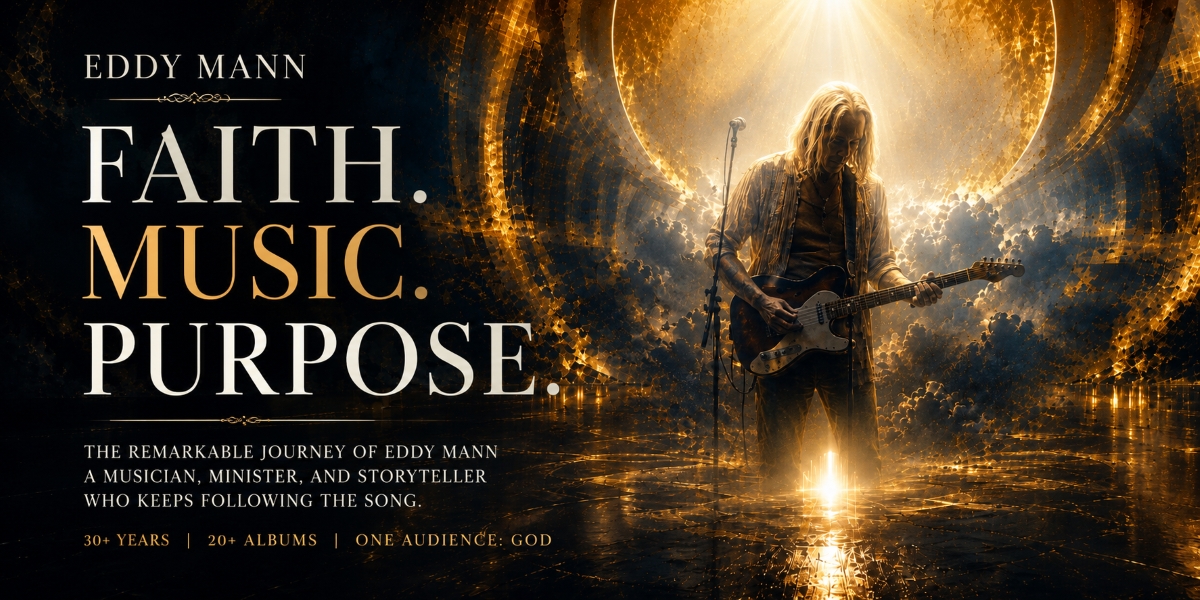
The explanation is simple: Eddy Mann has never treated music as merely a career. It is ministry with chords.
His story begins in a household where spirituality and creativity were hardly strangers. Mann’s father was a bebop pianist, while his mother encouraged an appreciation of culture and creativity. Those influences eventually produced an unusually broad musical vocabulary encompassing folk, blues, gospel, Americana, and jazz.
But faith ultimately provided the center.
A Life Shaped by Worship and Song
Mann’s first Christian album, Soul du Jour, arrived in 2000 and helped establish him on the café and coffeehouse circuit. Three years later came Dyo, recorded during a period when his live band was becoming increasingly active.
Then came an unexpected turn: Mann was invited to become a worship leader at Gloria Dei Church outside Philadelphia, a position he had not originally imagined for himself. By 2014, he had already spent more than 15 years leading worship while performing everywhere from coffeehouses to retreats and conferences.
That is important to understanding Mann. The church was not a branding strategy that arrived after the songs. Ministry became part of the architecture of his life.
And the songs kept coming.
One composition, “Unbreakable,” reportedly traveled far beyond his immediate congregation and was performed at weddings around the world. Years later, “The Consequence” became a Top 10 Christian Music Weekly radio hit. “Hope of the World” and “Hallelujah,” from Chapel Songs, reportedly reached No. 1 on the UK iTunes Christian chart, while the album accumulated more than 150,000 Spotify streams.
Those are meaningful markers, but Mann’s career makes more sense when viewed through accumulation rather than explosion.
He is not the story of the overnight sensation.
He is the story of showing up.
Faith Lived Rather Than Advertised
Albums including Pray On, IHS, Stars Under My Feet, Trio, Chapel Songs, and Turn Up the Divine document an artist continually circling the same fundamental questions: What does faith look like when lived rather than advertised? Where is God during uncertainty? What happens when prayer collides with ordinary human weakness?
Then came The Unveiling.
Released in 2026, the ten-song collection takes its inspiration entirely from the Book of Revelation. It sounds like difficult territory for a songwriter whose natural temperament leans toward compassion rather than catastrophe. Revelation has supplied generations of preachers and popular culture with beasts, judgment, apocalypse, and terror.
Mann found hope.
The project began with a creative burst. Between January 1 and February 9, 2023, Mann wrote and recorded 29 songs at Carousel Ln in Melbourne Beach, Florida. Ten eventually became The Unveiling, the culmination of a project that developed over roughly three years.
The album does not turn Revelation into a theological horror show. Mann instead concentrates on endurance, accountability, restoration, and the presence of a loving God.
That distinction feels central to his work.
The Unveiling and the Sound of Hope
His recent song “I Will Never Know the Desert Again” uses Revelation’s imagery to contemplate an end to suffering. “We Are,” inspired by Revelation chapter four, goes somewhere musically unexpected: jazz-influenced worship in 5/4 time.
The unusual meter was not necessarily a calculated attempt to make Christian music more sophisticated. Mann says the song simply settled naturally into five beats.
That instinct reveals something essential about his work. Mann allows songs to become what they want to become. The Unveiling itself follows that philosophy, with each composition permitted to develop without being forced toward an obvious commercial formula.
It is a risky philosophy in an industry shaped by algorithms, playlists, and instant gratification.
But Mann’s audience has never really been an algorithm.
For him, there is an “audience of One.”
Still Writing, Still Believing
That belief helps explain both the durability and independence of his career. Success might mean a chart position, but it might just as easily mean hearing that one song reached one person during one difficult night.
The distinction between Eddy Mann the musician and Eddy Mann the minister consequently becomes difficult to locate. The songwriting is ministry. The ministry becomes songwriting. Recording, performing, teaching, and worship are different dialects of the same language.
And after all these years, Mann still appears fascinated by what might happen next.
That may ultimately be one of his most meaningful career achievements. More than twenty albums, international chart recognition, radio success, and decades of ministry have not turned him into a monument to his own past.
He is still writing.
Still questioning.
Still believing.
Still following songs into unexpected places, even when they insist on counting to five.