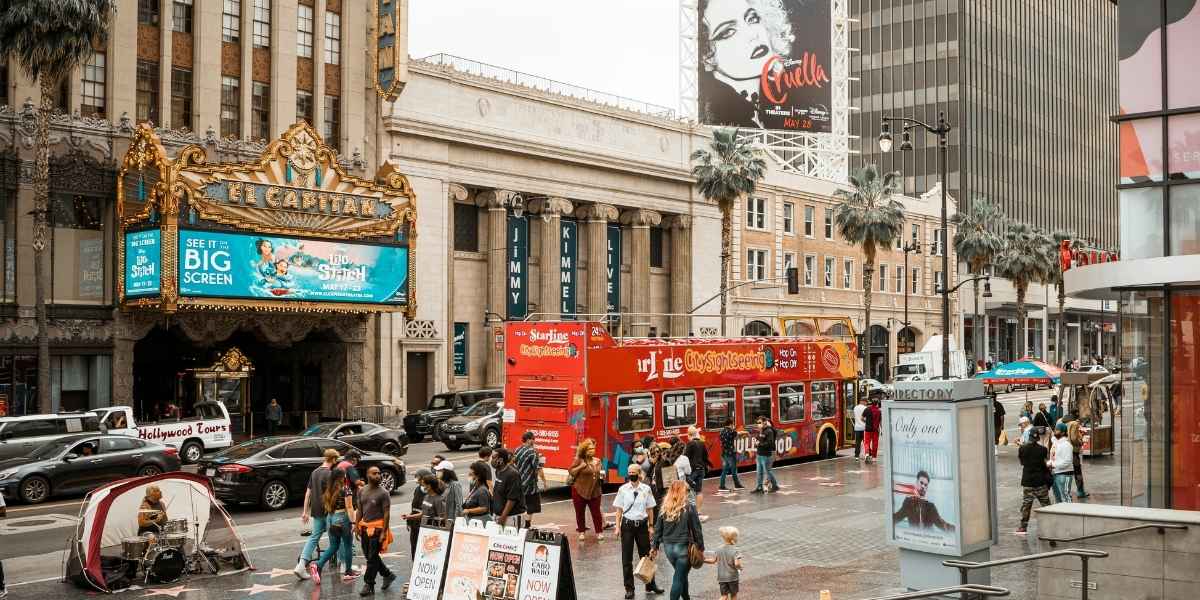



Hollywood Boulevard is seeing a street-level retail challenge shaped by vacancy, business costs, older buildings and uneven visitor spending. District data shows stronger conditions across the wider Hollywood Entertainment District, but storefront gaps along the boulevard remain visible in one of Los Angeles’ most recognizable commercial corridors.
Key Takeaways
- Hollywood Entertainment District retail vacancy was 6.8% in Q1 2026, according to The Hollywood Partnership.
- A separate street-level estimate placed Hollywood Boulevard vacancy at about 30%.
- The district includes 3.1 million square feet of retail space, with average monthly retail rent listed at $3 per square foot.
- Typical weekend pedestrian volume in the district was listed at about 127,000 people.
- Older buildings, renovation needs, labor, insurance, supplies and rent continue to shape leasing decisions.
Hollywood Boulevard remains one of the most familiar streets in Los Angeles, carrying the Walk of Fame, historic theaters, restaurants, bars, shops and visitor attractions. Yet the experience at street level can vary from crowded sidewalks to empty storefronts within the same corridor.
The issue is not a simple story of decline. Public data shows a stronger retail picture across the broader Hollywood Entertainment District than some blocks suggest. The Hollywood Partnership’s Q1 2026 Market Moves Data Dashboard listed retail vacancy in the district at 6.8%, down 4.3% year over year. Greater Hollywood was listed at 7.5%, while the City of Los Angeles was listed at 6.7%.
At the same time, a separate street-level report placed vacancy on Hollywood Boulevard at about 30%. That figure points to a narrower but more visible challenge. A vacant storefront on a famous pedestrian corridor can affect how residents, tourists and prospective tenants read the street, even when the wider district is performing closer to city averages.
What Do The Latest Hollywood Boulevard Retail Numbers Show?
Hollywood Boulevard sits inside a larger business district that continues to draw workers, residents and visitors. The Hollywood Partnership listed 2,977 total businesses in the Hollywood Entertainment District, 30,400 daily workers, 30,700 residents and 6.9 million domestic tourists in Q1 2026.
District Data Tells One Story
The same dashboard listed 3.1 million square feet of retail space in the Hollywood Entertainment District. Average monthly retail rent was listed at $3 per square foot, down 10% year over year in the retail market section.
Those numbers suggest that the district has not lost its retail base. Recent openings listed in the dashboard include Couplet Coffee at 6318 Hollywood Boulevard, Raising Cane’s at 6933 Hollywood Boulevard and several food, grocery and entertainment-adjacent concepts in nearby parts of the district.
The broader data matters because it shows that vacancy is not evenly distributed. Some areas continue to attract operators, while other storefronts remain harder to lease.
Street-Level Spaces Tell Another
Hollywood Boulevard’s more visible problem is the condition and availability of prominent ground-floor spaces. A districtwide vacancy rate can look manageable while a main visitor corridor still feels uneven.
Large storefronts create another challenge. Some spaces were built for older retail formats that do not match today’s smaller restaurant, service or specialty retail concepts. When those spaces require major work before occupancy, the cost can slow leasing even when rent softens.
That mismatch helps explain why some vacancies last. A lower monthly rent may not be enough when a tenant still faces buildout costs, equipment, permits, insurance and months of limited revenue before opening.
Why Are Costs Harder For Businesses To Absorb?
Hollywood Boulevard businesses face the same cost pressures seen across many urban retail corridors, including payroll, rent, supplies, insurance, utilities and maintenance. For restaurants, food prices and staffing needs can change quickly. For retailers, inventory and customer conversion can be difficult when foot traffic includes many visitors who browse but do not buy.
A wider cost environment also affects shoppers. Los Angeles County’s sales tax rate is scheduled to rise from 9.75% to 10.25% on Oct. 1, 2026, adding another checkout consideration for taxable purchases. Retailers and restaurants already tracking rent, payroll and supplies may also need to account for retail checkout costs as households watch spending.
Rent Is Only One Line Item
Rent remains one of the clearest costs, but it is rarely the only pressure. A themed bar on Hollywood Boulevard was publicly reported to have once faced rent of $28,000 per month for less than 2,800 square feet before a later renegotiation.
That kind of fixed cost can be difficult for operators that rely on nightlife, tourism or event-driven traffic. A strong Saturday does not always offset a soft Monday, Tuesday or Wednesday. Operators also need enough margin to cover labor, security, cleaning, utilities, insurance and debt tied to opening costs.
Older Buildings Can Add Delays
Hollywood Boulevard also has a building-stock issue. Some historic or older properties need seismic upgrades, accessibility improvements, kitchen systems, fire safety work, electrical updates or other repairs before a new tenant can operate.
SFGATE reported that some historically designated buildings along the boulevard need costly renovation and earthquake retrofitting. A Hollywood Partnership representative quoted in that report described the issue as a legacy problem requiring structural changes.
For a small operator, those costs may be too large to carry. For a landlord, major building work can be expensive without a tenant ready to sign a long-term lease. That standoff can leave storefronts empty longer than the public expects.
Can Visitor Traffic Still Support Hollywood Boulevard Storefronts?
Hollywood Boulevard still benefits from name recognition and steady foot traffic. The Hollywood Partnership listed typical weekday pedestrian volume at 92,000 and typical weekend volume at 127,000 in the district. High-attendance days were listed at 138,000, with LA Pride reaching 156,000 across 2023 to 2025.
The district also remains tied to major attractions. The Hollywood Entertainment District includes more than 2,800 Walk of Fame stars, more than 30 theaters, more than 20,000 theater seats and more than 50 red carpet events annually, according to the dashboard.
Foot Traffic Remains Significant
Foot traffic gives the corridor a base that many retail districts lack. Visitors still arrive for the Walk of Fame, the TCL Chinese Theatre area, the Dolby Theatre, nightlife, restaurants, events and guided tours.
Transit access also matters. Hollywood is already connected by Metro rail, and other Los Angeles corridors are expanding transit access to commercial areas. Recent new rail access along Wilshire Boulevard shows how transportation changes can place more riders near cultural, retail and business districts.
For Hollywood Boulevard, foot traffic is not the only question. The more difficult issue is whether that traffic turns into enough spending to support fixed costs.
Spending Patterns Matter
Tourists may visit for photos rather than purchases. Residents may avoid certain blocks if they do not see the stores, restaurants or daily services they need. Workers may support lunch and after-work spending, but hybrid schedules can reduce weekday consistency.
That mix creates a narrow path for tenants. A souvenir shop, quick-service restaurant, coffee bar, theater-adjacent venue or experiential concept may fit the corridor better than a traditional large-format store. But even those concepts need manageable rent, reasonable buildout costs and enough repeat activity.
Frequently Asked Questions
Is Hollywood Boulevard retail vacancy really 30%?
A street-level report placed Hollywood Boulevard vacancy at about 30%. That figure differs from the wider Hollywood Entertainment District retail vacancy rate of 6.8% in Q1 2026, showing that the boulevard itself can look weaker than the broader district.
What is the retail vacancy rate in the Hollywood Entertainment District?
The Hollywood Partnership listed Hollywood Entertainment District retail vacancy at 6.8% in Q1 2026. Greater Hollywood was listed at 7.5%, while the City of Los Angeles was listed at 6.7%.
Why are some Hollywood Boulevard storefronts hard to fill?
Some storefronts are large, older or in need of costly upgrades before a tenant can open. Rent, labor, insurance, supplies, permits and construction costs can also make it harder for smaller operators to take on a space.
Does Hollywood Boulevard still get strong foot traffic?
Yes, district data listed typical weekday pedestrian volume at 92,000 and typical weekend volume at 127,000. The challenge is not only visitor volume, but whether enough visitors spend money inside nearby businesses.
What types of businesses may fit Hollywood Boulevard now?
Food, beverage, entertainment, service and experience-driven concepts may fit the corridor when lease terms and buildout costs are workable. Large traditional retail spaces may face a tougher path if the space requires major upgrades or does not match current tenant demand.