


Luxury jewelry is no longer defined by what is recognizable. Today, it is becoming increasingly defined by what cannot be replicated.
Over the past decade, fine jewelry buyers have shifted away from standardized pieces toward designs that reflect specific moments, relationships, and personal histories. Engagement rings are redesigned instead of being purchased from display cases. Anniversary gifts are commissioned rather than selected. Even everyday fine jewelry is being reconsidered as something that should carry meaning, not just value.
This shift has created space for smaller, design-led brands that prioritize craftsmanship and customization over scale. Among them is Mera Jewelry, founded by Katherine Paul, whose work centers on bespoke pieces built around client collaboration and gemstone integrity.
Paul’s approach isn’t built on reinvention. It is built on returning to a more traditional model of jewelry-making, where the relationship between designer and client is part of the final piece.
Why Are Emeralds Gaining Ground Over Diamonds?
Diamonds still dominate the global jewelry market, but they no longer hold the same cultural exclusivity. Their strength has always been consistency (e.g., grading systems, clarity scales, and predictable quality), and that same consistency now works against them in a market that increasingly values individuality.
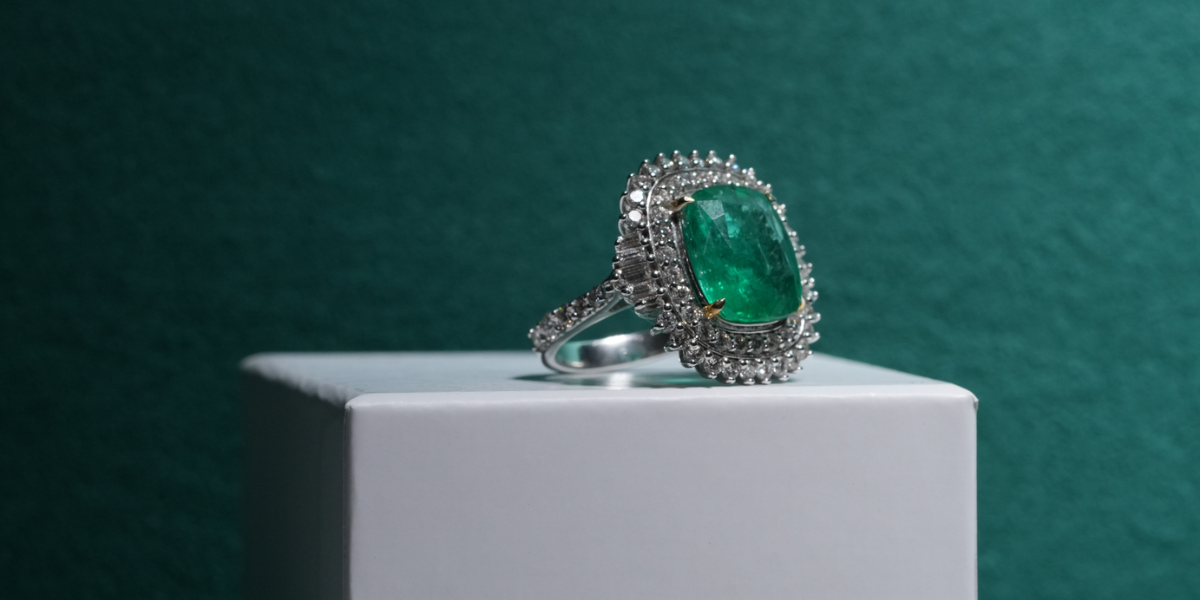
Emeralds offer the opposite. Each stone carries visible inclusions, tonal variation, and structural differences that cannot be standardized. These characteristics are not treated as flaws, but as part of what distinguishes one piece from another.
For Paul, that distinction is central to Mera Jewelry’s identity. Raised in Colombia, where emeralds are a significant part of both the economy and cultural identity, she builds her collections around stones that reflect that origin. The brand’s emerald pieces are not positioned as alternatives to diamonds but as a distinct category of luxury that prioritizes rarity through variation over uniformity.
This is one reason why emerald engagement rings and custom emerald pieces have become more visible in recent years. They signal a departure from expected choices and reflect a more deliberate selection process.
The Role of Training in a Bespoke Process
Custom jewelry depends on more than design instinct. It requires technical fluency.
Paul’s training at the Gemological Institute of America, where she specialized in diamond grading, informs how she evaluates stones, sources materials, and constructs each piece. That background allows her to move between creative direction and structural precision without separating the two.
In a bespoke setting, this matters. Clients are often making decisions without prior knowledge of gemstones or jewelry construction, so the designer must be able to explain trade-offs clearly, whether that’s between size and clarity, color and durability, or design ambition and long-term wearability.
Without that level of expertise, customization becomes surface-level. With it, however, the process produces pieces that are both visually distinct and technically sound.
Designing With Motif and Meaning
Mera Jewelry’s collections incorporate recurring motifs, most notably butterflies and clovers, rendered in diamonds, sapphires, and emeralds. These symbols are familiar, but they are not treated as decorative trends.
The butterfly, often associated with change, appears in pieces that can help mark transitions in life, such as career shifts, personal milestones, or significant life events. The clover, traditionally linked to luck, is used in designs intended as long-term keepsakes.
What distinguishes these motifs isn’t the symbolism itself, but how they are integrated. The designs avoid exaggeration. Stones are set to maintain proportion and balance, rather than to maximize visual impact at a distance. The pieces are meant to be worn consistently, not reserved for occasional display.
This design restraint aligns with how clients use jewelry today. Pieces are expected to move between formal and informal settings without losing relevance.
How the Bespoke Experience Works
The process of creating a custom piece at Mera Jewelry begins with a conversation. Some clients come with a clear vision, while others begin with a single element (i.e., a gemstone, a reference image, or a personal milestone) that they want reflected in the design.
From there, the process develops collaboratively. Stone sourcing, sketching, and refinement happen in stages, with adjustments made as the design becomes more defined.
This approach contrasts with traditional retail models, where the product exists before the client enters the space. In bespoke work, the product emerges through interaction.
That difference affects the final outcome. A custom piece isn’t only shaped by design decisions, but by the context in which it was created. The result is jewelry that reflects both the maker’s expertise and the client’s intent.
So, Why the Shift From Diamonds to Emeralds?
The growth of bespoke jewelry is not a temporary change. It reflects a broader redefinition of value within luxury markets.
Consumers are more informed, more selective, and less interested in owning items that can be easily duplicated, which has led to increased demand for pieces that are traceable in origin and specific in design. Emerald jewelry, particularly in custom formats, fits this shift. The inherent variation in each stone makes duplication difficult, and the collaborative design process ensures that no two pieces are identical in execution.
For designers like Katherine Paul, this creates both an opportunity and a responsibility. The opportunity is to build a brand around craftsmanship and client relationships rather than volume. The responsibility is to maintain standards of sourcing, design, and construction that justify the bespoke model.
Mera Jewelry operates within that balance. Its pieces are not designed to follow seasonal cycles or respond to rapid shifts in trends. Instead, they are built to remain relevant to the person wearing them, which ultimately determines whether a piece holds its value over time.
In a market that once equated luxury with visibility, the emphasis has moved toward distinction. Custom emerald jewelry, with its combination of rarity, craftsmanship, and personal significance, is increasingly where that distinction is found.