



By Cameron Blake
Los Angeles has always understood reinvention. It’s practically a municipal requirement. People arrive carrying old identities, abandoned plans and private damage, then drive beneath the glow of Sunset Boulevard convincing themselves that tomorrow they can become somebody else. Cello’s Singing to Serpents sounds like the record playing during that drive, preferably sometime after 2 a.m., when the traffic finally disappears and the billboards start looking like messages from another planet.
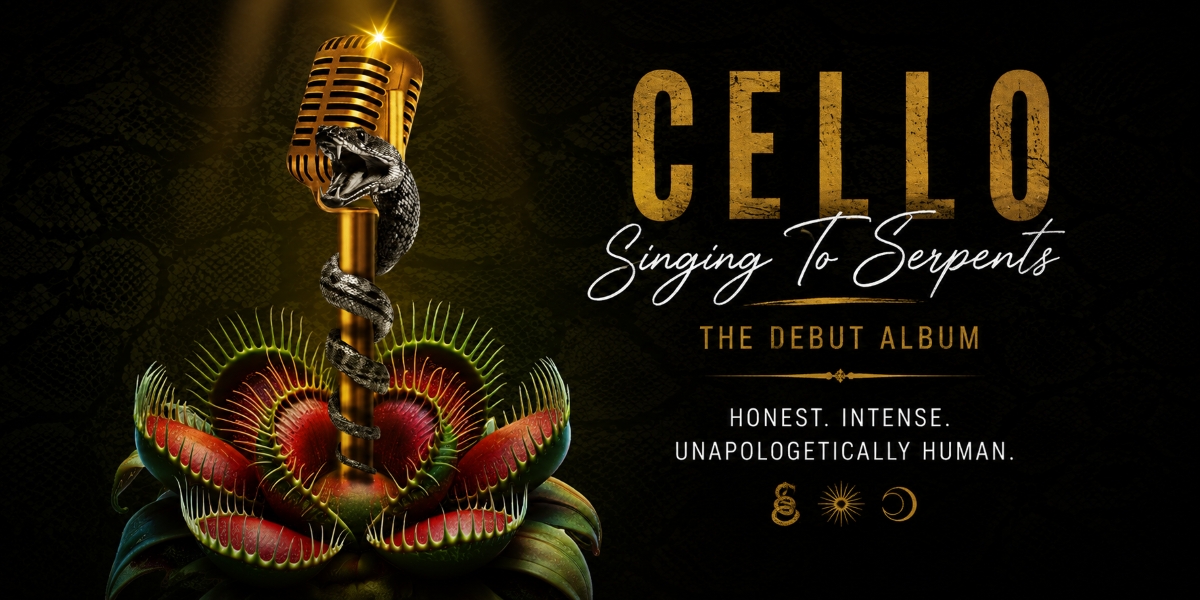
The Pittsburgh artist, born Marcello Valletta, may be geographically removed from Southern California, but his nine-song LP possesses an unmistakably Los Angeles emotional geography: ambition colliding with insecurity, spirituality wrestling with temptation, intimacy deteriorating into obsession and confidence occasionally revealing itself as another elaborate disguise for fear. Released March 1, the 29-minute album moves through “Stay Here,” “Elevate,” “Sucks to Be Used,” “Full Moon,” “So Long,” “Cravings,” “Pray,” “Faith” and “Sleeping.”
If Hollywood traditionally sells fantasy, Singing to Serpents investigates what happens after fantasy stops working.
“Stay Here” opens like a relationship argument unfolding somewhere between Laurel Canyon and a red light on Sunset. Cello repeats his central plea until romance begins sounding like fixation. It’s immediately apparent that repetition on this album isn’t simply a hook-writing technique. Thoughts return because Cello hasn’t finished processing them. Words become loops; loops become emotional environments.
Then “Elevate” enters wearing ambition like a designer jacket. There’s swagger here, but listen underneath it and something less secure emerges. That’s very L.A., too. This is a city where confidence is frequently part performance, where everybody at the Chateau Marmont appears to have a movie entering production until somebody asks who financed it.
Cello understands the distance between projecting invincibility and actually possessing it.
“Sucks to Be Used” makes that distinction even clearer. It’s bruised, defensive and confrontational, a song in which anger functions as body armor. Cello isn’t interested in presenting himself as the innocent protagonist of every situation. That’s precisely why the record works. His characters, or perhaps versions of himself, can be wounded and unpleasant simultaneously.
Hollywood could use more protagonists like that.
“Full Moon” and “Cravings” push the album deeper into nocturnal territory. Desire becomes intoxicating, physical and vaguely dangerous. You can almost imagine these songs leaking from a car cruising through Koreatown at midnight, neon signs bleeding across the windshield while somebody makes another terrible romantic decision.
But Singing to Serpents isn’t merely an album about desire.
It is an album about processing.
Cello has spoken openly about being autistic and having ADHD, and that neurodivergent perspective provides valuable context for the record’s fixation, repetition and emotional intensity. The music can feel like thought happening faster than language can contain it: ideas circling, sensations magnifying, confidence and uncertainty arriving almost simultaneously.
Crucially, Cello never turns neurodivergence into a marketing gimmick. It informs his artistic perspective without becoming the only reason for listening.
Before establishing himself as a recording artist, Valletta worked in acting and poetry, and that background remains audible. His songs often feel halfway between traditional songwriting and performed internal monologues. He’s interested in language, character and emotional contradiction, qualities that make Singing to Serpents unusually theatrical without making it artificial.
The spiritual pairing of “Pray” and “Faith” provides the record’s most compelling turn.
Los Angeles has always been America’s great supermarket of spirituality: old churches beside meditation studios, crystal shops around the corner from nightclubs, seekers arriving every day hoping someone possesses the secret. Cello approaches belief with considerably more uncertainty. His faith isn’t packaged as enlightenment. It’s questioned, desired and sometimes desperately needed.
That uncertainty makes “Faith” especially effective. Cello isn’t singing from the mountaintop. He’s somewhere on the climb, unsure whether he’s heading upward at all.
Then comes “Sleeping.”
At nearly five minutes, the closing track is the album’s longest, and after everything preceding it, the desire, ego, bitterness, longing and spiritual wrestling, it feels like sunrise breaking through curtains after a night nobody entirely remembers.
There is no grand resolution because Cello isn’t selling one.
That’s ultimately what makes Singing to Serpents such an intriguing record. In a culture increasingly engineered around branding, optimization and instant gratification, Cello has created something messy enough to feel human. His music crosses alternative, atmospheric pop, melodic rap and spoken-word territory without settling comfortably into any single category.
Los Angeles understands people who refuse categories.
It understands dreamers, performers, outsiders, obsessive personalities and people constructing identities while simultaneously trying to understand the ones they already possess.
Singing to Serpents belongs in that landscape.
Put it on after dark. Drive west until the city lights start disappearing in the rearview mirror.
Cello’s serpents will make perfect traveling companions.