




The Video That Never Needed a Camera, and How AI-Generated Cinematic Content Is Changing Modern Media
By: Natalie Johnson
In a media landscape built on the assumption that great visuals require great budgets, a new class of AI video technology is proving that assumption wrong, and production teams, brand marketers, independent creators, and educators are paying close attention.
According to IAB’s 2025 Digital Video Ad Spend and Strategy Report, 86% of ad buyers are now using or planning to use generative AI to build video ad creative, and 83% of ad executives say their companies have deployed AI in the creative process, up from 60% the year prior. Those numbers landed in an industry already in the middle of a significant transition. For the past two decades, cinematic video production operated on a straightforward hierarchy: the bigger the budget, the better the visual story. A 90-second brand film that felt like a real film required directors, lighting crews, location scouts, editors, and post-production pipelines that took weeks. The outcome was that only a small category of brands, educators, and creators could afford the kind of video that actually engaged audiences. Everyone else settled for formats audiences had already learned to skip.
Artificial intelligence is not simply reducing the cost of that production hierarchy. It is collapsing.
A Different Kind of Problem
The conversation around AI-generated video has, for years, centered on the wrong question. Most of the debate focused on whether AI-generated content could be visually convincing. Could it replicate realistic human movement? Could it meet resolution standards for broadcast or digital advertising? Those questions have largely been answered. The industry is now competing with a more serious one.
The problem was never whether AI could make a video. The problem was whether it could make a video that functions as a narrative. A sequence of visually impressive frames is not a story; it is an assembly. Audiences in 2026 have been exposed to enough content, across enough platforms, to detect the difference within the first few seconds of viewing. Content that reads as assembled gets scrolled past. Content that reads as authored holds attention.
AI systems trained on volume rather than coherence have produced exactly what their design prioritized. High output, low narrative integrity, scenes that do not relate to each other with any dramatic logic, characters who change voice or appearance between frames, and voiceovers that do not match the visual rhythm of what is being shown. These are not technical failures. They are the predictable result of building AI video tools for quantity rather than quality. Teams deploying this content across industries, from marketing to education to healthcare communication, quickly found that audience response dropped below even their pre-AI benchmarks. The content was cheaper to produce and worse at performing. That outcome forced a rethink.
What Changes When the Answer Is Yes
The platforms now addressing that structural question are producing something categorically different from first-generation AI video tools. Coherence is now the design goal, not frame quality, not generation speed, not output volume.
This matters because narrative coherence is what separates content that is consumed from content that is experienced. A viewer who experiences a video remembers it. A viewer who consumes it does not. Personalized, story-led video tends to stay with audiences in a way that generic digital advertising does not, and that difference is not explained by production budget or visual polish. It comes down to whether the story holds together well enough for the viewer to stay with it.
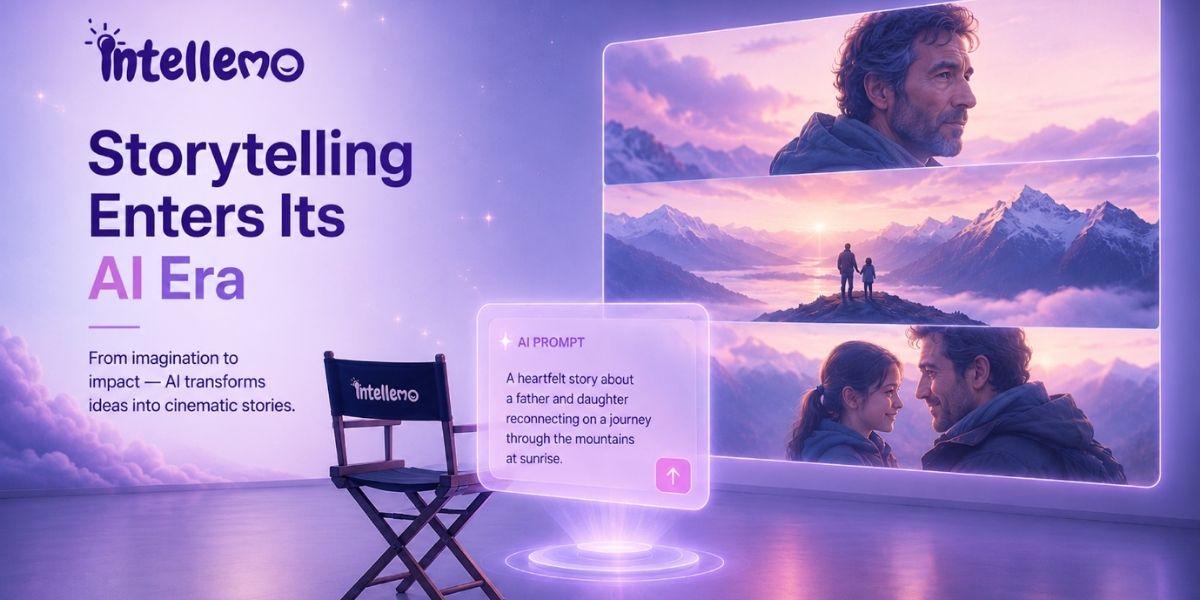
Platforms like Intellemo AI have built their infrastructure around this specific problem. The platform maintains character consistency, voice coherence, and narrative structure across every scene, treating the output not as a collection of moments but as a unified cinematic piece. The standard is not the generation rate. It is story integrity.
The Larger Shift
What is happening in AI video production is not an isolated technology story. It is part of a broader change in how media is made and what audiences expect from it. Branded documentary, creator content, educational video, and long-form storytelling have all moved progressively closer to the language and standards of film. Viewers do not evaluate content by who made it or why. They evaluate it based on whether it is worth watching.
AI-generated cinematic video is accelerating that convergence by removing the last major structural barrier: production cost. When the economics of high-quality narrative video shift the way they are shifting now, the brands, creators, educators, and organizations that previously competed on frequency gain the option to compete on craft instead.
The question is not whether AI video becomes a standard production method. That outcome is not in serious dispute. The question is whether the tools producing that content are built for storytelling or built for output, and the answer will determine whether the next era of video media raises the standard of what audiences receive or simply increases the volume of what they have to scroll through.
Every cinematic video has always been asked to do the same thing: respect the audience enough to tell them a story. The question is which tools are built to answer that query.
About Intellemo AI
Intellemo AI is an AI-powered cinematic video generation platform that helps brands, creators, educators, and businesses produce story-led video content from text prompts, with built-in character consistency, accurate lip sync, and performance infrastructure for video content management.