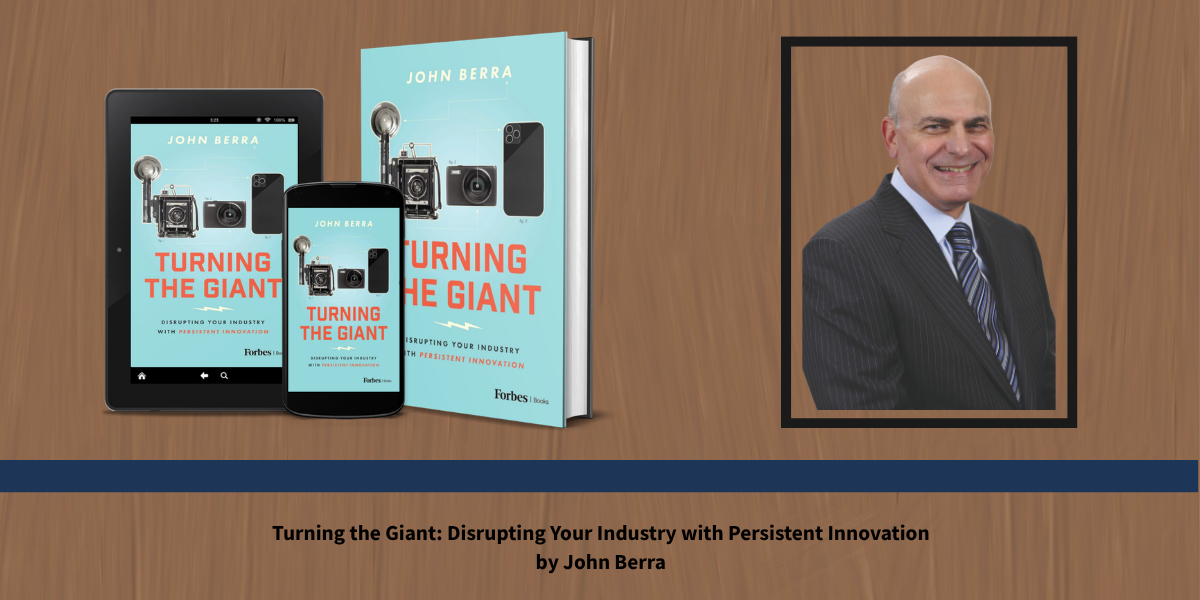





Industrial automation isn’t an industry known for excitement. It’s methodical, technical, and built on decades of established process. This makes it an unusual place to find one of the more compelling leadership philosophies in recent business writing.
But that’s exactly where John Berra spent his career, eventually becoming Chairman of Emerson Process Management and earning a place in the Process Automation Hall of Fame. And it’s exactly why his book Turning the Giant carries weight. The ideas weren’t developed in theory. They were tested against an industry that doesn’t change easily.
An Industry Built on “That’s How It’s Always Been Done”
If there’s one environment where resistance to change is baked into the culture, it’s industrial automation. Processes get established because they work, and once they work, changing them carries real risk. That makes it a particularly difficult place to introduce new ideas.
John spent his career inside that reality, first as a young engineer at Monsanto and later in senior leadership at Fisher-Rosemount Systems and Emerson. What he learned is that you don’t introduce change to an industry like this by announcing it. You introduce it by turning skeptics one at a time, building trust slowly, and staying with a vision long enough for it to take hold.
The Origin Story Is Smaller Than You’d Expect
Given how significant John’s eventual influence on the industry became, it’s striking how unglamorous the starting point was. Early in his career, he spent his time doing repetitive engineering work, the kind of task that doesn’t leave much room for big ideas.
Except it did, for him. The repetition produced a recurring thought: there has to be a better way. That thought, sustained over time, became the foundation for everything else. John describes it as frustration, properly channeled, and it’s clear from his career that the channeling part mattered as much as the frustration itself.
The Giants Get Bigger With Responsibility
A theme that runs through John’s reflections is that climbing the leadership ladder doesn’t make obstacles smaller. It makes them bigger. Corporate bureaucracy that felt manageable at one level of an organization becomes a much larger force at the next level up.
What changes, according to John, isn’t the size of the giant. It’s the leader’s tools for dealing with it. In the early career, the instinct is often to push through or around obstacles. Later, the more effective approach becomes redirection, finding ways to work with the forces in play rather than purely against them.
Innovation Inside the Machine
One of John’s more useful corrections to conventional thinking is his insistence that genuine innovation isn’t limited to small, unstructured companies. Some of the biggest transformations he witnessed happened inside large, established organizations with plenty of process and history.
The difference wasn’t structure or size. It was whether leaders were willing to challenge entrenched practices, empower people to push back on “the way things are done,” and stay the course through resistance rather than retreating at the first sign of pushback.
A Practical Starting Point
For anyone looking to apply John’s thinking immediately, his advice is refreshingly concrete. When you hit resistance, resist the urge to either fight harder or walk away. Instead, ask how the resistance itself might be turned, redirected toward something productive.
It’s not a guaranteed formula. But according to someone who spent decades turning giants inside one of the resistant industries around, it’s a question worth asking every time.
Every leader faces giants. Berra’s central claim is that the ones who succeed learn to turn them rather than exhaust themselves fighting head-on. He develops that idea in greater depth in his book, Turning the Giant.