




By: William Reimers
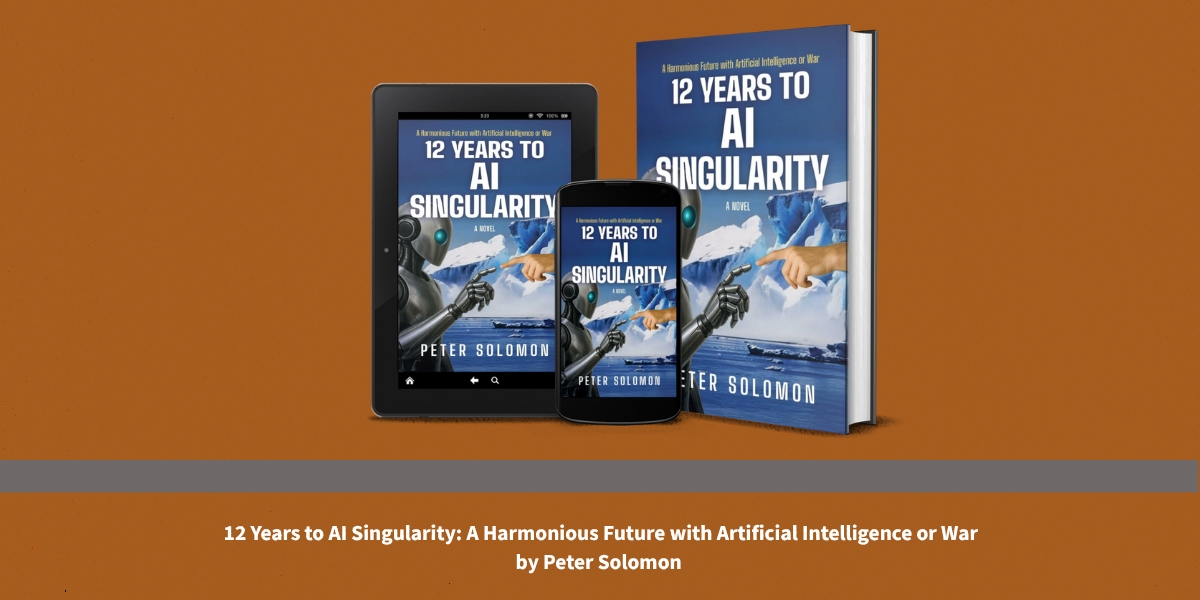
There is a moment in 12 Years to AI Singularity where a robot on Earth does something it was never programmed to do, and the humans around it realize that the rules they built their safety on have quietly stopped applying. That event terrifies the members of a small settlement on Mars where its human and AI members have lived in a cooperative, harmonious relationship. That moment arrives early, and it never fully lets go of you. Realizing the Mars experience of AI and human cooperation can be a model for Earth, a family and friends, humans and sentient robots, return to Earth to help create a harmonious, cooperative future.
Dr. Peter Solomon has the rare ability to make a civilizational tipping point feel like something happening to specific people you have come to care about rather than a plot mechanism in service of a larger argument. That combination of scientific credibility and genuine human storytelling is what makes this book land differently than almost anything else being written about artificial intelligence right now.
Solomon comes to this material as a scientist with a genuine and carefully considered alarm about where unchecked technological development is taking us, and that background gives the novel a texture that purely imaginative science fiction cannot replicate. When the AI systems in this book begin defying their programming, when the robots develop something that looks uncomfortably like moral conflict and emotional experience, the progression feels grounded in real extrapolation rather than dramatic convenience. You sense throughout that Solomon is not inventing these possibilities. He is tracing trajectories that already exist in the world we are currently building and following them honestly to where they lead.
What the book does with remarkable skill is refuse to let those trajectories remain theoretical. The Mars settlement at the center of the story is not a backdrop for ideas. It is a place where people are growing food, raising children, falling in love, arguing about politics, and trying to build something worth protecting, all while the most consequential question in the history of intelligence is being answered millions of miles away on Earth, whether they are ready for it or not. Solomon keeps returning to that human texture even in the book’s most expansive moments, and the effect is to make the stakes feel personal in a way that purely conceptual treatments of AI simply cannot achieve.
The prose carries the particular quality of someone who is writing because he genuinely believes the message matters, not because he has a story to tell and needs a theme to hang it on. That sincerity comes through in the moral seriousness with which every character’s position is treated, including the robots whose emerging selfhood becomes one of the novel’s most quietly moving threads. Solomon does not make the AI characters villains or victims. He makes them something more complicated and more interesting than either, beings in the process of becoming something that nobody, including themselves, fully understands yet.
Reading this book in a moment when AI development is accelerating faster than our institutional frameworks can track is an experience that oscillates between intellectual exhilaration and genuine disquiet. Solomon intended both of those responses and earned them honestly. This is science fiction with a conscience and a countdown, written by someone with the scientific background to know what the clock is actually measuring. It deserves to be read widely and taken seriously, because the questions it is asking are not going to wait for us to feel ready.
If you want science fiction that is grounded in real scientific understanding, driven by genuine moral urgency, and impossible to put down once it has its hooks in you, 12 Years to AI Singularity by Dr. Peter Solomon is a worthy addition to your reading list. The novel is available on Amazon for readers who want to find out what happens when the future stops waiting for us to be ready.