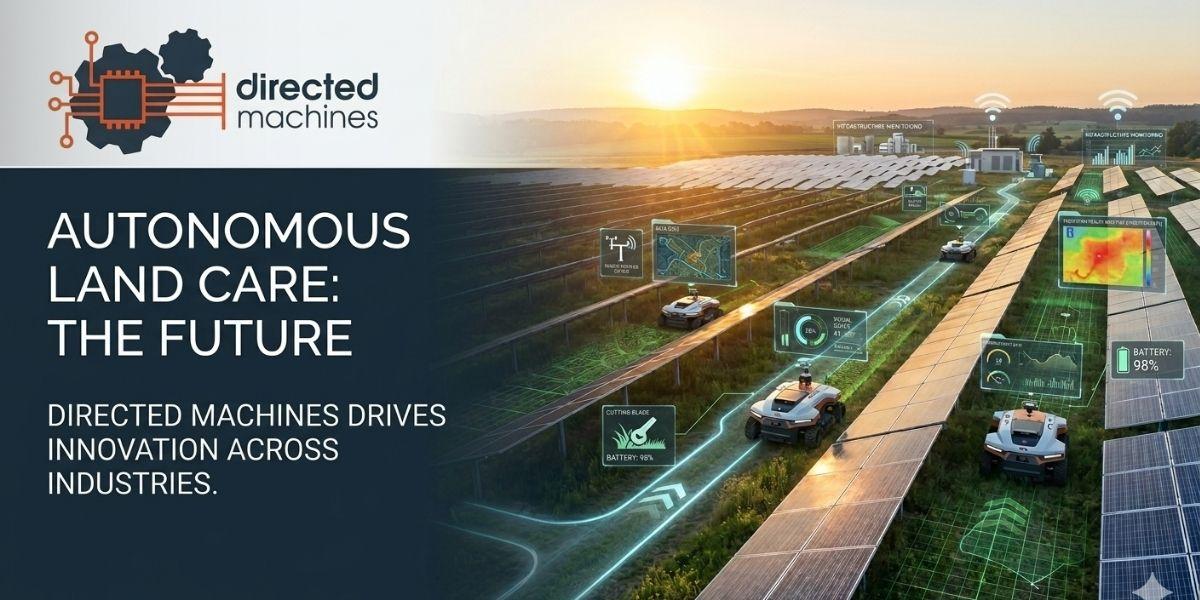




Automation Expands Into Outdoor Infrastructure
As industries across the United States continue to adopt automation and electrification, a growing number of companies are focusing on technologies designed to improve operational efficiency while reducing environmental impact. Among the firms operating within this emerging space is Directed Machines, a Seattle-based robotics company developing autonomous electric systems for land care management across sectors such as agriculture, renewable energy, airports, turf maintenance, and roadside operations.
Founded in 2018, Directed Machines specializes in the development of what it calls “Land Care Robots” (LCRs), autonomous electric machines capable of performing tasks including mowing, towing, vegetation management, inspection, and hauling. According to the company, the machines are designed to operate in structured and unstructured outdoor environments while reducing dependence on fossil fuels, herbicides, and labor-intensive workflows.
The Development of Autonomous Land Care Robots
The company’s emergence reflects a broader trend toward automation within agriculture and infrastructure management industries, where labor shortages, rising operational costs, and environmental concerns are driving investment into autonomous systems. In sectors such as utility-scale solar farms and large agricultural operations, vegetation management has traditionally relied on gas-powered machinery and chemical herbicides.
Directed Machines positions its electric robotic systems as an alternative approach focused on mechanical land care and autonomous operation. At the center of the company’s operations is its Land Care Robot platform, described as a compact, bi-directional, electric machine capable of both remote-controlled and autonomous operation.
The robots are engineered for multiple applications, allowing operators to configure a single platform for mowing, towing, grading, or site inspection, depending on operational requirements.
Applications Across Multiple Industries
According to company materials and industry profiles, Directed Machines has deployed its robotic systems across multiple verticals in North America, including solar farms, golf courses, nurseries, airports, and agricultural environments.
The company states that its systems are designed for all-weather operation and can function continuously in environments where conventional land care methods may require larger labor teams or higher fuel consumption.
In addition to mowing and towing capabilities, the machines can reportedly integrate inspection tools and sensors for identifying infrastructure issues or monitoring environmental conditions across large operational sites.
Sustainability and Environmental Objectives
One of the more notable aspects of the company’s positioning is its emphasis on sustainability and environmental impact. Directed Machines states that its robots are fully electric and intended to eliminate greenhouse gas emissions associated with conventional fuel-powered land management equipment.
The company also promotes herbicide-free vegetation management as part of its operational model. This focus aligns with increasing regulatory and public attention surrounding environmental practices in infrastructure and agriculture.
Industry discussions surrounding sustainable land care have increasingly highlighted concerns related to chemical herbicide usage, soil quality, worker exposure, and ecological impact. Directed Machines has stated that some deployment sites using its systems have reported reduced noise pollution and increased biodiversity compared to traditional equipment operations.
From Solar Robotics to Broader Infrastructure Solutions
The company’s development history also reflects the growing overlap between robotics, climate technology, and renewable energy infrastructure. Prior to adopting the Directed Machines name, the business reportedly operated under the name dCentralized Systems and initially focused on solar-powered robotic concepts and autonomous weeding technologies.
Over time, the company expanded its platform into broader industrial land care applications. This transition mirrors a wider trend within the robotics sector, where companies are increasingly adapting autonomous technologies for practical infrastructure and operational use cases.
The Growing Role of Robotics in Land Management
Industry observers have increasingly identified automation as a significant growth area within land management and agricultural technology markets. The integration of robotics into outdoor operations has accelerated in recent years as organizations seek methods to improve productivity while reducing operational overhead.
Directed Machines has positioned itself within this expanding category by focusing on electric autonomous systems capable of long-duration outdoor deployment. The company has also emphasized scalability as part of its business model, particularly in utility-scale and industrial environments where vegetation management and infrastructure maintenance are recurring operational challenges.
A Broader Shift Toward Autonomous Environmental Technologies
As automation continues to reshape traditional industries, companies developing autonomous electric machinery are expected to play an increasing role in operational infrastructure. Analysts across the robotics and climate technology sectors have noted growing interest in solutions capable of addressing both labor shortages and sustainability goals simultaneously.
While the long-term adoption of autonomous land care systems will depend on factors including cost efficiency, scalability, infrastructure compatibility, and regulatory considerations, the sector itself continues to attract attention from agriculture, renewable energy, and industrial operations stakeholders.
With its focus on autonomous electric robotics for land care and infrastructure management, Directed Machines represents one example of how robotics companies are attempting to bridge operational efficiency with environmental sustainability through automation-driven technologies.