




By: Ethan Rogers
Los Angeles has long attracted people looking to reinvent themselves. For Praveen Saravanan, that reinvention is taking place at the intersection of graduate education, artificial intelligence, and the unpredictable path of building a future in a new country.
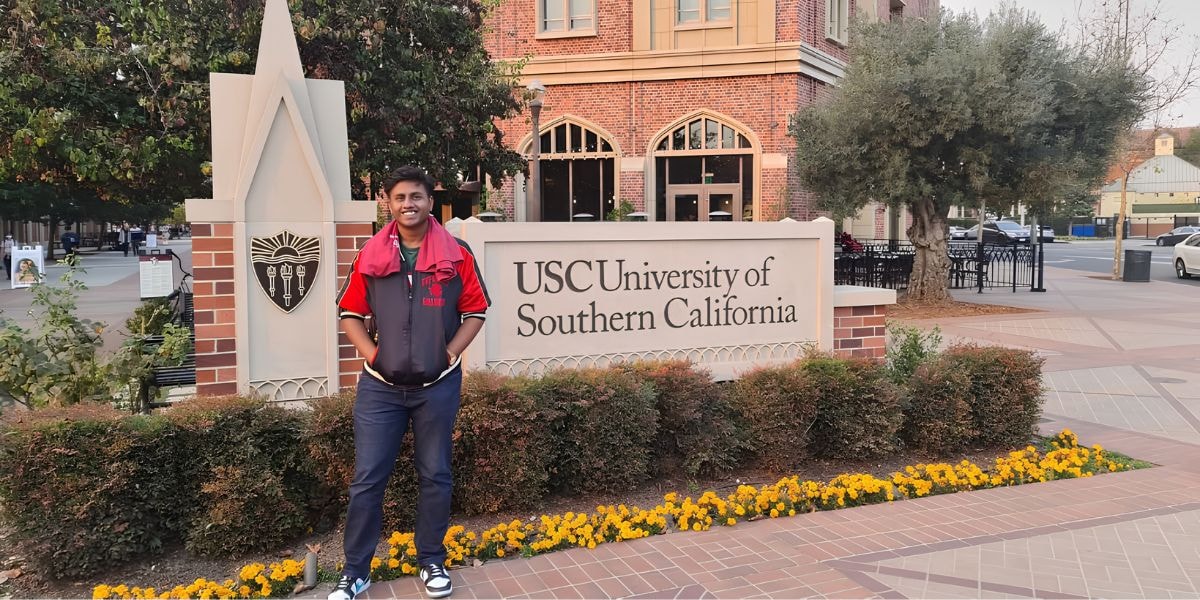
Praveen is currently pursuing a Master’s in Computer Science at the University of Southern California, but describing him only as a graduate student would leave out much of the story. Before arriving in Los Angeles, he had already spent years working inside the evolving world of artificial intelligence, joining Lyzr AI as its fourth employee and helping build AI products, software development kits, and autonomous agent frameworks from the ground up.
Now, his move to Los Angeles represents more than an academic transition. It is a personal and professional reinvention, one that reflects a new generation of international technologists arriving in the United States with experience already behind them and ambitions that extend beyond the classroom.
For Praveen, the central question has not simply been what he can learn. It has been what he can build.
That distinction has shaped many stages of his journey.
From Studying Technology to Shipping It
Praveen’s relationship with artificial intelligence developed through execution rather than observation. While many young engineers encounter emerging technology through coursework, research papers, and personal experiments, his early career placed him inside the pressure of an early-stage startup.
As one of the early engineers at Lyzr AI, Praveen worked across products, SDKs, autonomous agent frameworks, voice AI, enterprise AI systems, prospecting engines, and conversational workflows. Products he helped build have reached more than 65,000 users, and he contributed to multiple launches that ranked on Product Hunt. His technical work has also extended into research, including a patent application involving adaptive learning rates, a national journal paper on generative AI and logical reasoning, and a published book chapter on smart campus initiatives.
The experience changed how he understood technology.
Instead of seeing engineering as an isolated technical discipline, he began viewing it as a cycle: identify a problem, build quickly, listen to users, improve the product, and repeat. That cycle became a defining part of his professional identity.
In late 2023, while still completing his undergraduate education, Praveen was already working deeply with Lyzr AI. The safer path would have been to concentrate exclusively on his studies, earn his degree, and pursue a conventional job afterward. Instead, he found himself increasingly drawn to the immediacy of startup work.
Within months, the team began selling its first product. Seeing software move from an idea to something used by real people gave Praveen a new understanding of impact. The work was no longer theoretical. Code could become a product, a product could solve a problem, and a small group of people could create momentum beyond themselves.
That experience created a difficult tension. Praveen wanted to continue building, but he also wanted to complete his education.
Rather than choosing one path, he attempted both.
For two semesters, he maintained a schedule that often stretched to 16-hour days. The result was not a clean story of effortless balance. It required discipline, sacrifice, and constant decisions about where his attention mattered most. Ultimately, he graduated First Class with Distinction while continuing his work in AI.
The lesson he carried forward was simple: ambition may create momentum, but discipline determines whether that momentum can last.
Los Angeles as a New Starting Point
Arriving in Los Angeles introduced a different kind of challenge.
Praveen was no longer only trying to build products. He was also learning how to establish himself inside a new technology ecosystem, navigate the realities of being an international student, continue developing technically, and determine what kind of operator he wanted to become.
USC gave him access to a major research university and a new network, but Praveen did not arrive with the mindset of waiting until graduation to begin his career.
He had already experienced the intensity of early-stage building.
He knew what it felt like to ship a product before every detail was perfect, to work through ambiguity, and to learn from users rather than assumptions. Los Angeles became a new environment in which to expand that experience rather than replace it.
His story is part of a broader change in how technical careers are being built. The traditional sequence, study, graduate, find a job, and then begin gaining practical experience, is becoming less universal. For a growing number of young engineers, particularly those working in AI, learning and building happen simultaneously.
Praveen sees himself within that shift.
His goal is to become what he describes as a technical founder-operator: someone capable of writing code deeply, understanding product decisions, communicating ideas clearly, and moving quickly through uncertain environments.
That combination can be especially relevant in artificial intelligence, where technical capability alone does not necessarily create a useful product. The industry is moving quickly, but Praveen believes the opportunity belongs to builders who can connect emerging capabilities with actual user needs.
For him, curiosity is useful when it leads to execution.
The instinct is straightforward: What can be built with a new technology? Who would actually use it? How can it become useful?
Those questions have followed Praveen from his early work in India to his current chapter in Los Angeles.
Building Before Feeling Ready
One of the important ideas shaping Praveen’s approach is the belief that meaningful work often begins before a person feels fully prepared.
Perfect credentials, complete confidence, and flawless plans rarely arrive at the same time. Waiting for all three can become its own form of paralysis.
Praveen’s experience has taught him to begin with what is available and improve through execution. He believes that every shipped product, failed attempt, difficult conversation, late night, and small victory can compound into something larger over time.
That philosophy does not mean glorifying endless work or taking unnecessary risks.
A serious bike crash became an important point of reflection in his life. The experience changed how he viewed risk, pushing him away from the idea that risk itself should be celebrated. Instead, he began thinking more carefully about the difference between reckless decisions and intentional commitments.
For Praveen, meaningful risk means understanding what matters enough to pursue seriously and then accepting the uncertainty that comes with pursuing it.
That distinction has become especially relevant as he builds a life in the United States.
International students often operate under pressures that are invisible from the outside: immigration uncertainty, academic expectations, career competition, and the feeling that every decision carries unusually high stakes. Praveen does not see those constraints as the entirety of his story, but he acknowledges that they have influenced the way he approaches opportunity.
Being an outsider, in his view, can sharpen a person’s willingness to learn quickly and build from scratch.
A New Generation of Global AI Builders
The AI industry is often discussed through models, funding rounds, benchmark scores, and predictions about what the technology might eventually become.
Praveen’s story offers another perspective: the people building the systems.
Many of the engineers shaping the next phase of artificial intelligence are globally mobile, technically ambitious, and comfortable working across boundaries that once separated research, software engineering, product development, and entrepreneurship.
Praveen reflects that emerging profile.
His experience at Lyzr AI gave him exposure to the realities of building enterprise AI products at an early stage. The company, founded in 2023, develops infrastructure designed to help enterprises build, govern, and operate AI agents in production environments. Praveen’s portfolio describes his work as spanning autonomous agents, voice AI, enterprise transformation systems, prospecting engines, conversational AI workflows, and SDK development.
But his long-term ambition extends beyond any single role.
Over the next several years, Praveen wants to continue developing into a technical founder and operator, building products at the intersection of deep technology, real user needs, and practical execution. Areas of interest include autonomous agents, voice AI, enterprise automation, AI infrastructure, and product-led AI systems.
The goal is not simply to understand artificial intelligence.
It is to make it useful.
That may be an important thread connecting the different chapters of his journey. From joining an early-stage startup to balancing engineering work with college, from India to Los Angeles, and from technical execution to founder-level ambition, Praveen has repeatedly chosen environments where the outcome is uncertain but the opportunity to build is real.
Los Angeles is the latest chapter of that process.
At USC, he is expanding his technical foundation. In the American technology ecosystem, he is learning a new landscape. And through his continued work in AI, he is developing an identity that does not fit neatly into one category.
Engineer. Builder. Student. Emerging founder-operator.
For Praveen, those identities are not competing with one another. They are converging.
His journey in Los Angeles is still unfolding, but its direction appears clear. He is not waiting for the perfect moment to begin building a future in AI.
He has already started.