




By: Ethan Caldwell
For Jeremy Parsons, a career in music was never defined by a single dramatic moment when everything suddenly became clear. Instead, it grew quietly and persistently, one song, one performance, and one listener at a time. Music kept calling him back, whether he was writing, performing, discovering songs by other artists, or simply trying to understand why certain lyrics could reach so deeply into a person’s emotional life.
The turning point came less through revelation than repetition. Parsons began to see his private thoughts grow larger once they left the notebook. A song written alone could travel across a room and somehow become part of another person’s story. Shows led to more shows. Songs created new songs. Listeners became a community. Eventually, Parsons realized he was no longer waiting for someone else to validate the path he had chosen.
He was already living it.
That understanding, however, would be tested by one of the most difficult periods of his career: returning home after living in Nashville. Parsons had viewed the move to Nashville as a major step toward the career he imagined for himself. Coming home initially carried the uncomfortable feeling that he might be moving backward.
Instead, it became one of the defining experiences of his artistic life.
Parsons came to understand that a dream changing shape did not mean the dream had ended. He was returning with experience, relationships, mistakes, perspective, and a clearer understanding of the artist he wanted to become. More importantly, he stopped measuring progress by geography or by someone else’s definition of what a successful music career was supposed to look like.
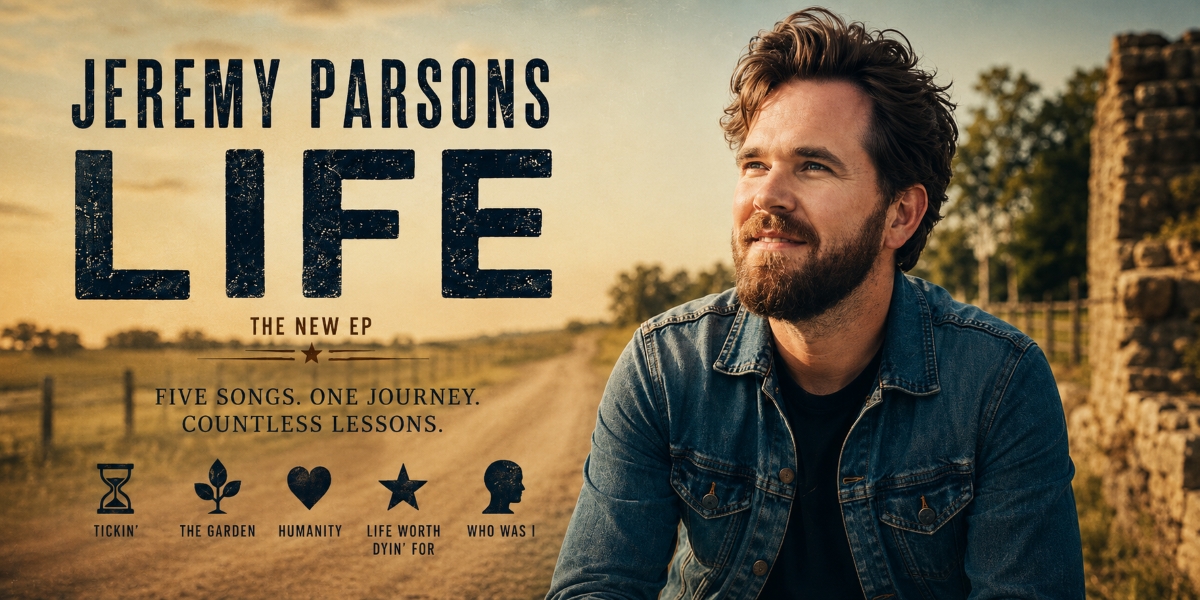
That philosophy runs through his deeply personal project, Life, a collection that finds Parsons confronting identity, time, mental health, purpose, humanity, and the complicated process of becoming someone new without completely abandoning the person you once were.
Parsons says the biggest difference between Life and his earlier work is his willingness to be direct. His songwriting has always drawn from personal experience, but he previously created distance through characters, imagery, and metaphor. On Life, he allowed himself fewer places to hide.
“Who Was I” forces Parsons to examine an earlier version of himself, including the decisions, confusion, and growth that ultimately led him to the present. “The Garden,” meanwhile, began with memories of his father, a horticulturist, before expanding into a meditation on mental health, care, neglect, and the difficult work required to nurture something back toward health.
Throughout the project, Parsons does not pretend to have solved life’s biggest questions. That uncertainty is part of the album’s appeal. Rather than delivering lessons from a position of authority, he sounds like someone working through the questions alongside the listener.
That search for connection has also helped Parsons’ music travel well beyond the places where it was created. International chart recognition has shown him how something intensely specific can become unexpectedly universal. A song written in Texas about memory, regret, love, grief, hope, or uncertainty can reach someone thousands of miles away because, underneath the details, human emotions remain remarkably similar.
For an independent musician, that realization carries special significance. Songs are often released without any certainty about where they might land. Discovering listeners in countries Parsons has never visited has reinforced his belief that music can create an emotional meeting place between strangers.
That same perspective has changed his definition of success.
Earlier in his career, Parsons imagined success as a destination, some major accomplishment that would finally prove he had arrived. The awards, chart positions, recognition, and opportunities still matter to him, but he has become increasingly careful not to let temporary achievements determine his happiness.
Success now looks more sustainable and personal: making honest music, developing as a songwriter and performer, reaching new listeners, playing meaningful shows, and knowing that each record represents growth from the one before it.
His personal life has expanded that definition even further. Parsons recently married and is building a life with someone he loves, which has reminded him that music, while enormously important, cannot be the only measure of a life well lived. Peace, relationships, health, gratitude, and simply being present have become equally significant.
Much of Life was written during a period when the outside world suddenly stopped moving. Touring, shows, travel, and the usual indicators of professional momentum disappeared, leaving Parsons to reconsider not only how he created but why.
The experience sharpened his appreciation for ordinary human connection: conversations, meals, gatherings, standing beside another person, or occupying a room where people are collectively experiencing music. It also caused him to reconsider ambition itself. Achievement without meaningful connection, he discovered, could feel surprisingly empty.
Musically, Parsons continues to draw on country, folk, Americana, and the Texas songwriting tradition, citing Guy Clark, Townes Van Zandt, Rodney Crowell, Robert Earl Keen, Radney Foster, and Steve Earle as important influences. Yet he refuses to let genre become a fence around his creativity. His allegiance remains primarily to the song.
That may ultimately be the clearest way to understand Life and Jeremy Parsons himself.
He is fascinated by time, memory, relationships, identity, and growth not because he believes he possesses answers, but because he remains interested in the search. His songs document a person willing to acknowledge mistakes, appreciate change, remain grateful, and continue forward.
And Parsons hopes that when listeners finish Life, they will not simply understand him better.
He hopes they might understand something about themselves, too.