




By Daniel Harrington
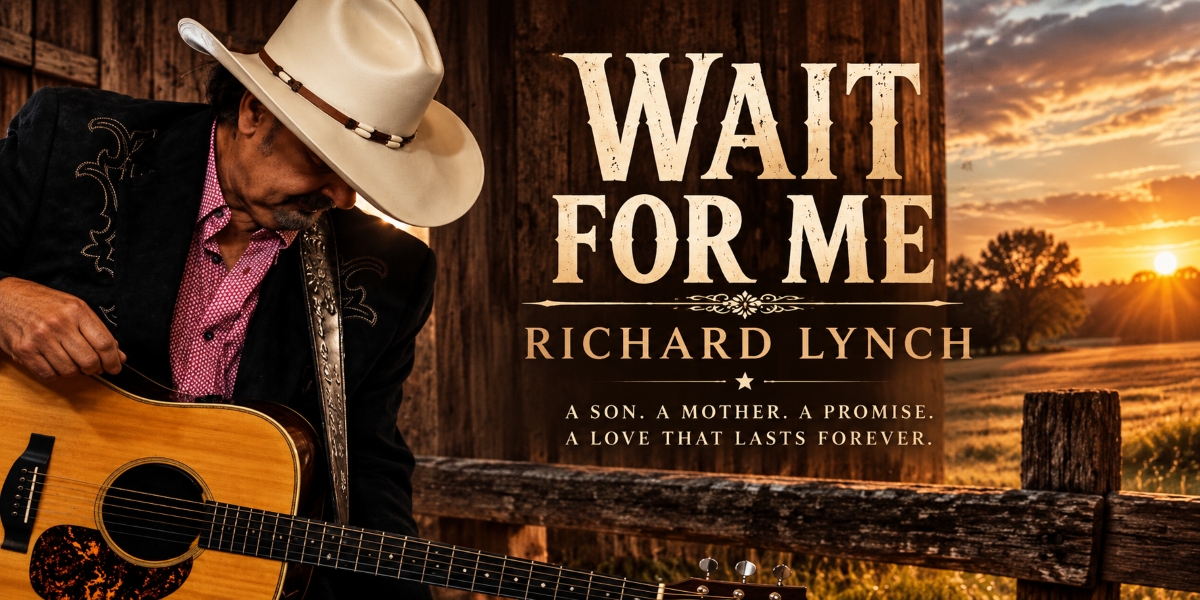
There are songs you admire for their craftsmanship, songs you play because the chorus refuses to leave your head, and songs that manage to stop you completely. Richard Lynch’s “Wait For Me” belongs firmly in that final category. This is not simply another traditional country ballad about loss. It is a deeply human account of a son, his mother, and the terrifying realization that there may only be minutes left to say what a lifetime somehow never adequately expressed.
Co-written by Lynch and John Lee, “Wait For Me” begins quietly. Lynch recalls visiting his mother and finding her asleep. He stays beside her, holds her hands and begins to cry.
Immediately, though, the lyric makes an important distinction. These are not simply tears of grief. They are tears of thankfulness and joy.
And then Lynch looks at those hands.
That is where this very good country song becomes something exceptional.
The hands become a map of his mother’s life. They comforted him when he was a boy. They wiped away tears, soothed pain, stitched clothes and performed the countless everyday tasks through which parental love is expressed without fanfare.
Lynch even sings of those hands having “moved mountains.”
In isolation, that phrase might sound like exaggeration. Within this song, it feels entirely justified. Anyone fortunate enough to have been raised by a loving parent eventually discovers that many of the things that seemed effortless during childhood required extraordinary effort from somebody else.
As children, we see the result.
As adults, we finally begin to understand the cost.
Then comes the call.
Lynch learns his mother is ready “to leave with God.” She has made peace. She has always believed. But her son is not quite ready for goodbye.
“Momma, I’m on my way.”
Four words, followed by the plea around which everything revolves:
“Hold on, wait for me.”
It is breathtaking precisely because it is so uncomplicated.
There is no elaborate metaphor because nobody receiving that phone call would have time for one. The universe suddenly contracts to two questions: Can I get there? Will she still be there?
Lynch’s vocal is ideally suited to this kind of material. His voice possesses the seasoning of a man who has lived enough life to understand what he is singing. There is no unnecessary theatricality, no attempt to turn sorrow into a vocal showcase. He simply tells the story.
That restraint matters.
“Wait For Me” contains enough emotional ammunition to become unbearably sentimental in the wrong hands. Motherhood, death, childhood memories, faith and heaven all occupy the same song. Yet Lynch never appears interested in forcing the listener to cry.
Instead, he gives us reasons to remember.
The arrangement follows the same philosophy. Traditional country textures support rather than overwhelm the narrative. Nothing fights Lynch for attention because everyone involved appears to understand that the lyric is the star.
The song’s third verse may be its finest.
Lynch wonders whether his mother’s hands are tired now, whether they sometimes ache because of everything they have done “for someone else’s sake.” Then comes the realization that perhaps, during those final moments together, he managed to return some tiny portion of what she had spent a lifetime giving him.
“Maybe I gave you a little comfort back, in some small way.”
That line is quietly devastating.
How do you repay a mother for decades of love?
You don’t.
You sit beside her.
You hold her hand.
You show up.
Faith provides “Wait For Me” with hope, but importantly, it never eliminates the sadness. Lynch’s mother believes in God and has made peace with leaving. Her son believes too, yet he still races toward her.
That is one of the song’s most truthful observations. Belief in eternity does not make earthly separation painless. Faith and grief can coexist.
Then the ending arrives.
“Your pain is gone / Now you can rest.”
And finally:
“You held on / You waited for me.”
Those words change the entire song.
The desperate request of the chorus has been answered. He made it. She waited. She knew he was there, and he was able to tell her how deeply she was loved.
There is no grander miracle required.
Richard Lynch has spent years standing resolutely on the traditional side of country music, and “Wait For Me” demonstrates why that tradition remains essential. Country’s greatest strength has never been a particular instrument, production style or wardrobe. It has been its ability to take experiences millions of people endure privately and turn them into stories we can share publicly.
Parents age.
Children become caregivers.
Hands that once seemed impossibly strong become fragile.
And suddenly all the time we assumed was available becomes precious.
“Wait For Me” understands every part of that transition.
This is a song about death, certainly, but calling it merely sad misses its real achievement. It is overwhelmingly about gratitude. Lynch isn’t simply mourning what he is losing. He is recognizing everything he was fortunate enough to receive.
That makes the song’s message impossible to ignore.
Call your mother.
Call your father.
Visit the person you keep promising you’ll visit.
Say thank you.
Say “I love you.”
Because one day, “later” becomes “now,” and eventually even “now” disappears.
Richard Lynch’s “Wait For Me” is traditional country storytelling at its most effective: simple without being simplistic, emotional without becoming manipulative, and deeply personal while somehow feeling universal.
Most songs end when the music stops.
This one leaves you thinking about whose hand you wish you could hold.
And whose hand you still can.