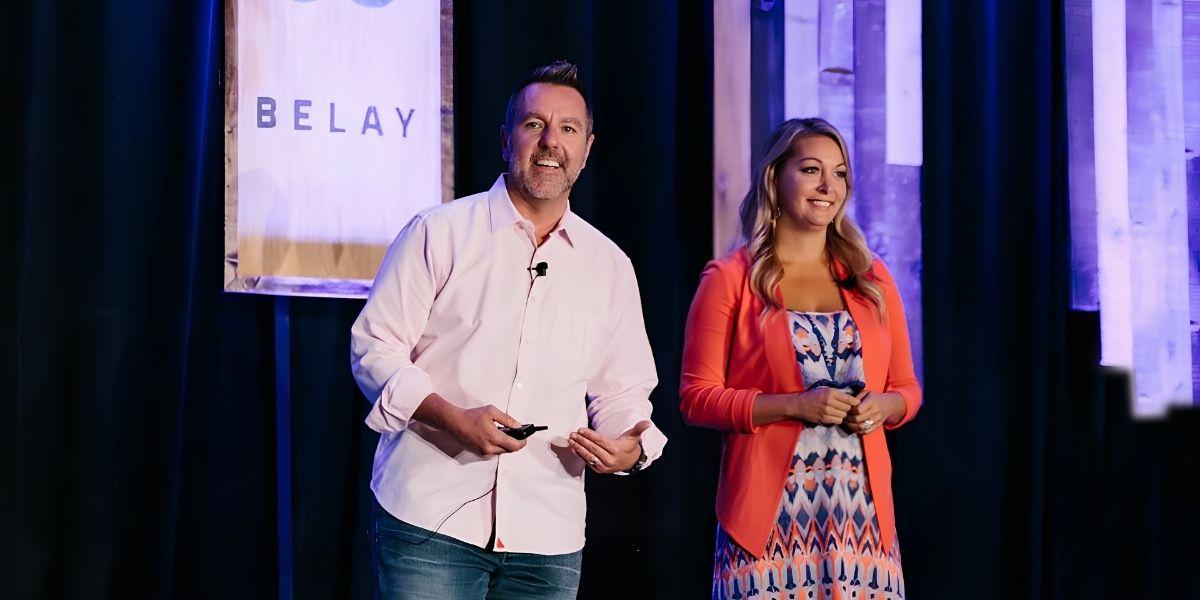




Over the past couple of years, the nature of work has changed more profoundly than it has during any other period in modern business history. This shift, from working in an office to hybrid and remote operations, which used to be considered quite unconventional, has grown into a defining trend for small businesses and billion-dollar corporations alike. According to a 2024 McKinsey study, approximately 58 percent of U.S. workers were able to work at least one day a week remotely, compared with about 24 percent before 2010. But this sea change was not simply due to improved technology; it was due to entrepreneurs who, long before it went mainstream, realized the potential power of virtual collaboration. Included within that first generation of this movement’s pioneers were Bryan and Shannon Miles, whose vision for a company would become BELAY, one of America’s virtual staffing services companies.
How Bryan and Shannon Miles Founded BELAY
BELAY’s story started in 2010 when the couple, both graduates of Mount Vernon Nazarene University in Ohio, opted out of traditional employment to take up an idea they felt was a bit ahead of its time. The Miles observed that small businesses and executives were consistently finding it hard to handle operations efficiently while managing growth demands and, especially, administrative and bookkeeping tasks. They recognized a growing gap between available talent and companies that could not afford full-time, on-site staff. This insight provided the founding principle for BELAY in offering virtual assistant, bookkeeping, and social media management services to clients across the country.
In an era where the term “virtual assistant” had yet to become a household name among most American businesses, BELAY created a model that focused on not just quality but also cultural alignment. The early growth at BELAY was fostered through a wave of talented remote workers, many of whom were seasoned professionals who sought flexible work opportunities outside the constraints of traditional office settings. In the first few short years, BELAY proved the scalability of remote staffing, maintaining consistent client satisfaction while growing rapidly year over year. BELAY was called one of the fastest-growing private companies in America by Inc. Magazine, ranking on the Inc. 5000 for ten consecutive years from 2014 through 2023.
Building a Remote-First Culture in Virtual Staffing
Along the way, BELAY made it a point to emphasize company culture, unusual for a typically isolated, transactional industry. Entrepreneur Magazine listed it as one of the best organizations to have in terms of workplace culture, mentioning how the leadership encouraged transparency and autonomy among their employees and contractors. While remote work was often associated with the early 2010s phenomenon of being a disconnected team, Miles created practices where trust and accountability were cornerstones of the organization. It would later mirror principles many corporations adopted during the pandemic years of 2020 and 2021, when continuity depended on remote collaboration.
By 2018, BELAY was supporting thousands of organizations across the United States, many small and mid-sized companies that were increasingly dependent upon remote staff to support administrative and financial work. The success of the firm coincided with the broader evolution of the digital workplace, supported by technologies ranging from cloud storage and video conferencing to project management platforms. According to Statista, the virtual assistant market in North America had surpassed $8 billion by 2022, a figure that shows how mature the sector has become very quickly. BELAY’s longevity and continued ranking on national growth lists have proven that early adaptation, paired with disciplined leadership, has enabled it to compete effectively in this crowded, fast-changing field.
In 2020, when the COVID-19 pandemic reached its height, BELAY’s leadership appeared on CNBC to discuss how the company’s remote-first structure positioned it toward this shift in global work patterns. While many organizations scurried to go online, BELAY’s operations were already fully virtual. The Miles contended that good remote work requires not just technology but also intentional management principles: measurable goals, discipline in communication, and trusting in distributed teams. Their stress on these fundamentals contributed to BELAY’s continued stability through one of the modern economy’s most volatile periods.
Life After BELAY and the Rise of Miles AG
BELAY reached another milestone as the founders stepped back from daily operations and the company moved into a new ownership chapter. That transition capped fifteen years of disciplined leadership and showed how a remote service firm could mature into a substantial, well-established business. Bryan and Shannon Miles then turned their attention to fresh pursuits through their holding company, Miles AG, expanding into hospitality, craft brewing, and sports ventures. BELAY stayed the cornerstone of their professional story, the foundation on which their later projects were built.
What BELAY’s Story Means for the Remote Work Economy
In the context of American entrepreneurship, BELAY’s trajectory may serve to illustrate how small innovations in workflow design can create major business transformations. By fusing traditional management values with the flexibility of digital operations, the company bridged the gap between freelancing and structured remote employment in its early days. It also influenced how employers thought about outsourcing core administrative functions, proving that productivity need not be constrained by geography.
The recognition BELAY received throughout its history also placed the company within a broader conversation about work-life balance and the changing definition of employment. Money.com and Entrepreneur, among others, featured the founders in articles that explored how married couples, or co-founders, move through a high-growth venture while keeping the professional and operational elements of the business in focus.
By the time the founders moved on to their next ventures, BELAY had grown from a small startup to a recognized name in virtual staffing, with thousands of contractors working for the company and serving clients across many industries. Having been recognized by Inc. Magazine for a decade, along with cultural accolades from Entrepreneur and sustained national media, it would make for a compelling case study in the rise of virtual work models. Although many companies that used technology to thrive came onto the scene about the same time, what made BELAY stand out was its combination of human-centered management with scalable systems, along with helping to forge a path for businesses to address remote working long before it became a more widespread model.
The continued presence of Bryan and Shannon Miles in the business community reflects both their early embrace of remote working principles and BELAY’s standing as an established player in virtual staffing. BELAY’s contribution to modern workplace structures fits into global discussions about the changing nature of work, now woven together with the digital systems that support traditional business management.