


Hotels, restaurants and destinations have never been easier to find. The Jones believes knowing which ones are actually worth your time has never been harder.
There is a strange problem with having the entire world at your fingertips.
You still have to decide where to go.
Search for a hotel in Paris and hundreds appear.
Look for restaurants in Los Angeles and there are thousands.
Open social media before a trip to Italy and within minutes you can save enough hotels, beach clubs, restaurants, villas and “hidden gems” to fill three summers.
We have more recommendations than any generation in history.
What we increasingly lack is conviction.
Not another list of 50 restaurants.
Not every five-star hotel in a city.
Not whatever happens to be trending this week.
Just someone willing to say:
Go here.
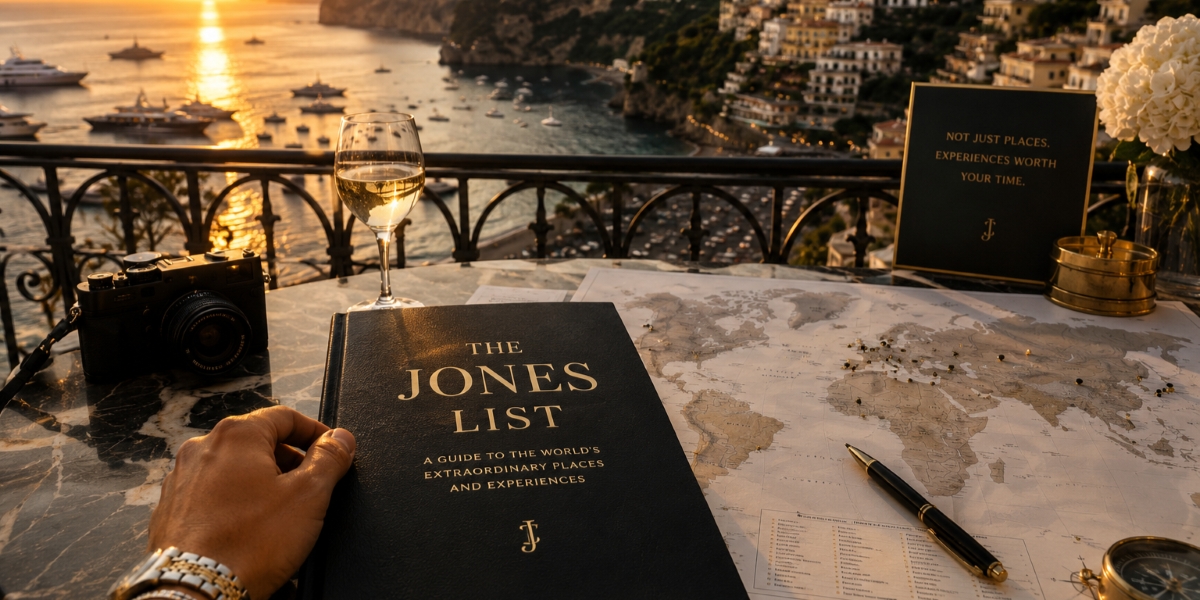
That is the idea behind The Jones List, the curated global guide being built at the center of The Jones luxury platform.
Its ambition isn’t to catalog the luxury world.
It is to edit it.
The Internet Solved Discovery, Then Created Another Problem
Travel discovery used to be difficult.
People relied on guidebooks, travel agents, magazines and recommendations from friends who had already been somewhere.
The internet changed that.
Today, nearly any hotel, restaurant or destination can be discovered in seconds.
But abundance created a different problem.
Too much choice.
A traveler planning three nights in New York doesn’t need 1,200 restaurant options.
Someone spending a week on the French Riviera doesn’t need a database containing every beach club between Saint-Tropez and Monaco.
They need to know which ones are actually worth giving part of their trip to.
That distinction is important because the scarcest resource in luxury travel often isn’t money.
It’s time.
You only get so many dinners in Paris.
So many sunsets in Santorini.
So many mornings on Lake Como.
So many nights in Tokyo.
Choosing the wrong place costs something considerably more valuable than the bill.
It costs part of the experience.
What Makes The Jones List Different
The Jones List is being developed around a deliberately simple philosophy:
Not everything belongs on it.
The platform is intended to curate standout hotels, restaurants, resorts, bars, beach clubs, cultural destinations and experiences across the world’s most compelling cities and destinations.
But inclusion isn’t designed to function as a directory listing.
It is a recommendation.
That means asking questions that cannot always be answered by a star rating.
Does this place have a sense of arrival?
Would we actually send someone here?
Is there something memorable about the experience?
Does it understand its location?
Is the service exceptional?
Does the atmosphere justify the attention?
Would you still recommend it if nobody on social media knew about it?
And perhaps most importantly:
Is it worth someone’s time?
That final question may ultimately define The Jones List.
Luxury Doesn’t Always Mean the Most Expensive
The philosophy also allows The Jones to take a broader view of luxury.
Some experiences on the List will inevitably be expensive.
Legendary hotels.
Private villas.
Exceptional resorts.
Michelin-starred restaurants.
Yacht experiences.
Iconic sporting hospitality.
But price alone is a poor measure of whether something is extraordinary.
A tiny restaurant down an alley in Kyoto can produce a more memorable evening than the most expensive dining room in a city.
A morning espresso overlooking Lake Como can matter more than the suite it was served from.
A neighborhood institution in New York may belong beside a newly opened luxury restaurant because both deliver something exceptional in completely different ways.
The Jones is interested in quality of experience rather than simply cost of admission.
That distinction could prove important as the definition of luxury continues to evolve.
The Return of the Trusted Recommendation
There is something almost nostalgic about the model.
Before algorithms decided what people should see, great recommendations were personal.
A friend returned from Italy and told you exactly where to stay.
Someone who knew Paris gave you the name of the restaurant tourists hadn’t discovered.
A hotel concierge told you which table to request.
A person whose taste you trusted said:
Trust me.
That recommendation carried weight because the person making it had something at stake.
Their taste.
The Jones List is effectively attempting to scale that relationship.
The value isn’t in having the most listings.
The value is in developing enough trust that someone planning a trip eventually asks a different question.
Not:
“What are all my options?”
But:
“What does The Jones recommend?”
That is a much harder position to earn.
It is also considerably more valuable.
From a List to a Global Luxury Map
The long-term opportunity extends beyond individual recommendations.
As The Jones List expands geographically, it can become something closer to a curated map of an extraordinary life.
Imagine opening Los Angeles and seeing the hotels, restaurants, wellness destinations, cultural institutions and experiences actually worth knowing.
Then New York.
Miami.
London.
Paris.
Saint-Tropez.
Capri.
Lake Como.
Ibiza.
Tokyo.
Dubai.
St. Moritz.
Instead of beginning every trip with a blank search bar, travelers begin with an edited world.
The result isn’t merely another city guide.
It is a global point of view.
The Places Are Only One Layer
The Jones List also sits inside a larger ecosystem.
That distinction matters.
Traditional travel lists usually end once the recommendation has been made.
The Jones is being built so that discovery can lead somewhere.
A traveler might first encounter a destination through The Jones Media.
They could then use The Jones List to determine where to stay, eat and spend their time.
Through The Jones Concierge, the intention is to help translate those decisions into reservations, itineraries and bookings.
And for experiences that cannot simply be purchased through a standard booking engine, The Jones Access is being developed around private and hard-to-access opportunities.
The goal is to collapse the distance between:
“That looks incredible.”
and
“We’re going.”
Beyond Hotels and Restaurants
That becomes particularly interesting when The Jones List moves beyond traditional hospitality.
Because some of the world’s best experiences don’t have permanent addresses.
The Monaco Grand Prix.
The Kentucky Derby.
Wimbledon.
Cannes.
The Venice Film Festival.
St. Moritz Snow Polo.
Art Basel.
The Masters.
Royal Ascot.
These are not simply events.
For the right audience, they are anchors around which an entire trip can be built.
And even within those events, there are dramatically different levels of experience.
Where you stay matters.
Where you sit matters.
Where you eat afterward matters.
What party you attend matters.
Who can get you into the room matters.
The Jones therefore has an opportunity to curate not simply places, but moments.
Media Makes the List Feel Alive
That is also where The Jones’ emerging visual media strategy becomes important.
A traditional guide can tell someone that Finnish Lapland is worth visiting.
The Jones can place them beneath the Northern Lights for ten seconds.
A travel article can describe Monaco during Formula 1.
The Jones can put the viewer inside a garage moments before a race car rolls toward pit lane.
A hotel listing can describe a terrace in Santorini.
The Jones can give someone the sunset.
These short, immersive visual experiences turn discovery into something emotional.
You don’t merely understand why somewhere belongs on the List.
You begin to feel why you want to be there.
Curation May Become More Valuable in the Age of AI
There is another reason the timing of The Jones List is interesting.
The internet is entering an era of essentially unlimited information.
Artificial intelligence can generate itineraries instantly.
Search engines can surface thousands of options.
Social platforms can recommend endless places.
Content itself is becoming abundant.
When information becomes infinite, selection becomes valuable.
The important question may no longer be:
Can you find something?
Of course you can.
The question becomes:
Whose judgment do you trust?
That gives strong editorial brands an unusual opportunity.
Technology can organize the world.
But taste still determines which parts of it are worth experiencing.
The Ultimate Luxury May Be Not Wasting Your Time
There is an irony at the heart of modern luxury.
People spend extraordinary amounts of money trying to have extraordinary experiences.
Yet money cannot give them another Saturday in Capri.
Another dinner in Paris.
Another morning in Kyoto.
Another summer.
Time remains stubbornly finite.
Perhaps that is why curation matters more than it first appears.
A great guide doesn’t merely help someone spend money better.
It helps them spend life better.
The Jones List is being built around that responsibility.
Not to document every place in the world.
Not to chase every opening.
Not to confuse expensive with exceptional.
But to keep searching for the places, rooms, events and experiences that produce the simplest reaction of all:
I’m glad we came.
And in a world with unlimited options, that may be one of the most valuable recommendations anyone can make.