




By: Claire Donovan
Los Angeles knows something about ghosts.
They live in the bungalows tucked into Laurel Canyon, in old photographs of the Sunset Strip, in songs written decades ago that still drift from car windows on warm evenings. This is a city famously obsessed with reinvention, yet it remains strangely devoted to what came before. Maybe that contradiction explains why CattSue’s “A Whisper on the Wind” feels surprisingly natural here.
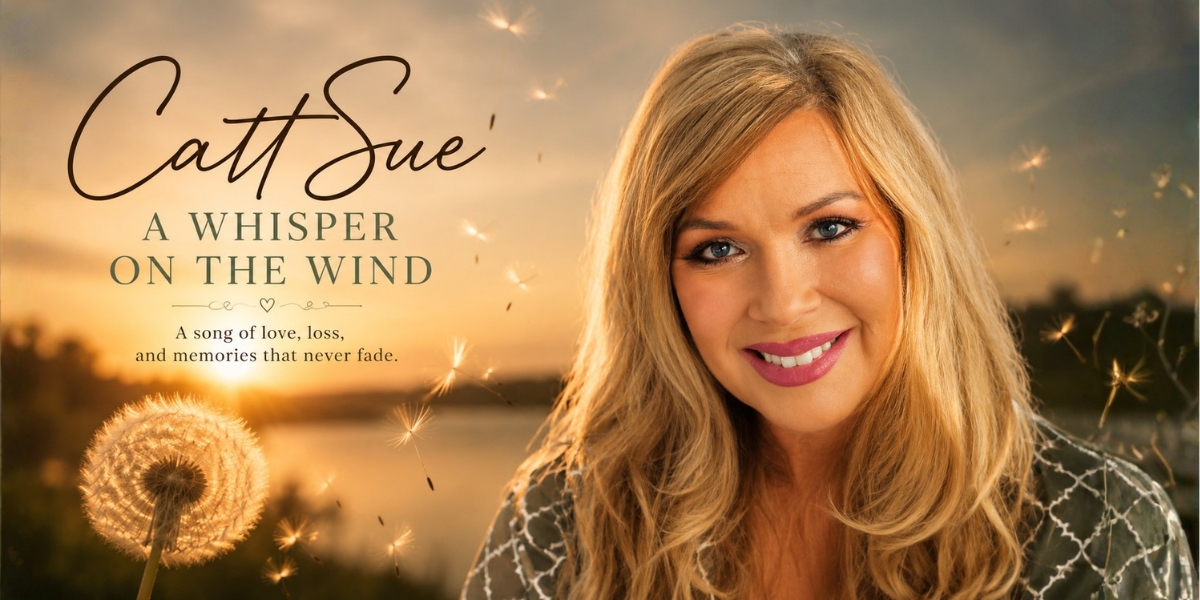
The Jacksonville-based singer-songwriter’s deeply personal single is far removed geographically from Southern California, but emotionally it belongs to a storytelling tradition Los Angeles has understood for generations. Even today, country, Americana, and singer-songwriter music maintain a visible presence around the city, from songwriter rounds to roots-oriented showcases and historic rooms such as the Troubadour.
“A Whisper on the Wind” would sound perfectly comfortable in one of those intimate rooms.
Not because CattSue is trying to recreate Laurel Canyon circa 1971. She isn’t. What connects her to that tradition is something more fundamental: the belief that an ordinary detail from one person’s life can become the doorway into something universal.
For CattSue, that doorway is Mrs. Beasley.
She was only four and a half when her mother died. Too young to comprehend death intellectually, she nevertheless understood absence. Her Mrs. Beasley doll became a source of comfort, something tangible to hold when the person she most wanted to hold was no longer there.
Decades later, that childhood object finds its way into “A Whisper on the Wind,” and its presence gives the song much of its emotional credibility. CattSue doesn’t simply tell us she misses her mother. She brings us into the confused world of a little girl trying to understand why Mom isn’t coming home.
That’s where the record becomes something more than another memorial ballad.
CattSue’s vocal is appropriately restrained. There’s no attempt to overwhelm the listener with vocal gymnastics, and the song doesn’t require them. She sings like someone telling you something important across a kitchen table, understanding that the story carries enough weight without theatrical assistance.
In Los Angeles terms, think less arena spotlight and more late set at a small Hollywood songwriter room, where everybody has finally stopped talking.
The song’s title provides its central metaphor. Her mother exists now in photographs, inherited stories, imagination, and those inexplicable moments when memory seems to arrive from nowhere, as a whisper carried through the air.
That’s particularly evocative in Southern California, where the wind has always seemed to possess a personality of its own. The Santa Anas announce themselves. They move through canyons, rattle windows, and alter the atmosphere. CattSue’s wind is gentler, but it performs a similar function: something invisible suddenly makes itself impossible to ignore.
The song becomes most affecting when CattSue confronts what she doesn’t remember.
She cannot clearly recall her mother’s voice. She cannot summon the sound of her saying her daughter’s name. For someone who lost a parent so young, that’s an especially cruel dimension of grief. Memories don’t simply hurt; eventually, some disappear.
So CattSue creates one.
She imagines her mother telling her, “My girl, I’m proud of you, go chase your dreams.”
It’s the emotional center of the record because CattSue isn’t claiming supernatural communication. She’s allowing the woman she became to provide the little girl she once was with words she desperately needed to hear.
That distinction matters.
Los Angeles has manufactured dreams professionally for more than a century. Around here, “chase your dreams” can sound like something printed on the wall of an acting studio. In CattSue’s song, however, the phrase carries weight because the imagined speaker isn’t a motivational guru. It’s Mom.
And Mom never got the chance to say it.
The production wisely leaves room around that emotion. “A Whisper on the Wind” occupies the intersection of country, Americana, and adult singer-songwriter pop without seeming especially worried about choosing a permanent address. That’s increasingly appropriate for an L.A. roots scene where country and Americana coexist with folk, rock and other influences rather than remaining sealed into separate boxes.
CattSue’s strength isn’t musical revolution anyway. It’s communication.
Her earlier “Come Home to Me” demonstrated that an independent artist could reach listeners beyond her immediate geography, including chart attention in the UK. But “A Whisper on the Wind” makes a stronger argument for why listeners might remain interested after the numbers disappear from the screen.
There’s a person here.
There’s history.
There’s a little girl holding a doll.
And there’s an adult woman finally figuring out what to do with a loss she was too young to understand when it happened.
That feels particularly valuable in Los Angeles in 2026, when emerging artists still compete for attention in legendary clubs while audiences encounter more music than anyone could reasonably absorb. The city’s historic venues continue presenting new voices, proving that beneath all the technology and industry machinery, discovering a song in a room still matters.
“A Whisper on the Wind” understands why.
Because eventually, songs aren’t about markets, platforms, or genres.
They’re about remembering.
CattSue can’t recover every memory of her mother. She can’t recreate her voice or manufacture the childhood years they never had together. What she can do is take the fragments that remain and give them melody.
Somewhere between Jacksonville and Laurel Canyon, that’s still one of the oldest reasons anybody writes a song.
And when “A Whisper on the Wind” ends, you don’t feel as though CattSue has said goodbye.
You feel as though, for a few minutes, she found her way back.